
Rickettsia species — MCQs

A 45-year-old man presents to the physician with complaints of fever with rigors, headache, malaise, muscle pains, nausea, vomiting, and decreased appetite for the past 3 days. He informs the physician that he had been backpacking on the Appalachian Trail in the woods of Georgia in the month of June, 2 weeks ago, and had been bitten by a tick there. His temperature is 39.0°C (102.3°F), pulse is 94/min, respirations are 18/min, and blood pressure is 126/82 mm Hg. His physical exam does not reveal any significant abnormality except for mild splenomegaly. Laboratory studies show: Total white blood cell count 3,700/mm3 (3.7 x 10⁹/L) Differential count Neutrophils 85% Lymphocytes 12% Monocytes 2% Eosinophils 1% Basophils 0% Platelet count 88,000/mm3 (95 x 109/L) Serum alanine aminotransferase 140 IU/L Serum aspartate aminotransferase 80 IU/L Microscopic examination of a peripheral blood smear stained with Wright-Giemsa stain shows the presence of morulae in the cytoplasm of leukocytes. In addition to drugs for symptomatic relief, what is the most appropriate initial step in the treatment of this patient?
A 33-year-old man presents to the emergency department with a fever and fatigue. He states that he has not felt well since he returned from a hiking trip in Alabama. He is generally healthy and has no other medical conditions. His temperature is 101°F (38.3°C), blood pressure is 127/85 mmHg, pulse is 108/min, respirations are 14/min, and oxygen saturation is 99% on room air. Physical exam including a full dermatologic inspection is unremarkable. Laboratory studies are ordered as seen below. Hemoglobin: 13 g/dL Hematocrit: 39% Leukocyte count: 2,200/mm^3 with normal differential Platelet count: 77,000/mm^3 Serum: Na+: 139 mEq/L Cl-: 100 mEq/L K+: 4.3 mEq/L HCO3-: 24 mEq/L BUN: 19 mg/dL Glucose: 98 mg/dL Creatinine: 1.3 mg/dL Ca2+: 10.2 mg/dL AST: 92 U/L ALT: 100 U/L Which of the following is the most likely diagnosis?
A 13-year-old girl is brought to the physician because of worsening fever, headache, photophobia, and nausea for 2 days. One week ago, she returned from summer camp. She has received all age-appropriate immunizations. Her temperature is 39.1°C (102.3°F). She is oriented to person, place, and time. Physical examination shows a maculopapular rash. There is rigidity of the neck; forced flexion of the neck results in involuntary flexion of the knees and hips. Cerebrospinal fluid studies show: Opening pressure 120 mm H2O Appearance Clear Protein 47 mg/dL Glucose 68 mg/dL White cell count 280/mm3 Segmented neutrophils 15% Lymphocytes 85% Which of the following is the most likely causal organism?
A previously healthy 5-year-old boy is brought to the physician because of increasing weakness and a retroauricular rash that started 2 days ago. The rash spread rapidly and involves the trunk and extremities. Last week, he had a mild sore throat, pink eyes, and a headache. His family recently immigrated from Ethiopia. His immunization status is unknown. The patient appears severely ill. His temperature is 38.5°C (101.3°F). Examination shows tender postauricular and suboccipital lymphadenopathy. There is a nonconfluent, maculopapular rash over the torso and extremities. Infection with which of the following is the most likely cause of this patient's symptoms?
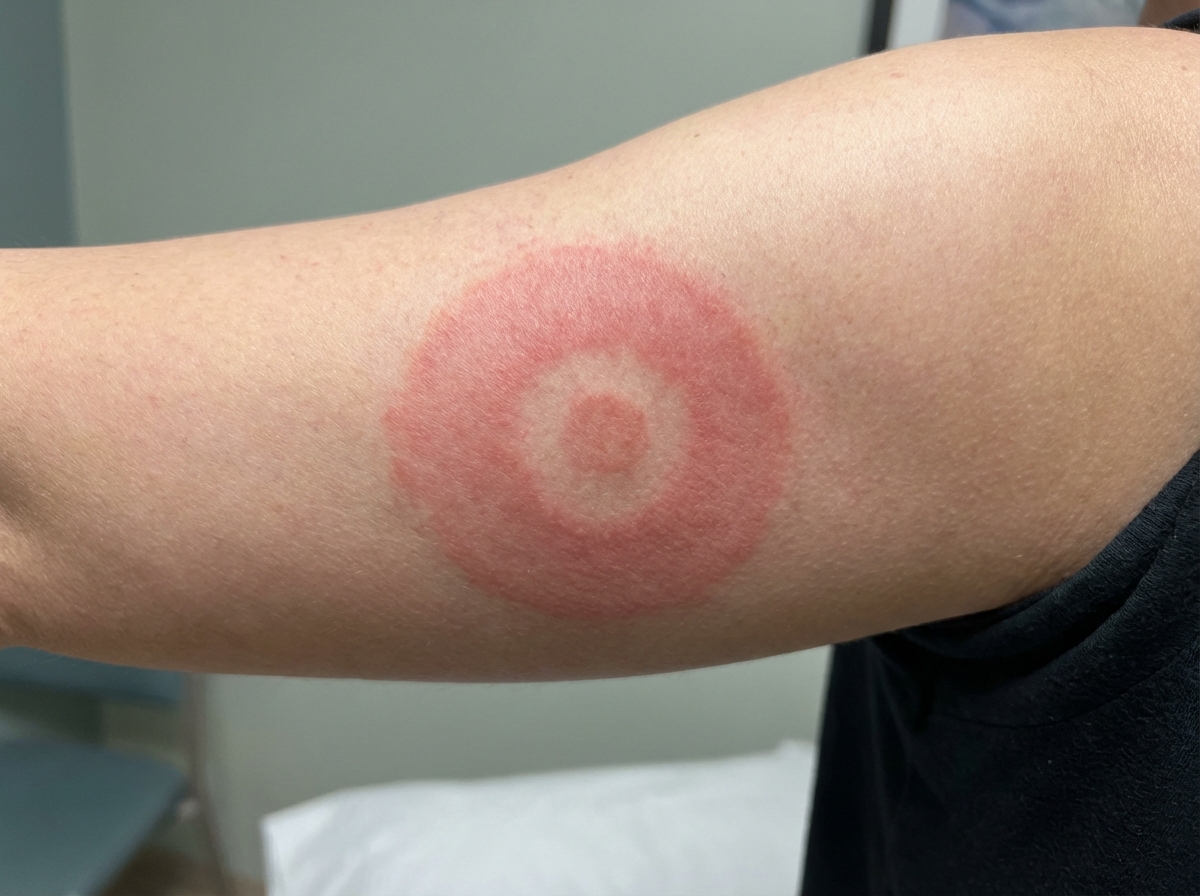
A 28-year-old man presents with fever, chills, and malaise which began 5 days ago. He also mentions that the back of his right upper arm feels itchy. He says he works as a forest guide and recently came back from a forest expedition. Upon asking, he reports that the forest where he works is infested with ticks. His temperature is 38.3°C (100.9°F), the pulse is 87/min, the respiratory rate is 15/min, and the blood pressure is 122/90 mm Hg. On physical examination, there is a rash present on the posterior aspect of his upper right arm which is shown in the image. Which of the following medications is the best course of treatment for this patient?
A 17-year-old boy comes to the physician because of fever, fatigue, and a sore throat for 12 days. He was prescribed amoxicillin at another clinic and now has a diffuse rash all over his body. He was treated for gonorrhea one year ago. He has multiple sexual partners and uses condoms inconsistently. He appears lethargic and thin. His BMI is 19.0 kg/m2. His temperature is 38.4°C (101.1°F), pulse 94/min, blood pressure 106/72 mm Hg. Examination shows a morbilliform rash over his extremities. Oropharyngeal examination shows tonsillar enlargement and erythema with exudates. Tender cervical and inguinal lymphadenopathy is present. Abdominal examination shows mild splenomegaly. Laboratory studies show: Hemoglobin 14 g/dL Leukocyte count 13,200/mm3 Platelet count 160,000/mm3 Which of the following is the next best step in management?
A 2-year-old boy presents to the pediatrician for evaluation of an elevated temperature, sore throat, runny nose, and lacrimation for the past week, and a rash which he developed yesterday. The rash began on the patient’s face and spread down to the trunk, hands, and feet. The patient’s mother gave him ibuprofen to control the fever. The child has not received mumps, measles, and rubella vaccinations because he was ill when the vaccine was scheduled and was later lost to follow-up. The vital signs include blood pressure 90/50 mm Hg, heart rate 110/min, respiratory rate 22/min, and temperature 37.8°C (100.0℉). On physical examination, the child was drowsy. His face, trunk, and extremities were covered with a maculopapular erythematous rash. Two irregularly-shaped red dots were also noted on the mucosa of the lower lip. The remainder of the physical examination was within normal limits. What is the probable causative agent for this child’s condition?
A 24-year-old female comes to the physician because of flu-like symptoms and a new rash for 2 days. She denies contacts with sick individuals or recent travel abroad, but recently went camping in Vermont. Vital signs are within normal limits. Examination of the lateral right thigh shows a circular red ring with central clearing. Which of the following is the natural reservoir of the pathogen responsible for this patient's symptoms?
A 27-year-old man comes to the physician with throbbing right scrotal pain for 1 day. He has also had a burning sensation on urination during the last 4 days. He is sexually active with multiple female partners and does not use condoms. Physical examination shows a tender, palpable swelling on the upper pole of the right testicle; lifting the testicle relieves the pain. A Gram stain of urethral secretions shows numerous polymorphonuclear leukocytes but no organisms. Which of the following is the most likely causal pathogen of this patient's symptoms?
A 19-year-old college student presents to student health with 1 day of fever and chills. He says that he has also been coughing for 2 days. His roommate was sick 3 days ago with similar symptoms and was diagnosed with Mycoplasma infection. He has otherwise been healthy and has had all the required vaccines as scheduled. He is currently taking introductory biology as part of his premedical studies and recently learned about antibodies. He therefore asks his physician about what his body is doing to fight off the infection. At this stage of his infection, which of the following forms are the antibodies circulating in his serum?
Want unlimited practice?
Get full access to all questions, explanations, and performance tracking.
Scan to download app