
Mycoplasma pneumoniae — MCQs

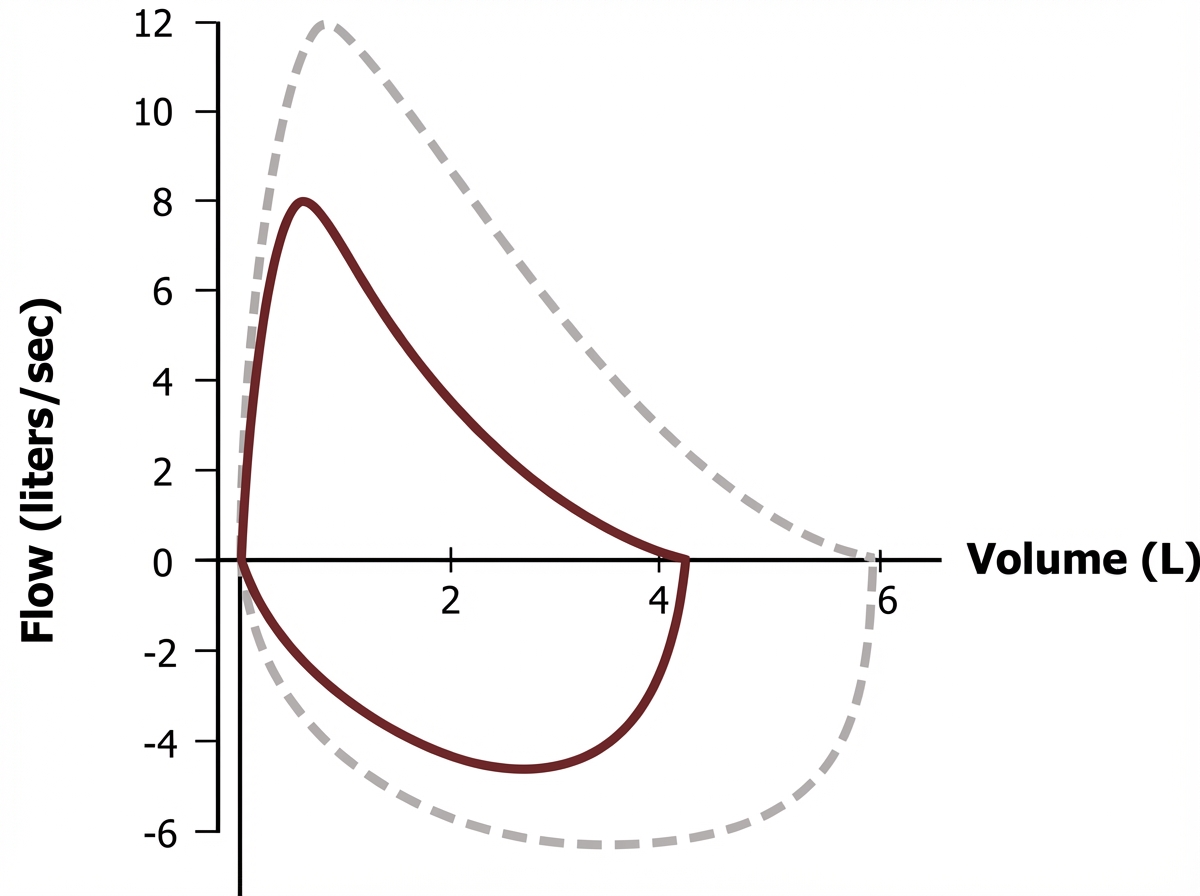
A 47-year-old woman comes to the physician because of a 3-week history of a dry cough. She does not smoke or use illicit drugs. Physical examination shows mild conjunctival hyperemia. Chest auscultation shows fine crackles in both lung fields. Laboratory studies show a total calcium concentration of 10.8 mg/dL. The results of spirometry are shown (dashed loop shows normal for comparison). Further evaluation of this patient is most likely to show an increase in which of the following?
A 10-year-old child presents to your office with a chronic cough. His mother states that he has had a cough for the past two weeks that is non-productive along with low fevers of 100.5 F as measured by an oral thermometer. The mother denies any other medical history and states that he has been around one other friend who also has had this cough for many weeks. The patient's vitals are within normal limits with the exception of his temperature of 100.7 F. His chest radiograph demonstrated diffuse interstitial infiltrates. Which organism is most likely causing his pneumonia?
A 51-year-old man comes to the physician because of a 4-day history of fever and cough productive of foul-smelling, dark red, gelatinous sputum. He has smoked 1 pack of cigarettes daily for 30 years and drinks two 12-oz bottles of beer daily. An x-ray of the chest shows a cavity with air-fluid levels in the right lower lobe. Sputum culture grows gram-negative rods. Which of the following virulence factors is most likely involved in the pathogenesis of this patient's condition?
An investigator is studying the genetic profile of an isolated pathogen that proliferates within macrophages. The pathogen contains sulfatide on the surface of its cell wall to prevent fusion of the phagosome and lysosome. She finds that some of the organisms under investigation have mutations in a gene that encodes the enzyme required for synthesis of RNA from a DNA template. The mutations are most likely to reduce the therapeutic effect of which of the following drugs?
A typically healthy 27-year-old woman presents to the physician because of a 3-week history of fatigue, headache, and dry cough. She does not smoke or use illicit drugs. Her temperature is 37.8°C (100.0°F). Chest examination shows mild inspiratory crackles in both lung fields. An X-ray of the chest shows diffuse interstitial infiltrates bilaterally. A Gram stain of saline-induced sputum shows no organisms. Inoculation of the induced sputum on a cell-free medium that is enriched with yeast extract, horse serum, cholesterol, and penicillin G grows colonies that resemble fried eggs. Which of the following is the most appropriate next step in management?
A 19-year-old college student presents to student health with 1 day of fever and chills. He says that he has also been coughing for 2 days. His roommate was sick 3 days ago with similar symptoms and was diagnosed with Mycoplasma infection. He has otherwise been healthy and has had all the required vaccines as scheduled. He is currently taking introductory biology as part of his premedical studies and recently learned about antibodies. He therefore asks his physician about what his body is doing to fight off the infection. At this stage of his infection, which of the following forms are the antibodies circulating in his serum?
An investigator is studying a strain of bacteria that retains a blue color after crystal violet dye and acetone are applied. The bacteria are inoculated in a petri dish containing hypotonic saline. After the addition of an antibiotic, the bacteria swell and rupture. This antibiotic most likely belongs to which of the following classes?
A 43-year-old woman comes to the physician because of a fever, nausea, and a nonproductive cough for 7 days. During this period, she has had headaches, generalized fatigue, and muscle and joint pain. She has also had increasing shortness of breath for 2 days. She has type 2 diabetes mellitus and osteoarthritis of her left knee. Current medications include insulin and ibuprofen. She had smoked two packs of cigarettes daily for 20 years but stopped 10 years ago. Her temperature is 38.1°C (100.6°F), pulse is 94/min, respirations are 18/min, and blood pressure is 132/86 mm Hg. The lungs are clear to auscultation. There are multiple skin lesions with a blue livid center, pale intermediate zone, and a dark red peripheral rim on the upper and lower extremities. Laboratory studies show: Hemoglobin 14.6 g/dL Leukocyte count 11,100/mm3 Serum Na+ 137 mEq/L K+ 4.1 mEq/L Cl- 99 mEq/L Urea nitrogen 17 mg/dL Glucose 123 mg/dL Creatinine 0.9 mg/dL Which of the following is the most likely causal organism?
A previously healthy 27-year-old woman comes to the physician because of a 3-week history of fatigue, headache, and dry cough. She does not smoke or use illicit drugs. Her temperature is 37.8°C (100°F). Chest examination shows mild inspiratory crackles in both lung fields. An x-ray of the chest shows diffuse interstitial infiltrates bilaterally. A Gram stain of saline-induced sputum shows no organisms. Inoculation of the induced sputum on a cell-free medium that is enriched with yeast extract, horse serum, cholesterol, and penicillin G grows colonies that resemble fried eggs. Which of the following organisms was most likely isolated on the culture medium?
A 23-year-old male comes to the physician because of a 2-week history of fatigue, muscle aches, and a dry cough. He has also had episodes of painful, bluish discoloration of the tips of his fingers, nose, and earlobes during this period. Three months ago, he joined the military and attended basic training in southern California. He does not smoke or use illicit drugs. His temperature is 37.8°C (100°F). Physical examination shows mildly pale conjunctivae and annular erythematous lesions with a dusky central area on the extensor surfaces of the lower extremities. Which of the following is the most likely causal organism?
Want unlimited practice?
Get full access to all questions, explanations, and performance tracking.
Scan to download app