
Leptospira species — MCQs

A 23-year-old woman presents with progressively worsening headache, photophobia, and intermittent fever that have lasted for 6 days. She says her headache is mostly frontal and radiates down her neck. She denies any recent history of blood transfusions, recent travel, or contact with animals. Her past medical history is unremarkable. She is sexually active with a single partner for the past 3 years. Her temperature is 38.5°C (101.3°F). On physical examination, she appears pale and diaphoretic. A fine erythematous rash is noted on the neck and forearms. A lumbar puncture is performed and CSF analysis reveals: Opening pressure: 300 mm H2O Erythrocytes: None Leukocytes: 72/mm3 Neutrophils: 10% Lymphocytes: 75% Mononuclear: 15% Protein: 100 mg/dL Glucose: 70 mg/dL Which of the following is the most likely diagnosis in this patient?
A 26-year-old immigrant from Mexico presents to your clinic for a physical. He tells you that several weeks ago, he noticed a lesion on his penis which went away after several weeks. It was nontender and did not bother him. He currently does not have any complaints. His temperature is 97.9°F (36.6°C), blood pressure is 139/91 mmHg, pulse is 87/min, respirations are 14/min, and oxygen saturation is 98% on room air. Physical exam is unremarkable and shows no evidence of any rash. A VDRL and FTA-ABS test are both positive. What is the most appropriate management of this patient?
A 30-year-old woman comes to the emergency department because of fever, watery diarrhea, and abdominal cramping for the past 24 hours. She recently went to an international food fair. Her temperature is 39°C (102.2°F). Physical examination shows increased bowel sounds. Stool cultures grow gram-positive, spore-forming, anaerobic rods that produce alpha toxin. The responsible organism also causes which of the following physical examination findings?
Six days after undergoing an elective hip replacement surgery, a 79-year-old man develops dysuria, flank pain, and fever. His temperature is 38.5°C (101.3°F). Examination shows marked tenderness in the right costovertebral area. Treatment with an antibiotic is begun, but his symptoms do not improve. Further evaluation shows that the causal organism produces an enzyme that inactivates the antibiotic via phosphorylation. An agent from which of the following classes of antibiotics was most likely administered?
A 13-year-old boy is brought to a physician with severe fevers and headaches for 3 days. The pain is constant and mainly behind the eyes. He has myalgias, nausea, vomiting, and a rash for one day. Last week, during an academic winter break, he traveled on a tour with his family to several countries, including Brazil, Panama, and Peru. They spent many evenings outdoors without any protection against insect bites. There is no history of contact with pets, serious illness, or use of medications. The temperature is 40.0℃ (104.0℉); the pulse is 110/min; the respiratory rate is 18/min, and the blood pressure is 110/60 mm Hg. A maculopapular rash is seen over the trunk and extremities. Several tender lymph nodes are palpated in the neck on both sides. A peripheral blood smear shows no organisms. Which of the following is most likely responsible for this patient’s presentation?
A 26-year-old woman seeks evaluation at an urgent care clinic with complaints of fever and generalized muscle and joint pain for the past 3 days. She also complains of nausea, but denies vomiting. She does not mention any past similar episodes. Her past medical history is unremarkable, but she returned to the United States 1 week ago after spending 2 weeks in southeast Asia doing charity work. She received all the recommended vaccines prior to traveling. The temperature is 40.0°C (104.0°F), the respirations are 15/min, the pulse is 107/min, and the blood pressure is 98/78 mm Hg. Physical examination shows mild gingival bleeding and a petechial rash over the trunk. Laboratory studies show the following: Laboratory test Leukocyte count 4,000/mm³ Platelet count 100,000/mm³ Partial thromboplastin time (activated) 45 seconds Which of the following is the most likely cause of this patient’s condition?
A 29-year-old man presents to the clinic complaining of fatigue and loss of sensation in his lower legs. The patient notes no history of trauma or chronic disease but states that he spends a lot of time outside and often encounters wild animals. On examination, the patient has multiple dark lesions over the skin of his face and back, as well as a decreased sensation of fine touch and vibration bilaterally in the lower extremities. What is the morphology of the etiologic agent causing this patient’s symptoms?
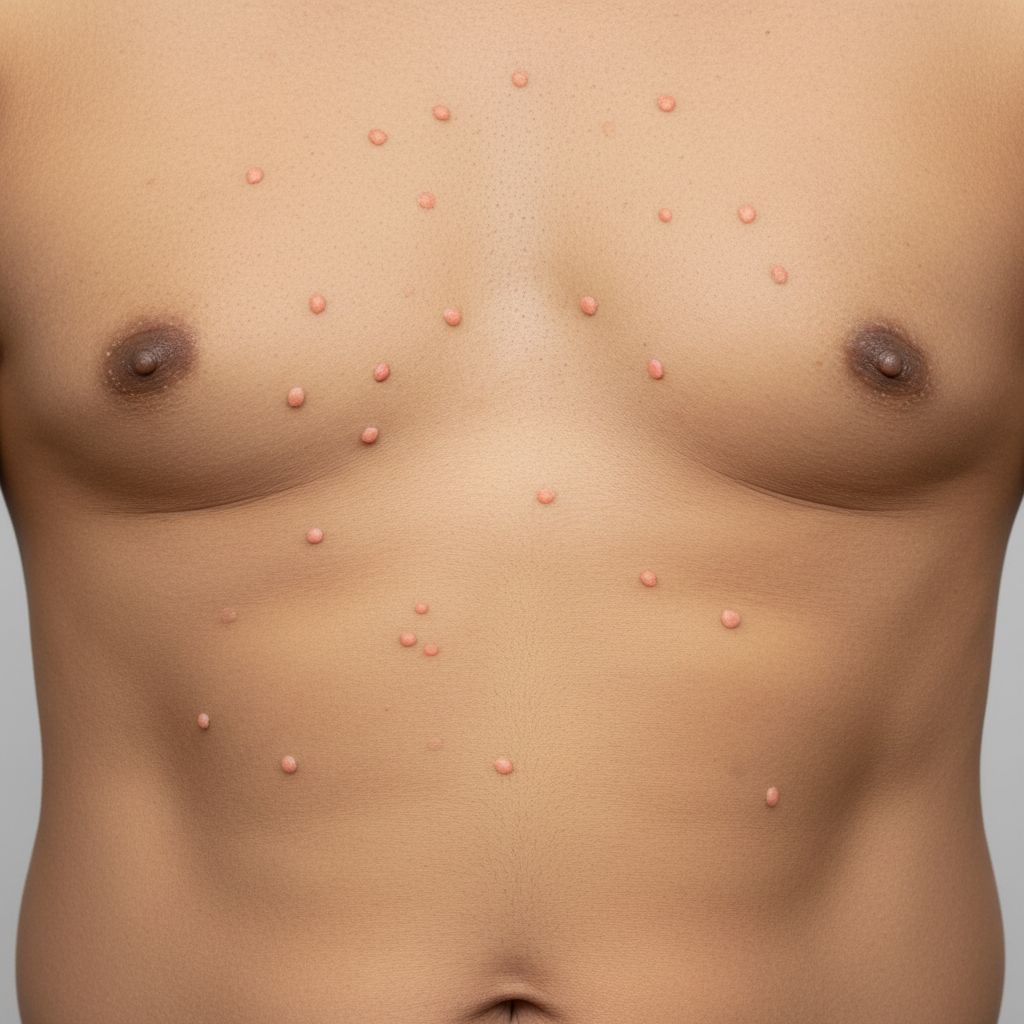
A 42-year-old man comes to his physician with a history of fever, non-bloody diarrhea, and headache for 10 days. He also complains of anorexia and abdominal pain. He returned from a trip to India 3 weeks ago. His temperature is 40.0°C (104.0°F), pulse is 65/min, respirations are 15/min, and blood pressure is 135/80 mm Hg. He has developed a blanchable rash on his chest and trunk. A photograph of the rash is shown. Examination of the heart, lungs, and abdomen show no abnormalities. Laboratory studies show: Hemoglobin 15 g/dL Mean corpuscular volume 95 μm3 White blood cell count 3400/mm3 Percent segmented neutrophils 40% Which of the following is the most likely diagnosis?
A 44-year-old woman presents to her primary care physician for worsening dysuria, hematuria, and lower abdominal pain. Her symptoms began approximately 2 days ago and have progressively worsened. She denies headache, nausea, vomiting, or diarrhea. She endorses feeling "feverish" and notes to having foul smelling urine. She has a past medical history of Romano-Ward syndrome and is not on any treatment. She experiences profuse diarrhea and nausea when taking carbapenems and develops a severe rash with cephalosporins. Her temperature is 100.4°F (38C), blood pressure is 138/93 mmHg, pulse is 100/min, and respirations are 18/min. On physical exam, the patient appears uncomfortable and there is tenderness to palpation around the bilateral flanks and costovertebral angle. A urinalysis and urine culture is obtained and appropriate antibiotics are administered. On her next clinical visit urine studies and a basic metabolic panel is obtained, which is shown below: Serum: Na+: 140 mEq/L Cl-: 101 mEq/L K+: 4.2 mEq/L HCO3-: 22 mEq/L BUN: 20 mg/dL Glucose: 94 mg/dL Creatinine: 2.4 mg/dL Urinalysis Color: Yellow Appearance: Clear Blood: Negative pH: 7 (Normal 5-8) Protein: Negative Nitrite: Negative Leukocyte esterase: Negative Cast: Epithelial casts FeNa: 3% Urine culture Preliminary report: 10,000 CFU/mL E. coli Which of the following antibiotics was most likely given to this patient?
A 24-year-old man presents with a painless genital ulcer for the past 2 weeks. He reports that he recently has been having unprotected sex with multiple partners. Past medical history is unremarkable. On physical examination, a single ulcer is present on the dorsal shaft of the penis which is circumscribed, indurated, and partially healed. There is moderate inguinal lymphadenopathy but no buboes. Which of the following tests would confirm the most likely diagnosis in this patient?
Want unlimited practice?
Get full access to all questions, explanations, and performance tracking.
Scan to download app