
Antithrombotic therapies — MCQs

An 11-year-old girl is brought to the emergency department after she fell during a dance class. She was unable to stand after the accident and has a painful and swollen knee. On presentation she says that she has had 2 previous swollen joints as well as profuse bleeding after minor cuts. Based on her presentation, a panel of bleeding tests is obtained with the following results: Bleeding time: 11 minutes Prothrombin time: 12 seconds Partial thromboplastin time: 52 seconds Which of the following treatments would be most effective in treating this patient's condition?
A 60-year-old woman presents to the emergency room with chest pain that started 20 minutes ago while watching television at home. The pain is substernal and squeezing in nature. She rates the pain as 6/10 and admits to having similar pain in the past with exertion. Her past medical history is significant for diabetes mellitus that is controlled with metformin. The physical examination is unremarkable. An electrocardiogram (ECG) shows ST-segment depression in the lateral leads. She is started on aspirin, nitroglycerin, metoprolol, unfractionated heparin, and insulin. She is asked not to take metformin while at the hospital. Three sets of cardiac enzymes are negative. Lab results are given below: Serum glucose 88 mg/dL Sodium 142 mEq/L Potassium 3.9 mEq/L Chloride 101 mEq/L Serum creatinine 1.2 mg/dL Blood urea nitrogen 22 mg/dL Cholesterol, total 170 mg/dL HDL-cholesterol 40 mg/dL LDL-cholesterol 80 mg/dL Triglycerides 170 mg/dL Hematocrit 38% Hemoglobin 13 g/dL Leucocyte count 7,500/mm3 Platelet count 185,000 /mm3 Activated partial thromboplastin time (aPTT) 30 seconds Prothrombin time (PT) 12 seconds Urinalysis Glucose negative Ketones negative Leucocytes negative Nitrites negative Red blood cells (RBC) negative Casts negative An echocardiogram reveals left ventricular wall motion abnormalities. With the pain subsiding, she was admitted and the medications were continued. A coronary angiography is planned in 4 days. In addition to regular blood glucose testing, which of the following should be closely monitored in this patient?
A 59-year-old woman comes to the physician because of left leg swelling that started after a transcontinental flight. A duplex ultrasound of the left leg shows a noncompressible popliteal vein. A drug is prescribed that inhibits the coagulation cascade. Two weeks later, laboratory studies show: Platelet count 210,000/mm3 Partial thromboplastin time 28 seconds (normal: 25-35) Prothrombin time 12 seconds (normal: 11-13) Thrombin time 15 seconds (control: 15 seconds) Which of the following drugs was most likely prescribed?
A 54-year-old man is brought to the emergency department 1 hour after the sudden onset of shortness of breath, severe chest pain, and sweating. He has hypertension and type 2 diabetes mellitus. He has smoked one pack and a half of cigarettes daily for 20 years. An ECG shows ST-segment elevations in leads II, III, and avF. The next hospital with a cardiac catheterization unit is more than 2 hours away. Reperfusion pharmacotherapy is initiated. Which of the following is the primary mechanism of action of this medication?
Drug A is an experimental compound being investigated for potential use as a protectant against venous thrombosis. Binding assays reveal that the drug’s primary mechanism of action is to block carboxylation of glutamic acid residues in certain serum proteins. Drug A is most similar to which of the following:
A 69-year-old man is brought by his son to the emergency department with weakness in his right arm and leg. The man insists that he is fine and blames his son for "creating panic". Four hours ago the patient was having tea with his wife when he suddenly dropped his teacup. He has had difficulty moving his right arm since then and cannot walk because his right leg feels stuck. He has a history of hypertension and dyslipidemia, for which he currently takes lisinopril and atorvastatin, respectively. He is allergic to aspirin and peanuts. A computerized tomography (CT) scan shows evidence of an ischemic stroke. Which medication would most likely prevent such attacks in this patient in the future?
A 73-year-old man presents to the outpatient clinic complaining of chest pain with exertion. He states that resting for a few minutes usually resolves the chest pain. Currently, he takes 81 mg of aspirin daily. He has a blood pressure of 127/85 mm Hg and heart rate of 75/min. Physical examination reveals regular heart sounds and clear lung sounds bilateral. Which medication regimen below should be added?
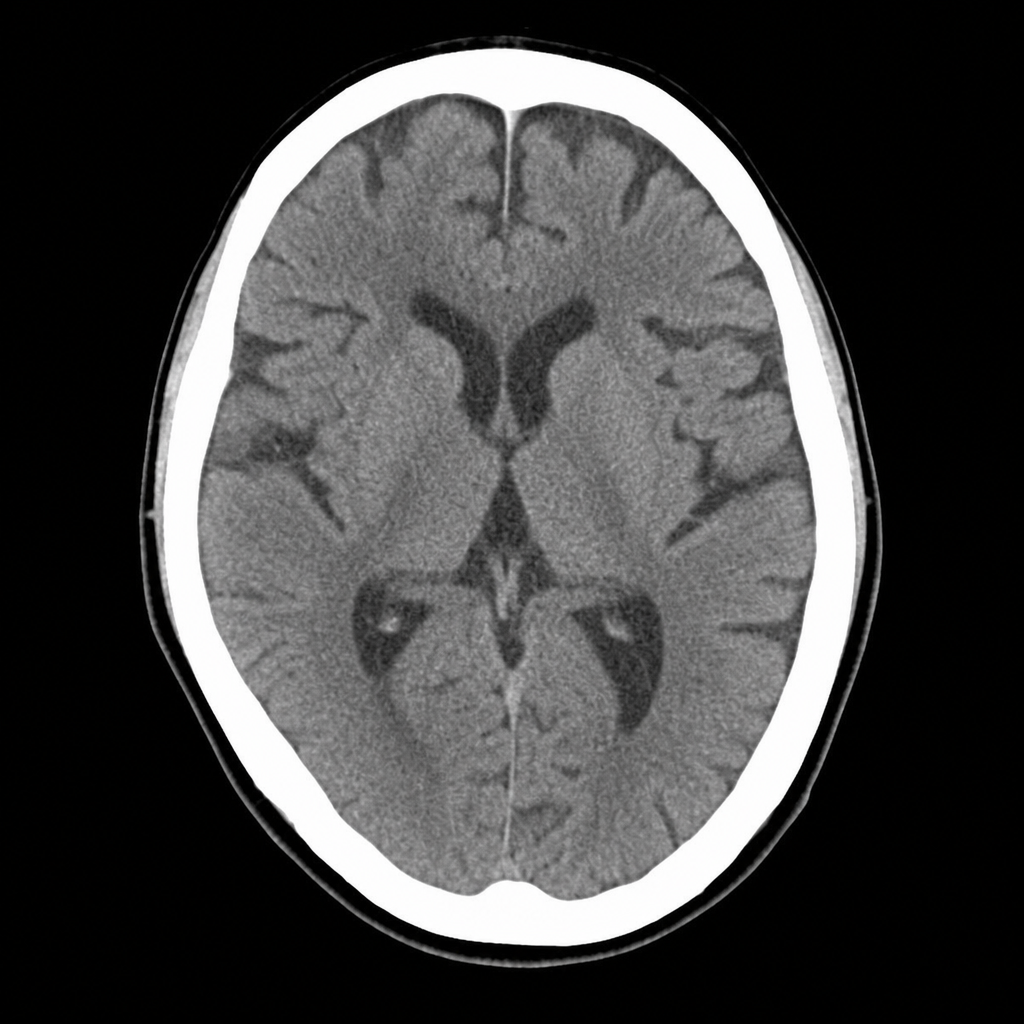
A 67-year-old man with hypertension and type 2 diabetes is brought to the ED by his wife, who noticed he developed sudden right-sided facial droop and slurred speech approximately 2 hours ago. On arrival, blood pressure is 188/104 mmHg, heart rate 82 bpm, oxygen saturation 97% on room air. Neurological examination reveals right facial weakness, dysarthria, and mild right arm drift. NIHSS score is 7. A non-contrast CT head is performed and shown above. No hemorrhage, early infarct signs, or mass lesion is identified. The patient takes metformin and lisinopril; no anticoagulants. Which of the following is the most appropriate immediate next step?
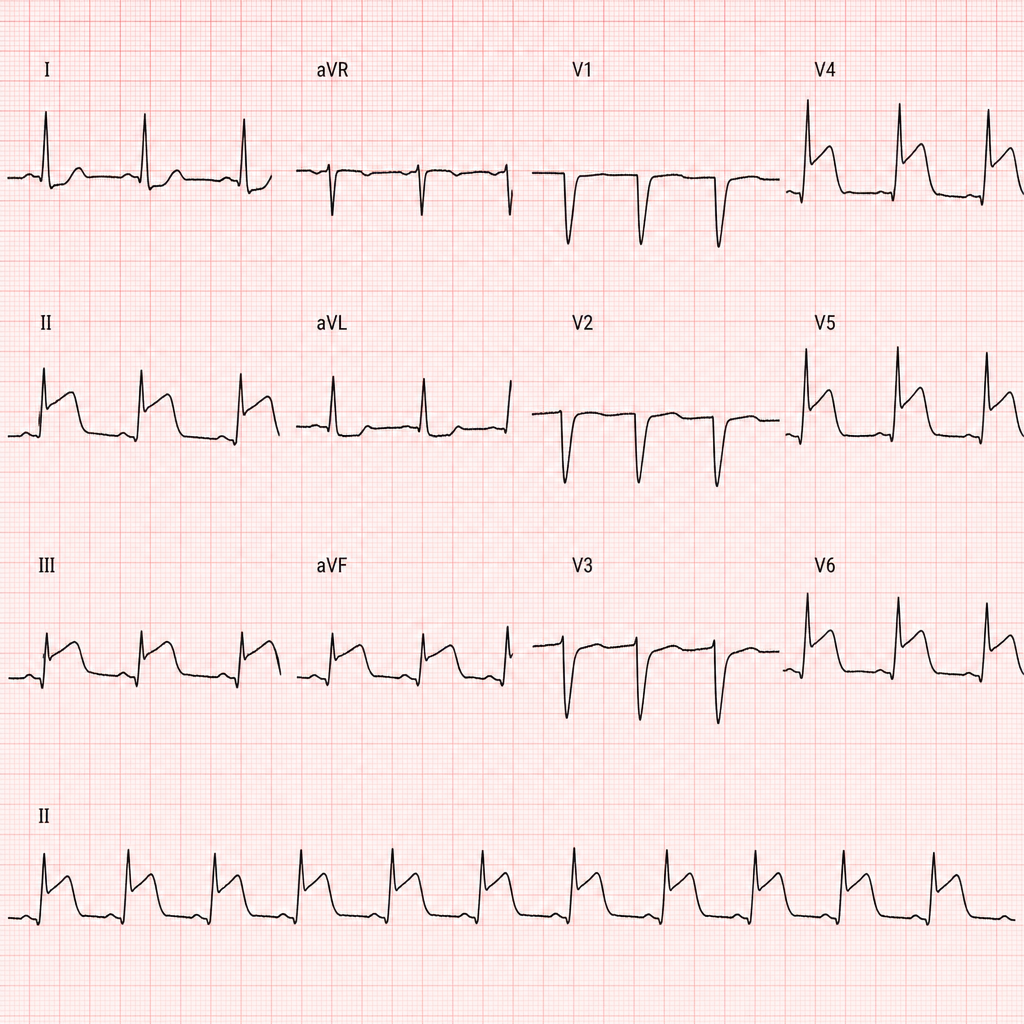
A 67-year-old man with hypertension and hyperlipidemia presents to the emergency department with 45 minutes of crushing substernal chest pain radiating to his left arm. He is diaphoretic and pale. Vital signs: BP 88/60 mmHg, HR 112 bpm, RR 20/min, SpO2 94% on room air. PCI is immediately available. An ECG is obtained and shown above. Two large-bore IVs are placed. Which of the following is the most appropriate immediate next step?
A 70-year-old man with diabetes, hypertension, and chronic kidney disease (eGFR 35 mL/min/1.73m²) presents with NSTEMI. Troponin is elevated at 8.5 ng/mL. ECG shows 2mm ST depression in V2-V5. GRACE score is 165 (high risk). He is hemodynamically stable. Cardiologist recommends early invasive strategy within 24 hours. Nephrologist is concerned about contrast-induced nephropathy potentially requiring dialysis. Patient is on metformin. Evaluate the management strategy integrating multiple specialist perspectives and evidence.
Want unlimited practice?
Get full access to all questions, explanations, and performance tracking.
Scan to download app