
Acute pain management — MCQs

A 50-year-old male is brought to the dermatologist's office with complaints of a pigmented lesion. The lesion is uniformly dark with clean borders and no asymmetry and has been increasing in size over the past two weeks. He works in construction and spends large portions of his day outside. The dermatologist believes that this mole should be biopsied. To prepare the patient for the biopsy, the dermatologist injects a small amount of lidocaine into the skin around the lesion. Which of the following nerve functions would be the last to be blocked by the lidocaine?
A 14-year-old boy is brought to the emergency department because of a 4-hour history of vomiting, lethargy, and confusion. Three days ago, he was treated with an over-the-counter medication for fever and runny nose. He is oriented only to person. His blood pressure is 100/70 mm Hg. Examination shows bilateral optic disc swelling and hepatomegaly. His blood glucose concentration is 65 mg/dL. Toxicology screening for serum acetaminophen is negative. The over-the-counter medication that was most likely used by this patient has which of the following additional effects?
A 72-year-old woman with metastatic ovarian cancer is brought to the physician by her son because she is in immense pain and cries all the time. On a 10-point scale, she rates the pain as an 8 to 9. One week ago, a decision to shift to palliative care was made after she failed to respond to 2 years of multiple chemotherapy regimens. She is now off chemotherapy drugs and has been in hospice care. Current medications include 2 mg morphine intravenously every 2 hours and 650 mg of acetaminophen every 4 to 6 hours. The son is concerned because he read online that increasing the dose of morphine would endanger her breathing. Which of the following is the most appropriate next step in management?
A 68-year-old man presents to his primary care physician with pain that started after he visited his daughter as she moved into her new apartment. The patient states that the pain is likely related to all the traveling he has done and helping his daughter move and set up furniture. The patient has a past medical history of obesity, type II diabetes, multiple concussions while he served in the army, and GERD. He is currently taking metformin, lisinopril, omeprazole, and a multivitamin. On physical exam, pain is elicited upon palpation of the patient's lower back. Flexion of the patient's leg results in pain that travels down the patient's lower extremity. The patient's cardiac, pulmonary, and abdominal exam are within normal limits. Rectal exam reveals normal rectal tone. The patient denies any difficulty caring for himself, defecating, or urinating. Which of the following is the best next step in management?
A 49-year-old man being treated for Helicobacter pylori infection presents to his primary care physician complaining of lower back pain. His physician determines that a non-steroidal anti-inflammatory drug (NSAID) would be the most appropriate initial treatment. Which of the following is the most appropriate NSAID for this patient?
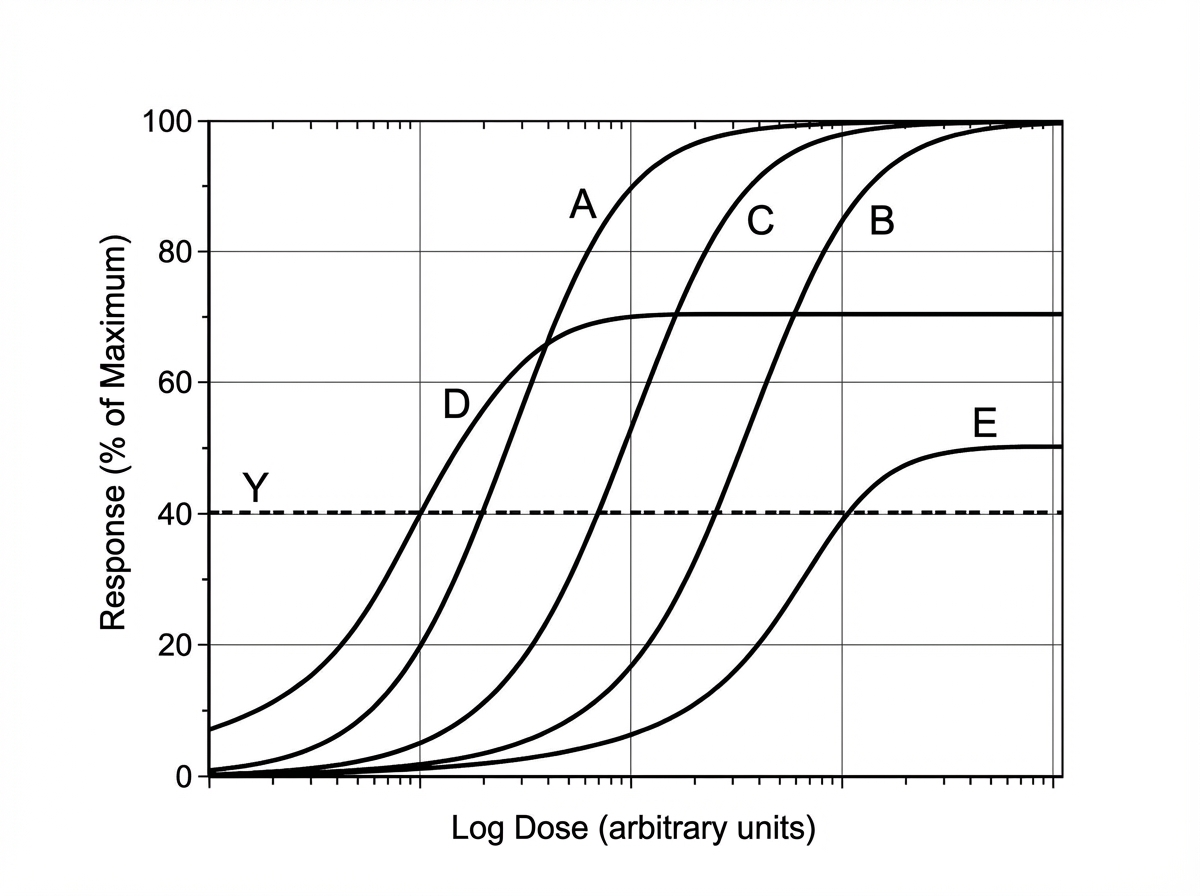
Scientists are developing a new non-steroidal anti-inflammatory drug for osteoarthritis. Their hope is that the new drug will have a higher potency but the same efficacy as ibuprofen in the hope of minimizing gastrointestinal side effects. If ibuprofen is curve C in the figure provided, which of the following would be the curve for the new drug based on the scientists’ specifications? The desired therapeutic effect in patients is represented by the dashed line Y.
29-year-old construction worker is brought to the emergency department after falling 10 ft (3 m) from the scaffolding at a construction site. He reports that he landed on his outstretched arms, which are now in severe pain (10/10 on a numeric scale). He has a history of opioid use disorder and is currently on methadone maintenance treatment. His pulse is 100/min, respirations are 20/min, and blood pressure is 140/90 mm Hg. Pulse oximetry on room air shows an oxygen saturation of 98%. He is diaphoretic and in distress. Physical examination shows a hematoma on the patient's right forearm. X-ray of the right arm shows a nondisplaced fracture of the ulna. A CT of the abdomen and pelvis shows no abnormalities. The patient requests pain medication. In addition to managing the patient's injury, which of the following is the most appropriate next step in management?
A 36-year-old man is admitted to the hospital for treatment of burn wounds on his upper extremities. Analgesic therapy with an opioid drug is begun. Shortly after, the patient develops chills, diaphoresis, nausea, and abdominal pain. On further questioning, the patient reports that he has been smoking opium at home to help him ""deal with the depression and pain.” This patient was most likely given which of the following opioid drugs?
A 45-year-old homeless man presents to the emergency department with a 1-week history of an intensely pruritic, red rash on his hands, wrists, and finger webs. The itching is worse at night. Physical examination reveals small, erythematous papules and burrows. A topical drug with which of the following mechanisms of action is most likely to be effective in treating this condition?
A 69-year-old man presents to his primary care physician for pain when he walks. He states that the pain is the worst in his left great toe but is also present in his hips and knees. He says that his symptoms are worse with activity and tend to improve with rest. His symptoms have progressively worsened over the past several years. He has a past medical history of obesity, type II diabetes mellitus, smoking, and hypertension. He drinks roughly ten beers per day. His current medications include metformin, insulin, lisinopril, and hydrochlorothiazide. The patient has a recent travel history to Bangkok where he admits to having unprotected sex. On physical exam, examination of the lower extremity results in pain. There is crepitus of the patient's hip when his thigh is flexed and extended. Which of the following is the most likely diagnosis?
Want unlimited practice?
Get full access to all questions, explanations, and performance tracking.
Scan to download app