
Acute liver failure — MCQs

A 63-year-old man comes to the physician for a routine health maintenance examination. He feels well. He has a history of hypertension, atrial fibrillation, bipolar disorder, and osteoarthritis of the knees. Current medications include lisinopril, amiodarone, lamotrigine, and acetaminophen. He started amiodarone 6 months ago and switched from lithium to lamotrigine 4 months ago. The patient does not smoke. He drinks 1–4 beers per week. He does not use illicit drugs. Vital signs are within normal limits. Examination shows no abnormalities. Laboratory studies show: Serum Na+ 137 mEq/L K+ 4.2 mEq/L Cl- 105 mEq/L HCO3- 24 mEq/L Urea nitrogen 14 mg/dL Creatinine 0.9 mg/dL Alkaline phosphatase 82 U/L Aspartate aminotransferase (AST) 110 U/L Alanine aminotransferase (ALT) 115 U/L Which of the following is the most appropriate next step in management?
A 60-year-old rock musician presents to the office because he has been feeling increasingly tired for the past 6 months. He has a history of intravenous drug use and alcohol abuse. He states that he feels quite tired, but he otherwise has no complaints. Physical examination is noncontributory. His laboratory values are normal other than moderately elevated liver enzymes. Which of the following additional tests should you order first?
A 9-year-old boy presents to the emergency department with a 12-hour history of severe vomiting and increased sleepiness. He experienced high fever and muscle pain about 5 days prior to presentation, and his parents gave him aspirin to control the fever at that time. On presentation, he is found to be afebrile though he is still somnolent and difficult to arouse. Physical exam reveals hepatomegaly and laboratory testing shows the following results: Alanine aminotransferase: 85 U/L Aspartate aminotransferase: 78 U/L Which of the following is the most likely cause of this patient's neurologic changes?
A 32-year-old woman comes to the emergency department for a 2-week history of right upper quadrant abdominal pain. She has also been feeling tired and nauseous for the past 5 weeks. She has a history of depression and suicidal ideation. She is a social worker for an international charity foundation. She used intravenous illicit drugs in the past but quit 4 months ago. Her only medication is sertraline. Her temperature is 37.8°C (100.0°F), pulse is 100/min, and blood pressure is 128/76 mm Hg. She is alert and oriented. Scleral icterus is present. Abdominal examination shows tenderness to palpation in the right upper quadrant. The liver edge is palpated 3 cm below the right costal margin. There is no rebound tenderness or guarding. The abdomen is non-distended and the fluid wave test is negative. She is able to extend her arms with wrists in full extension and hold them steady without flapping. Laboratory studies show: Hemoglobin 13.8 g/dL Leukocytes 13,700/mm3 Platelets 165,000/mm3 Prothrombin time 14 seconds Partial thromboplastin time 35 seconds Serum: Total bilirubin 4.8 mg/dL Direct bilirubin 1.3 mg/dL Aspartate aminotransferase 1852 U/L Alanine aminotransferase 2497 U/L Urea nitrogen 21 mg/dL Creatinine 1.2 mg/dL Hepatitis A IgM antibody Negative Hepatitis B surface antigen Negative Hepatitis B surface antibody Negative Hepatitis B core IgM antibody Positive Hepatitis C antibody Positive Hepatitis C RNA Negative Urine beta-hCG Negative Which of the following is the most appropriate next step in management?
A 56-year-old woman is brought to the emergency department by her family with altered mental status. Her husband says that she complained of fever, vomiting, and abdominal pain 2 days ago. She has a history of long-standing alcoholism and previous episodes of hepatic encephalopathy. Current vital signs include a temperature of 38.3°C (101°F), blood pressure of 85/60 mm Hg, pulse of 95/min, and a respiratory rate 30/min. On physical examination, the patient appears ill and obtunded. She is noted to have jaundice, a palpable firm liver, and massive abdominal distension with shifting dullness. Which of the following is the best initial step in management of this patient's condition?
A 57-year-old man presents to the emergency department with fatigue. He states that his symptoms started yesterday and have been worsening steadily. The patient endorses a recent weight loss of 7 pounds this past week and states that he feels diffusely itchy. The patient has a past medical history of alcohol abuse, obesity, asthma, and IV drug use. His current medications include metformin, atorvastatin, albuterol, and fluticasone. In addition, the patient admits to smoking and drinking more than usual lately due to the stress he has experienced. His temperature is 98.7°F (37.1°C), blood pressure is 130/75 mmHg, pulse is 90/min, respirations are 15/min, and oxygen saturation is 98% on room air. Physical exam is notable for an ill-appearing man. The patient's skin appears yellow. Abdominal exam is notable for right upper quadrant tenderness. Cardiac and pulmonary exams are within normal limits. Laboratory values are ordered as seen below: Hemoglobin: 14 g/dL Hematocrit: 42% Leukocyte count: 5,500 cells/mm^3 with normal differential Platelet count: 70,000/mm^3 Partial thromboplastin time: 92 seconds Prothrombin time: 42 seconds AST: 1110 U/L ALT: 990 U/L Which of the following is most likely to be found in this patient's history?
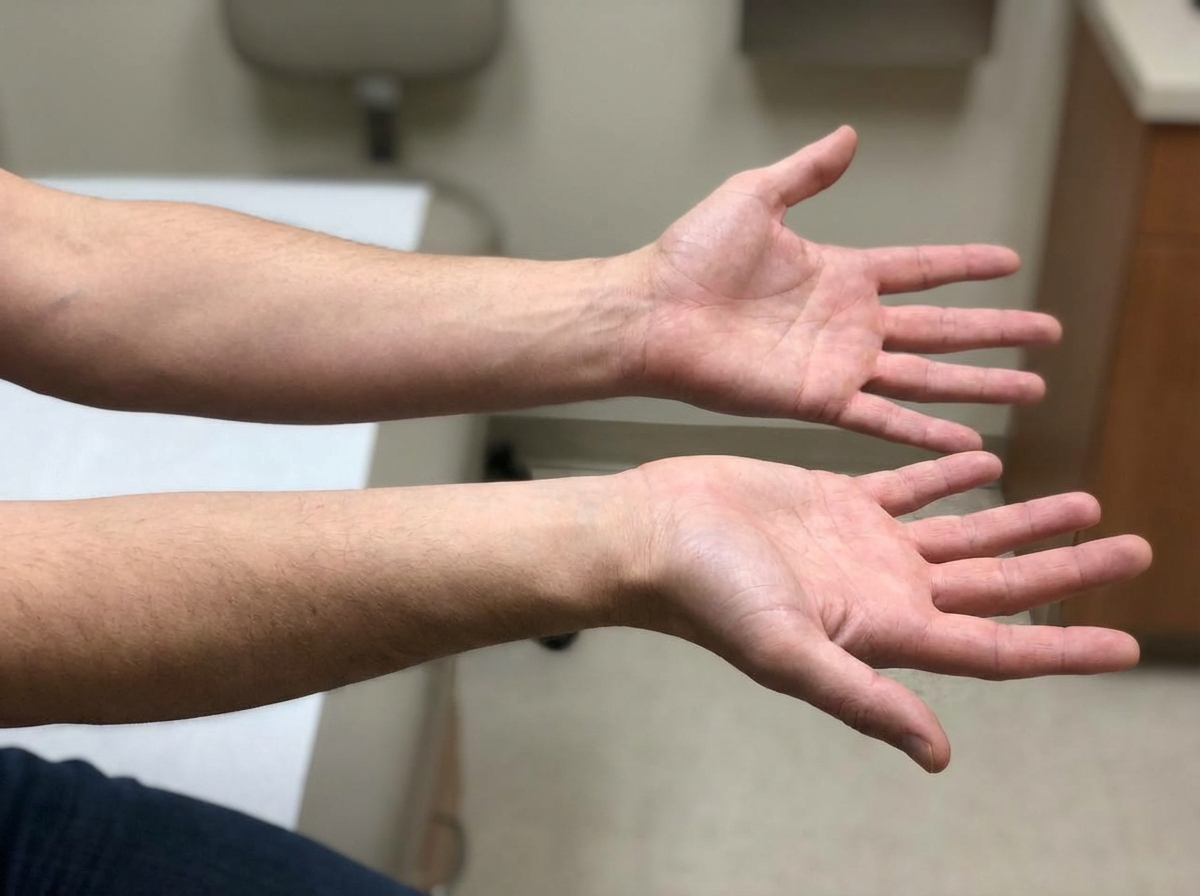
A 56-year-old male with a history of hepatitis C cirrhosis status post TIPS procedure is brought in by his wife to the emergency department because he has been acting disoriented, slurring his speech, and sleeping throughout the day. On arrival the patient is afebrile and his vital signs are pulse is 87/min, blood pressure is 137/93 mmHg, and respirations are 12/min with shallow breaths. Examination reveals a jaundiced male who appears older than stated age. Abdominal exam is positive for a fluid wave and shifting dullness to percussion. You note enlarged breasts, decreased facial hair, 3+ patellar reflexes bilaterally, and the following in the upper extremity (Image A). Paracentesis reveals ascitic fluid with neutrophil counts of < 100 cells/mcL. Serum creatinine is 1.0 and BUN is 15. Which of the following is the next best step in management?
A boy with diabetic ketoacidosis is admitted to the pediatric intensive care unit for closer monitoring. Peripheral venous access is established. He is treated with IV isotonic saline and started on an insulin infusion. This patient is at the highest risk for which of the following conditions in the next 24 hours?
A 78-year-old man dies suddenly from complications of acute kidney failure. An autopsy is performed and microscopic evaluation of the kidneys shows pale, swollen cells in the proximal convoluted tubules. Microscopic evaluation of the liver shows similar findings. Which of the following is the most likely underlying mechanism of these findings?
A 25-year-old male is brought to the emergency department by his friends after a camping trip. He and his friends were in the woods camping when the patient started experiencing severe right upper quadrant abdominal pain after foraging and ingesting some wild mushrooms about 3 hours earlier. The patient is lethargic on exam and appears jaundiced. He has scleral icterus and is severely tender to palpation in the right upper quadrant. He has scattered petechiae on his extremities. Liver function tests are: Serum: Na+: 134 mEq/L Cl-: 100 mEq/L K+: 4.2 mEq/L HCO3-: 24 mEq/L Urea nitrogen: 50 mg/dL Glucose: 100 mg/dL Creatinine: 1.4 mg/dL Alkaline phosphatase: 400 U/L Aspartate aminotransferase (AST, GOT): 3278 U/L Alanine aminotransferase (ALT, GPT): 3045 U/L gamma-Glutamyltransferase (GGT): 100 U/L The most likely cause of this patient’s clinical presentation acts by inhibiting which of the following molecules?
Want unlimited practice?
Get full access to all questions, explanations, and performance tracking.
Scan to download app