
Vasculitides classification — MCQs

A 6-year-old boy presents to his pediatrician accompanied by his mother for evaluation of a rash. The rash appeared a little over a week ago, and since that time the boy has felt tired. He is less interested in playing outside, preferring to remain indoors because his knees and stomach hurt. His past medical history is significant for an upper respiratory infection that resolved uneventfully without treatment 2 weeks ago. Temperature is 99.5°F (37.5°C), blood pressure is 115/70 mmHg, pulse is 90/min, and respirations are 18/min. Physical exam shows scattered maroon macules and papules on the lower extremities. The abdomen is diffusely tender to palpation. There is no cervical lymphadenopathy or conjunctival injection. Which of the following will most likely be found in this patient?
A 4-year-old boy is brought to the emergency department by his parents after 10 days of fever, varying from 38.0–40.0°C (100.4–104.0°F). On physical examination, the child is ill-looking with an extensive rash over his trunk with patchy desquamation. His hands are swollen, and he also shows signs of a bilateral conjunctivitis. The laboratory test results are as follows: Hemoglobin 12.9 g/dL Hematocrit 37.7% Mean corpuscular volume 82.2 μm3 Leukocyte count 10,500/mm3 Neutrophils 65% Lymphocytes 30% Monocytes 5% Platelet count 290,000/mm3 Erythrocyte sedimentation rate (ESR) 35 mm/h What is the next best step in the management of this patient’s condition?
A 53-year-old man comes to the emergency department because of a 1-month history of cough productive of small amounts of blood-tinged sputum. During this time, he has also developed fatigue, myalgia, and shortness of breath on exertion. He has had a 4-lb (2-kg) weight loss over the past 2 months. He has no personal history of serious illness. His mother has systemic lupus erythematosus. His temperature is 37.2°C (99.0 °F), pulse is 98/min, respirations are 22/min, and blood pressure is 152/98 mm Hg. Diffuse rhonchi are heard on auscultation of the chest bilaterally. There are multiple palpable, erythematous, nonblanching lesions on the lower extremities bilaterally. Laboratory studies show: Leukocyte count 12,300 cells/mm3 Platelet count 400,000 cells/mm3 Erythrocyte sedimentation rate 83 mm/hr Serum Creatinine 2.1 mg/dL Antinuclear antibody 1:40 Urine Protein 3+ Blood 2+ RBC casts numerous A biopsy specimen of the skin shows inflammation of the arterioles and capillaries without granuloma formation. Further evaluation of this patient is most likely to show which of the following findings?
A 72-year-old man comes to the physician because of a 6-month history of intermittent dull abdominal pain that radiates to the back. He has smoked one pack of cigarettes daily for 50 years. His blood pressure is 145/80 mm Hg. Abdominal examination shows generalized tenderness and a pulsatile mass in the periumbilical region on deep palpation. Further evaluation of the affected blood vessel is most likely to show which of the following?
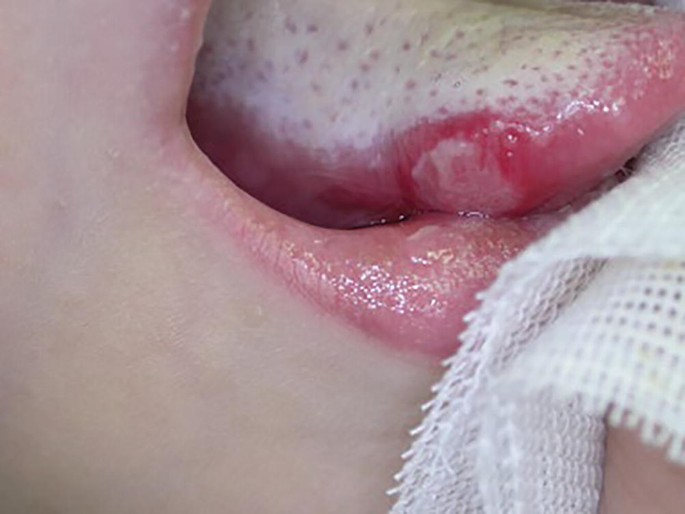
A 67-year-old man presents with an excruciatingly painful tongue lesion. He says the lesion was preceded by an intermittent headache for the past month that localized unilaterally to the left temple and occasionally radiates to the right eye. The tongue lesion onset acutely and has been present for a few days. The pain is constant. His past medical history is relevant for hypertension and recurrent migraines. Current medications include captopril. On physical examination, multiple knot-like swellings are seen on the left temple. Findings from an inspection of the oral cavity are shown in the exhibit (see image). Laboratory findings are significant for the following: Hemoglobin 12.9 g/dL Hematocrit 40.7% Leukocyte count 5500/mm3 Neutrophils 65% Lymphocytes 30% Monocytes 5% Mean corpuscular volume 88.2 μm3 Platelet count 190,000/mm3 Erythrocyte sedimentation rate 45 mm/h Which of the following is the next best step in the management of this patient?
A 75-year-old woman comes to the physician because of generalized weakness for 6 months. During this period, she has also had a 4-kg (8.8-lb) weight loss and frequent headaches. She has been avoiding eating solids because of severe jaw pain. She has hypertension and osteoporosis. She underwent a total left-sided knee arthroplasty 2 years ago because of osteoarthritis. The patient does not smoke or drink alcohol. Her current medications include enalapril, metoprolol, low-dose aspirin, and a multivitamin. She appears pale. Her temperature is 37.5°C (99.5°F), pulse is 82/min, and blood pressure is 135/80 mm Hg. Physical examination shows no abnormalities. Laboratory studies show: Hemoglobin 10 g/dL Mean corpuscular volume 87 μm3 Leukocyte count 8,500/mm3 Platelet count 450,000/mm3 Erythrocyte sedimentation rate 90 mm/h Which of the following is the most appropriate next step in management?
A 45-year-old man comes to the physician because of fatigue and joint pain for 8 months. He has pain in both knees, both elbows, and diffuse muscle pain. He does not have dyspnea. He also had several episodes of a nonpruritic rash on his lower extremities. Eight years ago, the patient was diagnosed with hepatitis C. His temperature is 37.9°C (100.2°F), pulse is 90/min, and blood pressure is 140/90 mm Hg. Examination of the lower extremities shows raised purple papules that do not blanch when pressure is applied. Cardiopulmonary examination shows no abnormalities. Laboratory studies show: Hemoglobin 13.9 g/dL Leukocyte count 8,500/mm3 Platelets 160,000/mm3 Serum Creatinine 1.1 mg/dL ALT 123 U/L AST 113 U/L Further evaluation of this patient is most likely to show which of the following findings?
A 40-year-old woman comes to the emergency department because of difficulty walking for the past 4 hours. She first noticed her symptoms after getting up this morning and her foot dragging while walking. She feels tired. She has a history of chronic sinusitis. Six months ago, she was diagnosed with asthma. Current medications include an albuterol inhaler and inhaled corticosteroids. Her temperature is 38.9°C (102°F), pulse is 80/min, and her blood pressure is 140/90 mm Hg. Auscultation of her lungs shows diffuse wheezing over bilateral lung fields. Physical examination shows tender subcutaneous nodules on the extensor surfaces of the elbows. There are palpable, non-blanching erythematous lesions on both shins. Dorsiflexion of the right foot is impaired. Sensation to pinprick, light touch, and vibration is decreased over the ulnar aspect of the left forearm. Laboratory studies show: Hemoglobin 11.3 g/dL Leukocyte count 24,500 Segmented neutrophils 48% Eosinophils 29% Lymphocytes 19% Monocytes 4% Platelet count 290,000/mm3 Serum Urea nitrogen 32 mg/dL Creatinine 1.85 mg/dL Urine Blood 2+ Protein 3+ Which of the following is the most likely diagnosis in this patient?
A 27-year-old man presents to his primary care physician with worsening cough and asthma. The patient reports that he was in his usual state of health until 1 month ago, when he developed a cold. Since then his cold has improved, but he continues to have a cough and worsening asthma symptoms. He says that he has been using his rescue inhaler 3 times a day with little improvement. He is studying for an accounting exam and states that his asthma is keeping him up at night and making it hard for him to focus during the day. The patient admits to smoking tobacco. His smoking has increased from a half pack per day since he was 17 years old to 1 pack per day during the past month to cope with the stress of his exam. The patient's temperature is 99°F (37.2°C), blood pressure is 110/74 mmHg, pulse is 75/min, and respirations are 15/min with an oxygen saturation of 97% on room air. Physical examination is notable for mild expiratory wheezes bilaterally. Labs are obtained, as shown below: Serum: Na+: 144 mEq/L Cl-: 95 mEq/L K+: 4.3 mEq/L HCO3-: 23 mEq/L Urea nitrogen: 24 mg/dL Glucose: 100 mg/dL Creatinine: 1.6 mg/dL Leukocyte count and differential: Leukocyte count: 13,000/mm^3 Segmented neutrophils: 63% Eosinophils: 15% Basophils: < 1% Lymphocytes: 20% Monocytes: 1.3% Hemoglobin: 13.5 g/dL Hematocrit: 50% Platelets: 200,000/mm^3 Urinalysis reveals proteinuria and microscopic hematuria. Which of the following is associated with the patient's most likely diagnosis?
A 62-year-old man presents to the emergency department with hematuria and hemoptysis that started in the morning. He notes that he has had frequent lung infections throughout his adult life, the most recent being 2 weeks ago. He also mentions that he has had hematuria twice before but never as severe as he is having currently. His medical history is otherwise non-significant, and his only medication is acetaminophen as needed. His blood pressure is 136/92 mm Hg, heart rate is 86/min, respiratory rate is 16/min, and temperature is 37.0°C (98.6°F). Chest radiography shows a resolving right middle lobe airspace opacity. His initial laboratory tests are notable for elevated erythrocyte sedimentation rate and C-reactive protein level. While in the examination room, the patient develops a spontaneous nosebleed. What is the most likely diagnosis?
Want unlimited practice?
Get full access to all questions, explanations, and performance tracking.
Scan to download app