
Pancreatic cancer risk in chronic pancreatitis — MCQs

A 62-year-old man presents with “yellowing” of the skin. He says he has been having intermittent upper abdominal pain, which is relieved by Tylenol. He also recalls that he has lost some weight over the past several months but can not quantify the amount. His past medical history is significant for type 2 diabetes mellitus. He reports a 40-pack-year smoking history. The patient is afebrile and vital signs are within normal limits. Physical examination reveals mild jaundice and a palpable gallbladder. Laboratory findings are significant for the following: Total bilirubin 13 mg/dL Direct bilirubin: 10 mg/dL Alkaline phosphatase (ALP): 560 IU/L An ultrasound of the abdomen reveals a hypoechoic mass in the epigastric region. The patient is scheduled for a CT abdomen and pelvis with specific organ protocol for further evaluation. Which of the following best describes this patient’s most likely diagnosis?
Researchers are investigating oncogenes, specifically the KRAS gene that is associated with colon, lung, and pancreatic cancer. They have established that the gain-of-function mutation in this gene increases the chance of cancer development. They are also working to advance the research further to study tumor suppressor genes. Which of the genes below is considered a tumor suppressor gene?
A 70-year-old male visits his primary care physician because of progressive weight loss. He has a 20-year history of smoking 2 packs of cigarettes a day and was diagnosed with diabetes mellitus 6 years ago. After physical examination, the physician tells the patient he suspects adenocarcinoma at the head of the pancreas. Which of the following physical examination findings would support the diagnosis?
A 55-year old man living in Midwest USA comes in complaining of painless hematuria for the past week. He denies dysuria but complains of fatigue and lethargy at work. He has lost about 9.0 kg (20.0 lb) in the past 6 months. He drinks 1–2 beers on the weekends over the past 10 years but denies smoking. He has worked at a plastic chemical plant for the past 30 years and has never been out of the country. His father died of a heart attack at age 62 and his mother is still alive and well. There is a distant history of pancreatic cancer, but he can not remember the specifics. His vitals are stable and his physical exam is unremarkable. Urinary analysis is positive for RBCs. A cystoscopy is performed and finds a pedunculated mass projecting into the bladder lumen. A biopsy shows malignant cells. Which of the following is the most concerning risk factor for this patient’s condition?
A 42-year-old man comes to the physician because of a 6-week history of intermittent fever, abdominal pain, bloody diarrhea, and sensation of incomplete rectal emptying. He also has had a 4.5-kg (10-lb) weight loss over the past 3 months. Abdominal examination shows diffuse tenderness. Colonoscopy shows circumferential erythematous lesions that extend without interruption from the anal verge to the cecum. A biopsy specimen taken from the rectum shows mucosal and submucosal inflammation with crypt abscesses. This patient is most likely at risk of developing colon cancer with which of the following characteristics?
A 46-year-old woman presents to her primary care physician for her annual examination. At her prior exam one year earlier, she had a Pap smear which was within normal limits. Which of the following health screenings is recommended for this patient?
A 62-year-old Caucasian man visits his primary care provider with recurrent episodes of moderate to severe abdominal pain, nausea, and anorexia for the past 2 years. Additional complaints include constipation, steatorrhea, weight loss, polyphagia, and polyuria. His personal history is relevant for a 2-year period of homelessness when the patient was 55 years old, cigarette smoking since the age of 20, alcohol abuse, and cocaine abuse for which is currently under the supervision of a psychiatry team. He has a pulse of 70/min, a respiratory rate of 16/min, a blood pressure of 130/70 mm Hg, and a body temperature of 36.4°C (97.5°F). His height is 178 cm (5 ft 10 in) and weight is 90 kg (198 lb). On physical examination, he is found to have telangiectasias over the anterior chest, mild epigastric tenderness, and a small nodular liver. Laboratory test results from his previous visit a month ago are shown below: Fasting plasma glucose 160 mg/dL HbA1c 8% Serum triglycerides 145 mg/dL Total cholesterol 250 mg/dL Total bilirubin 0.8 mg/dL Direct bilirubin 0.2 mg/dL Amylase 180 IU/L Lipase 50 IU/L Stool negative for blood; low elastase This patient’s condition is most likely secondary to which of the following conditions?
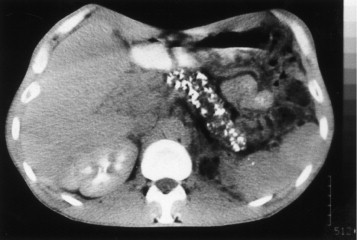
A 42-year-old man comes to the physician because of severe epigastric pain for a week. The pain is constant and he describes it as 6 out of 10 in intensity. The pain radiates to his back and is worse after meals. He has had several episodes of nausea and vomiting during this period. He has taken ibuprofen for multiple similar episodes of pain during the past 6 months. He also has had a 5.4-kg (12-lb) weight loss over the past 4 months. He has a 12-year history of drinking 3 to 4 pints of rum daily. He has been hospitalized three times for severe abdominal pain in the past 3 years. He appears ill. His temperature is 37°C (98.6°F), pulse is 87/min, and blood pressure is 110/70 mm Hg. There is severe epigastric tenderness to palpation. Bowel sounds are normal. Cardiopulmonary examination shows no abnormalities. Laboratory studies show: Hemoglobin 13.6 g/dL Leukocyte count 7,800/mm3 Serum Glucose 106 mg/dL Creatinine 1.1 mg/dL Amylase 150 U/L A CT of the abdomen is shown. Which of the following is the most appropriate long-term management for this patient?
A 52-year-old woman presents to the urgent care center with several hours of worsening abdominal discomfort with radiation to the back. The patient also complains of malaise, chills, nausea, and vomiting. Social history is notable for alcoholism. On physical exam, she is febrile to 39.5°C (103.1°F), and she is diffusely tender to abdominal palpation. Complete blood count is notable for 13,500 white blood cells, bilirubin 2.1, lipase 842, and amylase 3,210. Given the following options, what is the most likely diagnosis?
A 21-year-old college student comes to the emergency department because of a two-day history of vomiting and epigastric pain that radiates to the back. He has a history of atopic dermatitis and Hashimoto thyroiditis. His only medication is levothyroxine. He has not received any routine vaccinations. He drinks 1–2 beers on the weekends and occasionally smokes marijuana. The patient appears distressed and is diaphoretic. His temperature is 37.9°C (100.3°F), pulse is 105/min, respirations are 16/min, and blood pressure is 130/78 mm Hg. Physical examination shows abdominal distention with tenderness to palpation in the epigastrium. There is no guarding or rebound tenderness. Skin examination shows several clusters of yellow plaques over the trunk and extensor surfaces of the extremities. Hemoglobin concentration is 15.2 g/dL and serum calcium concentration is 7.9 mg/dL. Which of the following is the most appropriate next step in evaluation?
Want unlimited practice?
Get full access to all questions, explanations, and performance tracking.
Scan to download app