
Autoimmune pancreatitis — MCQs

A 35-year-old Caucasian female presents with anemia, malaise, bloating, and diarrhea. Past genetic testing revealed that this patient carries the HLA-DQ2 allele. The physician suspects that the patient's presentation is dietary in cause. Which of the following findings would definitively confirm this diagnosis?
A 36-year-old man is brought to the emergency department 3 hours after the onset of progressively worsening upper abdominal pain and 4 episodes of vomiting. His father had a myocardial infarction at the age of 40 years. Physical examination shows tenderness and guarding in the epigastrium. Bowel sounds are decreased. His serum amylase is 400 U/L. Symptomatic treatment and therapy with fenofibrate are initiated. Further evaluation of this patient is most likely to show which of the following findings?
A 21-year-old female presents to her obstetrician because she has stopped getting her period, after being irregular for the last 3 months. Upon further questioning, the patient reveals that she has had a 17 lb. unintended weight loss, endorses chronic diarrhea, abdominal pain, and constipation that waxes and wanes. Family history is notable only for an older brother with Type 1 Diabetes. She is healthy, and is eager to gain back some weight. Her OBGYN refers her to a gastroenterologist, but first sends serology laboratory studies for IgA anti-tissue transglutaminase antibodies (IgA-tTG). These results come back positive at > 10x the upper limit of normal. Which of the following is the gastroenterologist likely to find on endoscopy and duodenal biopsy?
A 15-year-old girl is brought to the physician because of an 8-month history of fatigue, intermittent postprandial abdominal bloating and discomfort, foul-smelling, watery diarrhea, and a 7-kg (15-lb) weight loss. She developed a pruritic rash on her knees 3 days ago. Physical examination shows several tense, excoriated vesicles on the knees bilaterally. The abdomen is soft and nontender. Her hemoglobin concentration is 8.2 g/dL and mean corpuscular volume is 76 μm3. Further evaluation of this patient is most likely to show which of the following findings?
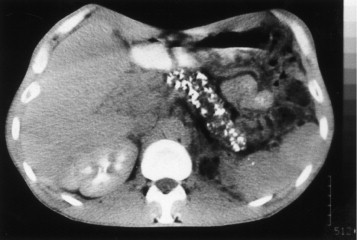
A 42-year-old man comes to the physician because of severe epigastric pain for a week. The pain is constant and he describes it as 6 out of 10 in intensity. The pain radiates to his back and is worse after meals. He has had several episodes of nausea and vomiting during this period. He has taken ibuprofen for multiple similar episodes of pain during the past 6 months. He also has had a 5.4-kg (12-lb) weight loss over the past 4 months. He has a 12-year history of drinking 3 to 4 pints of rum daily. He has been hospitalized three times for severe abdominal pain in the past 3 years. He appears ill. His temperature is 37°C (98.6°F), pulse is 87/min, and blood pressure is 110/70 mm Hg. There is severe epigastric tenderness to palpation. Bowel sounds are normal. Cardiopulmonary examination shows no abnormalities. Laboratory studies show: Hemoglobin 13.6 g/dL Leukocyte count 7,800/mm3 Serum Glucose 106 mg/dL Creatinine 1.1 mg/dL Amylase 150 U/L A CT of the abdomen is shown. Which of the following is the most appropriate long-term management for this patient?
A 22-year-old woman presents to the emergency department with a 3-day history of fever and abdominal pain. She says that the pain is located in the left lower quadrant of the abdomen and feels crampy in nature. The pain has been associated with bloody diarrhea and joint tenderness. She has no past medical history but says that she returned 2 weeks ago from vacation in Asia where she tried many new foods. Her family history is significant for multiple cancers in close relatives. Physical exam reveals swollen ulcers on her legs, and colonoscopy reveals contiguous ulcerations from the rectum through the descending colon. Which of the following is associated with the most likely cause of this patient's symptoms?
A 46-year-old man is brought to the emergency department because of severe epigastric pain and vomiting for the past 4 hours. The pain is constant, radiates to his back, and is worse on lying down. He has had 3–4 episodes of greenish-colored vomit. He was treated for H. pylori infection around 2 months ago with triple-regimen therapy. He has atrial fibrillation and hypertension. He owns a distillery on the outskirts of a town. The patient drinks 4–5 alcoholic beverages daily. Current medications include dabigatran and metoprolol. He appears uncomfortable. His temperature is 37.8°C (100°F), pulse is 102/min, and blood pressure is 138/86 mm Hg. Examination shows severe epigastric tenderness to palpation with guarding but no rebound. Bowel sounds are hypoactive. Rectal examination shows no abnormalities. Laboratory studies show: Hematocrit 53% Leukocyte count 11,300/mm3 Serum Na+ 133 mEq/L Cl- 98 mEq/L K+ 3.1 mEq/L Calcium 7.8 mg/dL Urea nitrogen 43 mg/dL Glucose 271 mg/dL Creatinine 2.0 mg/dL Total bilirubin 0.7 mg/dL Alkaline phosphatase 61 U/L AST 19 U/L ALT 17 U/L γ-glutamyl transferase (GGT) 88 u/L (N=5–50 U/L) Lipase 900 U/L (N=14–280 U/L) Which of the following is the most appropriate next step in management?
A 36-year-old woman presents for a pre-employment health assessment. She has no complaints. Her last annual physical examination 8 months ago was normal. She has no significant past medical history. She is a nonsmoker and says she quit all alcohol consumption last year. A complete hepatic biochemistry panel is performed, which is significant for a serum alkaline phosphatase (ALP) level 5 times the upper limit of the normal range. Immunologic tests are positive for antimitochondrial antibodies. A liver biopsy is performed and reveals an inflammatory infiltrate surrounding the biliary ducts. Which of the following is the most likely diagnosis in this patient?
A previously healthy 48-year-old man comes to the physician because of a 3-week history of progressively worsening jaundice, generalized itching, and epigastric discomfort. He also complains of nausea and loss of appetite. His stools have looked like clay for the past week. He has returned from a vacation in Thailand one week ago, where he got a new tattoo. He is sexually active with multiple partners and does not use protection. His vital signs are within normal limits. Examination shows jaundice and scleral icterus. Superficial excoriations are seen on all limbs. Abdominal examination shows no abnormalities. Serum studies show a fasting glucose level of 198 mg/dL, total bilirubin concentration of 10.6 mg/dL, direct bilirubin concentration of 9.8 mg/dl, and alkaline phosphatase activity of 450 U/L. Abdominal ultrasonography shows dilation of the biliary and pancreatic ducts and a 3-cm hypoechoic solid mass with irregular margins in the head of the pancreas. An elevation of which of the following serum findings is most specific for this patient's condition?
A 15-year-old African-American male with a BMI of 22 is brought to his physician by his mother to address concerns about a change in his dietary habits. The patient's mother notes that he is constantly hungry and thirsty, despite his eating and drinking water in excess. She also reports an increase in his use of the bathroom. The physician begins explaining that her son's symptoms are likely due to which of the following?
Want unlimited practice?
Get full access to all questions, explanations, and performance tracking.
Scan to download app