
Glomerulonephritis classification — MCQs

A 21-year-old male presents to your office with hematuria 3 days after the onset of a productive cough and fever. Following renal biopsy, immunofluorescence shows granular IgA deposits in the glomerular mesangium. Which of the following do you suspect in this patient?
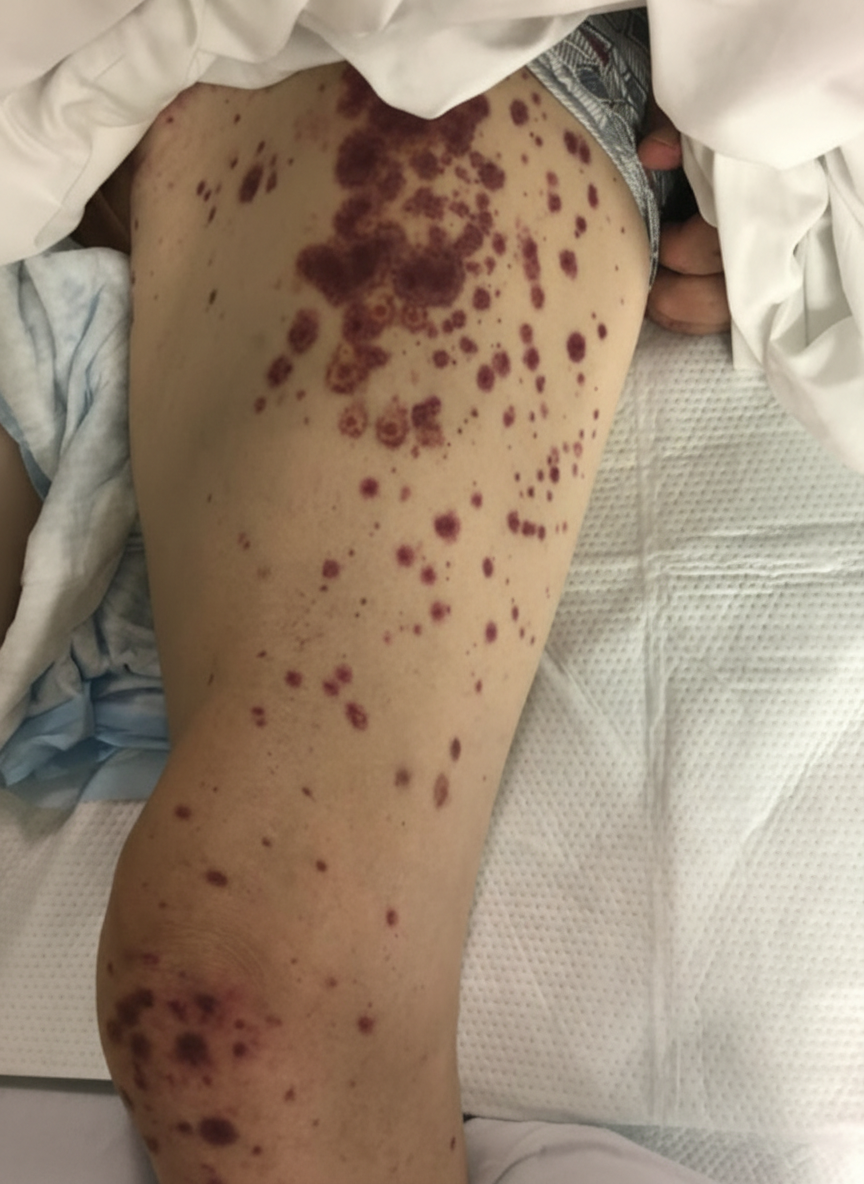
A 12-year-old boy is brought to an outpatient clinic by his mother, who noticed that her son’s urine has been dark for the past 4 days. She initially attributed this to inadequate hydration, so she monitored her son’s fluid intake and encouraged him to drink more water. However, she noticed that the color of the urine kept getting darker until it began to resemble cola. The boy’s medical history is significant for a sore throat approx. 2 weeks ago, which resolved without medication or treatment. The boy has also been complaining of pain in his ankles, which he first noticed shortly after soccer practice 1 week ago. He has had no pain during urination or urethral discharge, however, and does not have any history of previous episodes of cola-colored urine or passage of blood in the urine. However, the boy has been experiencing intermittent episodes of abdominal pain for the past 3 days. The boy also has wheals on his torso, legs, and buttocks, which his mother attributes to seasonal allergies. Physical examination reveals an alert child who is not in obvious distress but who has a mild conjunctival pallor. Vital signs include: respiratory rate is 22/min, temperature is 36.7°C (98.0°F), and blood pressure is 130/90 mm Hg. Examination of the musculoskeletal system reveals multiple skin lesions (see image). Which of the following laboratory findings is most likely associated with this patient’s clinical presentation?
A 61-year-old man comes to the physician because of progressively worsening swelling of his ankles. He says he has felt exhausted lately. Over the past 3 months, he has gained 5 kg. He has smoked one pack of cigarettes daily for 30 years. His pulse is 75/min and his blood pressure is 140/90 mmHg. Examination shows 2+ pitting edema in the lower extremities. Neurologic exam shows diminished two-point discrimination in the fingers and toes. A urine sample is noted to be foamy. Laboratory studies show a hemoglobin A1c of 7.9% and creatinine of 1.9 mg/dL. A biopsy specimen of the kidney is most likely to show which of the following?
A 22-year-old man comes to the emergency department because of several episodes of blood in his urine and decreased urine output for 5 days. His blood pressure is 158/94 mm Hg. Examination shows bilateral lower extremity edema. Urinalysis shows 3+ protein and red blood cell casts. Mass spectrometry analysis of the urinary protein detects albumin, transferrin, and IgG. Which of the following best describes this type of proteinuria?
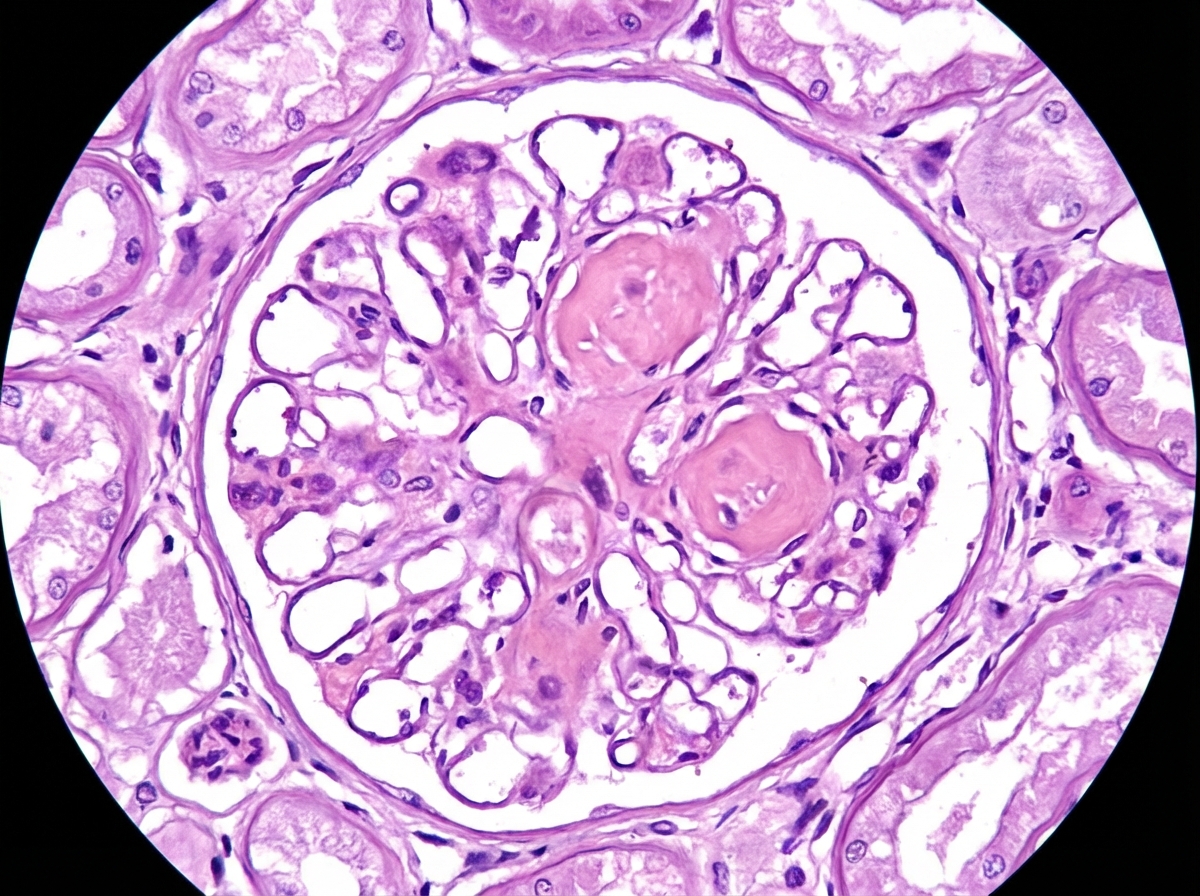
A 62-year-old man comes to the physician because of fatigue and decreased urine output for 2 weeks. He has not been to the physician for many years and takes no medications. Serum studies show a urea nitrogen concentration of 42 mg/dL and a creatinine concentration of 2.3 mg/dL. Urinalysis shows heavy proteinuria. A photomicrograph of a section of a kidney biopsy specimen is shown. Which of the following is the most likely underlying cause of this patient's symptoms?
A 47-year-old woman comes to the physician because of a 2-week history of gradually worsening facial and lower extremity swelling. She has had a 4-kg (8.8-lb) weight gain during this time. Her blood pressure is 150/88 mm Hg. Examination shows periorbital edema and 2+ pretibial edema bilaterally. A 24-hour collection of urine shows 4.0 g of proteinuria. Microscopic examination of a kidney biopsy specimen shows thickening of the glomerular basement membrane. Electron microscopy shows dense subepithelial deposits. Further evaluation is most likely to show which of the following?
A 57-year-old woman presents to her family physician because of sinusitis and nasal drainage for 3 months. The nasal drainage is purulent and occasionally hemorrhagic. She has only temporary improvement after trying multiple over the counter medications. Over the last 2 weeks, she also has fatigue and joint pain, mainly affecting the ankles, knees, and wrists. Vital signs include: temperature 36.9°C (98.4°F), blood pressure 142/91 mm Hg, and pulse 82/min. On examination, there is inflammation and bleeding of the nasal mucosa, along with tenderness to percussion over the maxillary sinuses. Urine dipstick reveals 4+ microscopic hematuria and 2+ proteinuria. Which of the following is the most likely diagnosis?
A 62-year-old man presents to the emergency department with hematuria and hemoptysis that started in the morning. He notes that he has had frequent lung infections throughout his adult life, the most recent being 2 weeks ago. He also mentions that he has had hematuria twice before but never as severe as he is having currently. His medical history is otherwise non-significant, and his only medication is acetaminophen as needed. His blood pressure is 136/92 mm Hg, heart rate is 86/min, respiratory rate is 16/min, and temperature is 37.0°C (98.6°F). Chest radiography shows a resolving right middle lobe airspace opacity. His initial laboratory tests are notable for elevated erythrocyte sedimentation rate and C-reactive protein level. While in the examination room, the patient develops a spontaneous nosebleed. What is the most likely diagnosis?
A 50-year-old woman comes to the emergency department because of fever and productive cough with blood in the sputum for 1 day. She also reports a sharp pain under her ribs that is worsened on taking deep breaths. Over the past 2 years, she has had repeated episodes of sinusitis, for which she used over the counter medication. She has recently started a new job at a wire-mesh factory. Her temperature is 38.3°C (100.9 °F), pulse is 72/min, respirations are 16/min, and blood pressure is 120/80 mm Hg. Physical examination shows palpable nonblanching skin lesions over her hands and feet. Examination of the nasal cavity shows ulcerations of the nasopharyngeal mucosa and a small septal perforation. Pulmonary examination shows stridor on inspiration. Laboratory studies show: Hemoglobin 13.2 g/dL Leukocyte count 10,300/mm3 Platelet count 205,000/mm3 Serum Urea nitrogen 24 mg/dL Creatinine 2.4 mg/dL Urine Protein 2+ RBC 70/hpf RBC casts numerous WBC 1–2/hpf A chest x-ray shows multiple cavitating, nodular lesions bilaterally. Which of the following additional findings is most likely to be present in this patient?
A 12-year-old boy presents with a 3-day history of frothy brown urine. He does not complain of any other symptoms. He notes that 3 weeks ago he had a fever with a sore throat, but he did not receive any treatment at the time. His blood pressure is 152/94 mm Hg, heart rate is 72/min, respiratory rate is 15/min, and temperature is 37.0°C (98.6°F). Review of his medical record shows that his blood pressure was 118/74 mm Hg just 4 weeks ago. Laboratory analysis reveals elevated serum creatinine, hematuria with RBC casts, and elevated urine protein without frank proteinuria. What laboratory test can confirm the most likely diagnosis in this patient?
Want unlimited practice?
Get full access to all questions, explanations, and performance tracking.
Scan to download app