
Diabetic nephropathy — MCQs

A 52-year-old man comes to the physician for a routine health maintenance examination. He feels well. His blood pressure is 125/70 mm Hg. His glomerular filtration rate is calculated to be 105 mL/min/1.73 m2 and glucose clearance is calculated to be 103 mL/min. This patient is most likely being treated with which of the following agents?
A 62-year-old woman with type 2 diabetes mellitus comes to the physician because of a 3-month history of fatigue and weakness. Her hemoglobin A1c concentration was 13.5% 12 weeks ago. Her blood pressure is 152/92 mm Hg. Examination shows lower extremity edema. Serum studies show: K+ 5.1 mEq/L Phosphorus 5.0 mg/dL Ca2+ 7.8 mg/dL Urea nitrogen 60 mg/dL Creatinine 2.2 mg/dL Which of the following is the best parameter for early detection of this patient’s renal condition?
A 44-year-old man presents for a checkup. The patient says he has to urinate quite frequently but denies any dysuria or pain on urination. Past medical history is significant for diabetes mellitus type 2 and hypertension, both managed medically, as well as a chronic mild cough for the past several years. Current medications are metformin, aspirin, rosuvastatin, captopril, and furosemide. His vital signs are an irregular pulse of 74/min, a respiratory rate of 14/min, a blood pressure of 130/80 mm Hg, and a temperature of 36.7°C (98.0°F). His BMI is 32 kg/m2. On physical examination, there are visible jugular pulsations present in the neck bilaterally. Laboratory findings are significant for the following: Glycated Hemoglobin (Hb A1c) 7.5% Fasting Blood Glucose 120 mg/dL Serum Electrolytes Sodium 138 mEq/L Potassium 3.9 mEq/L Chloride 101 mEq/L Serum Creatinine 1.3 mg/dL Blood Urea Nitrogen 18 mg/dL Which of the following is the next best step in the management of this patient?
A 67-year-old man presents to his primary care provider because of fatigue and loss of appetite. He is also concerned that his legs are swollen below the knee. He has had type 2 diabetes for 35 years, for which he takes metformin and glyburide. Today his temperature is 36.5°C (97.7°F), the blood pressure is 165/82 mm Hg, and the pulse is 88/min. Presence of which of the following would make diabetic kidney disease less likely in this patient?
A 51-year-old African American man presents to his primary care physician’s office for an annual visit. He has no major concerns and says that he has been healthy for the last year. His past medical history is significant for diabetes as well as long standing hypertension that has developed gradually since his 30's; however, he has refused to take any medications. Physical exam shows no abnormal findings. Routine laboratory testing reveals the following: Serum creatinine concentration: 1.5 mg/dL Blood urea nitrogen: 31 mg/dL Based on these results, urine studies are conducted that reveal mild proteinuria of less than 1 g/day and no casts. Which of the following is most likely associated with the cause of this patient's elevated creatinine?
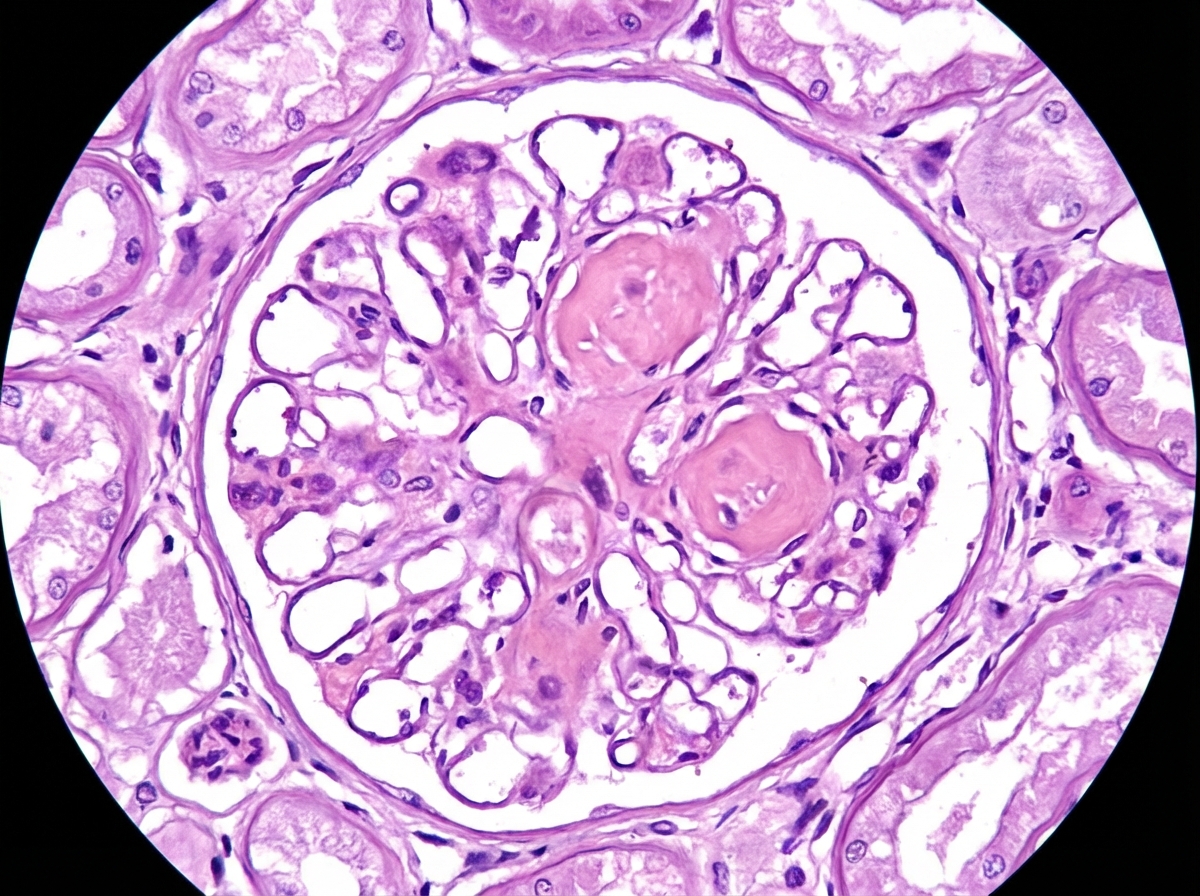
A 62-year-old man comes to the physician because of fatigue and decreased urine output for 2 weeks. He has not been to the physician for many years and takes no medications. Serum studies show a urea nitrogen concentration of 42 mg/dL and a creatinine concentration of 2.3 mg/dL. Urinalysis shows heavy proteinuria. A photomicrograph of a section of a kidney biopsy specimen is shown. Which of the following is the most likely underlying cause of this patient's symptoms?
A 76-year-old woman comes in for a routine checkup with her doctor. She is concerned that she feels tired most days and has difficulty doing her household chores. She complains that she gets fatigued and breathless with mild exertion. Past medical history is significant for diabetes mellitus, chronic kidney disease from prolonged elevated blood sugar, and primary biliary cirrhosis. Medications include lisinopril, insulin, and metformin. Family medicine is noncontributory. She drinks one beer every day. Today, she has a heart rate of 98/min, respiratory rate of 17/min, blood pressure of 110/65 mm Hg, and a temperature of 37.0°C (98.6°F). General examination shows that she is pale and haggard looking. She has a heartbeat with a regular rate and rhythm and her lungs are clear to auscultation bilaterally. A complete blood count (CBC) is as follows: Leukocyte count: 12,000/mm3 Red blood cell count: 3.1 million/mm3 Hemoglobin: 11.0 g/dL MCV: 85 fL MCH: 27 pg/cell Platelet count: 450,000/mm3 Fecal occult blood test is negative. What is the most likely cause of her anemia?
A 55-year-old Caucasian woman visits her family physician for a checkup and to discuss her laboratory results from a previous visit. The medical history is significant for obesity, hypothyroidism, and chronic venous insufficiency. The medications include thyroxine and a multivitamin. In her previous visit, she complained about being hungry all the time, urinating multiple times a day, and craving water for most of the day. Blood and urine samples were obtained. Today her blood pressure is 120/70 mm Hg, the pulse is 80/min, the respiratory rate is 18/min, and the body temperature is 36.4°C (97.5°F). The physical examination reveals clear lungs with regular heart sounds and no abdominal tenderness. There is mild pitting edema of the bilateral lower extremities. The laboratory results are as follows: Elevated SCr for an eGFR of 60 mL/min/1.73 m² Spot urine albumin-to-creatinine ratio 250 mg/g Urinalysis Specific gravity 1.070 Proteins (++) Glucose (+++) Nitrites (-) Microscopy Red blood cells none White blood cells none Hyaline casts few A bedside renal ultrasound revealed enlarged kidneys bilaterally without hydronephrosis. Which of the following kidney-related test should be ordered next?
A 75-year-old man presents to his primary care physician for foot pain. The patient states that he has had chronic foot pain, which has finally caused him to come and see the doctor. The patient's past medical history is unknown and he has not seen a doctor in over 50 years. The patient states he has led a healthy lifestyle, consumes a plant-based diet, exercised regularly, and avoided smoking, thus his lack of checkups with a physician. The patient lives alone as his wife died recently. His temperature is 98.1°F (36.7°C), blood pressure is 128/64 mmHg, pulse is 80/min, respirations are 13/min, and oxygen saturation is 98% on room air. The patient's BMI is 19 kg/m^2 and he appears healthy. Physical exam demonstrates a right foot that is diffusely swollen, mildly tender, and deformed. The patient's gait is abnormal. Which of the following is associated with the underlying cause of this patient's presentation?
A 42-year-old man comes to the physician because of a 2-month history of fatigue and increased urination. The patient reports that he has been drinking more than usual because he is constantly thirsty. He has avoided driving for the past 8 weeks because of intermittent episodes of blurred vision. He had elevated blood pressure at his previous visit but is otherwise healthy. Because of his busy work schedule, his diet consists primarily of fast food. He does not smoke or drink alcohol. He is 178 cm (5 ft 10 in) tall and weighs 109 kg (240 lb); BMI is 34 kg/m2. His pulse is 75/min and his blood pressure is 148/95 mm Hg. Cardiopulmonary examination shows no abnormalities. Laboratory studies show: Hemoglobin A1c 6.8% Serum Glucose 180 mg/dL Creatinine 1.0 mg/dL Total cholesterol 220 mg/dL HDL cholesterol 50 mg/dL Triglycerides 140 mg/dL Urine Blood negative Glucose 2+ Protein 1+ Ketones negative Which of the following is the most appropriate next step in management?
Want unlimited practice?
Get full access to all questions, explanations, and performance tracking.
Scan to download app