
Spontaneous bacterial peritonitis — MCQs

A 42-year-old man with chronic hepatitis C is admitted to the hospital because of jaundice and abdominal distention. He is diagnosed with decompensated liver cirrhosis, and treatment with diuretics is begun. Two days after admission, he develops abdominal pain and fever. Physical examination shows tense ascites and diffuse abdominal tenderness. Paracentesis yields cloudy fluid with elevated polymorphonuclear (PMN) leukocyte count. A drug with which of the following mechanisms is most appropriate for this patient's condition?
A 47-year-old man presents to the emergency department with jaundice and extreme fatigue for the past 4 days. He also noticed that his stool is very pale and urine is dark. Past medical history is unremarkable. The review of systems is significant for a 23 kg (50 lb) weight loss over the last 3 months which he says is due to decreased appetite. He is afebrile and the vital signs are within normal limits. A contrast computed tomography (CT) scan of the abdomen reveals a mass in the pancreatic head. A blood test for carbohydrate antigen (CA19-9) is positive. The patient is admitted to the intensive care unit (ICU) and undergoes surgical decompression of the biliary tract. He is placed on total parenteral nutrition (TPN). On day 4 after admission, his intravenous access site is found to be erythematous and edematous. Which of the following microorganisms is most likely responsible for this patient’s intravenous (IV) site infection?
A 50-year-old woman presents with esophageal varices, alcoholic cirrhosis, hepatic encephalopathy, portal hypertension, and recent onset confusion. The patient’s husband does not recall her past medical history but knows her current medications and states that she is quite disciplined about taking them. Current medications are spironolactone, labetalol, lactulose, and furosemide. Her temperature is 38.3°C (100.9°F), heart rate is 115/min, blood pressure is 105/62 mm Hg, respiratory rate is 12/min, and oxygen saturation is 96% on room air. On physical examination, the patient is disoriented, lethargic, and poorly responsive to commands. A cardiac examination is unremarkable. Lungs are clear to auscultation. The abdomen is distended, tense, and mildly tender. Mild asterixis is present. Neurologic examination is normal. The digital rectal examination reveals guaiac negative stool. Laboratory findings are significant for the following: Basic metabolic panel Unremarkable Platelet count 95,500/µL Leukocyte count 14,790/µL Hematocrit 33% (baseline is 30%) Which of the following would most likely be of diagnostic value in this patient?
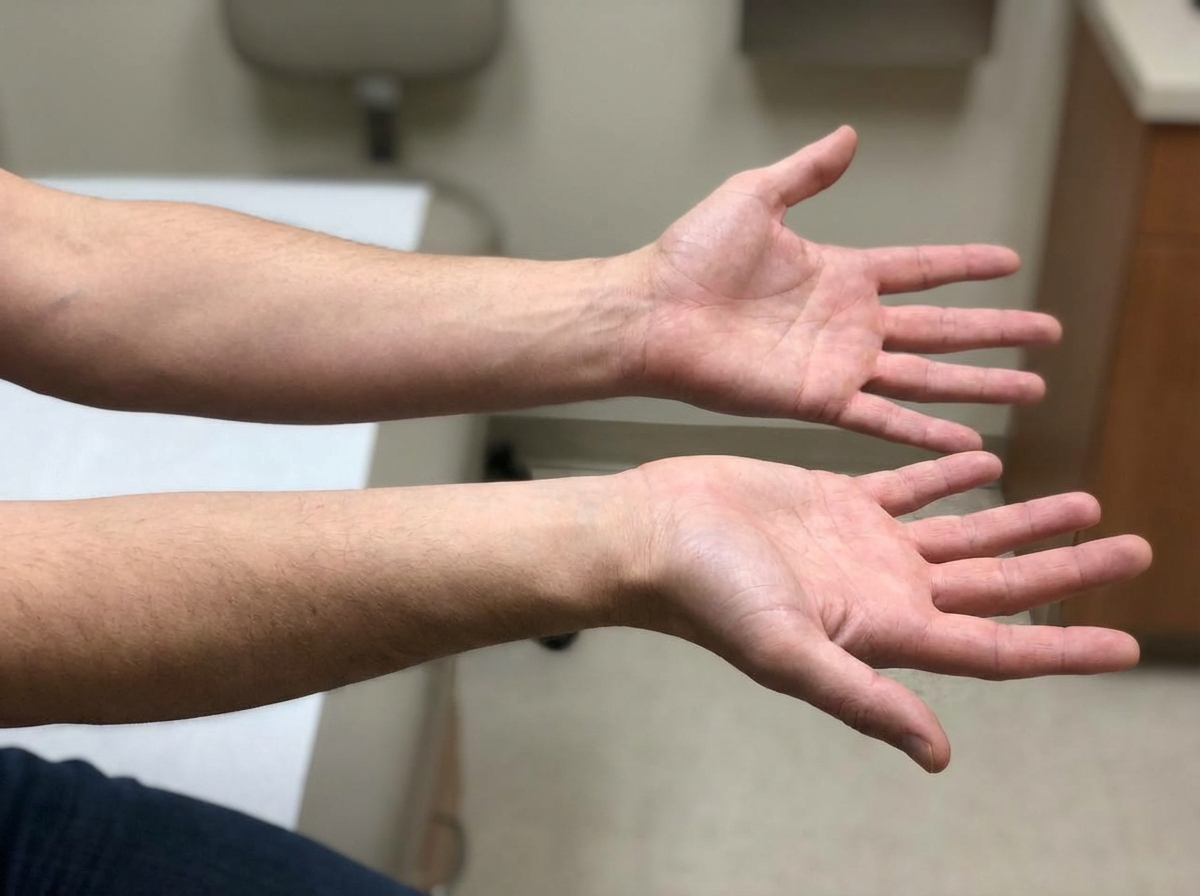
A 56-year-old male with a history of hepatitis C cirrhosis status post TIPS procedure is brought in by his wife to the emergency department because he has been acting disoriented, slurring his speech, and sleeping throughout the day. On arrival the patient is afebrile and his vital signs are pulse is 87/min, blood pressure is 137/93 mmHg, and respirations are 12/min with shallow breaths. Examination reveals a jaundiced male who appears older than stated age. Abdominal exam is positive for a fluid wave and shifting dullness to percussion. You note enlarged breasts, decreased facial hair, 3+ patellar reflexes bilaterally, and the following in the upper extremity (Image A). Paracentesis reveals ascitic fluid with neutrophil counts of < 100 cells/mcL. Serum creatinine is 1.0 and BUN is 15. Which of the following is the next best step in management?
A 49-year-old woman with a history of hepatitis C cirrhosis complicated by esophageal varices, ascites, and hepatic encephalopathy presents with 1 week of increasing abdominal discomfort. Currently, she takes lactulose, rifaximin, furosemide, and spironolactone. On physical examination, she has mild asterixis, generalized jaundice, and a distended abdomen with positive fluid wave. Diagnostic paracentesis yields a WBC count of 1196/uL with 85% neutrophils. Which of the following is the most appropriate treatment?
A 45-year-old homeless man is brought to the emergency department. He was found unconscious at the park. The patient has a past medical history of IV drug abuse, hepatitis C, alcohol abuse, schizophrenia, and depression. He does not receive normal medical follow up or care. His temperature is 102°F (38.9°C), blood pressure is 97/68 mmHg, pulse is 120/min, respirations are 22/min, and oxygen saturation is 98% on room air. Physical exam demonstrates a diffusely distended abdomen that is dull to percussion with a notable fluid wave. The abdominal exam causes the patient to contract his extremities. Cardiac and pulmonary exam are within normal limits. The patient responds to painful stimuli and smells heavily of alcohol. Which of the following is the best next step in management?
A 67-year-old man is brought to the emergency department when he was found obtunded at the homeless shelter. The patient is currently not responsive and smells of alcohol. The patient has a past medical history of alcohol use, IV drug use, and hepatitis C. His temperature is 99°F (37.2°C), blood pressure is 95/65 mmHg, pulse is 95/min, respirations are 13/min, and oxygen saturation is 95% on room air. The patient is started on IV fluids, and his pulse decreases to 70/min. On physical exam, the patient has an abdominal exam notable for distension and a positive fluid wave. The patient displays mild yellow discoloration of his skin. The patient has notable poor dentition and poor hygiene overall. A systolic murmur is heard along the left sternal border on cardiac exam. Pulmonary exam is notable for mild bibasilar crackles. Laboratory values are ordered, and return as below: Hemoglobin: 10 g/dL Hematocrit: 32% Leukocyte count: 7,500 cells/mm^3 with normal differential Platelet count: 227,000/mm^3 Serum: Na+: 125 mEq/L Cl-: 100 mEq/L K+: 5.0 mEq/L HCO3-: 24 mEq/L BUN: 51 mg/dL Glucose: 89 mg/dL Creatinine: 2.2 mg/dL Ca2+: 10.0 mg/dL AST: 22 U/L ALT: 19 U/L Urine: Color: Amber Nitrites: Negative Sodium: 12 mmol/24 hours Red blood cells: 0/hpf Over the next 24 hours, the patient produces very little urine. Which of the following best explains this patient’s renal findings?
A 52-year-old man comes to the physician because his skin has been progressively yellowing for the past 4 weeks. He also reports low appetite and difficulty fitting into his pants because of his swollen legs over the past several months. There is no personal or family history of serious illness. He does not smoke and drinks 1 to 2 beers on special occasions. He used to be sexually active with multiple female partners but has lost interest in sexual intercourse recently. He is 178 cm (5 ft 10 in) tall and weighs 68 kg (150 lb); his BMI is 22 kg/m2. Vital signs are within normal limits. Physical examination shows yellowing of the skin and sclera as well as erythema of the palms. There is bilateral enlargement of breast tissue. Cardiopulmonary examinations show no abnormalities. The abdomen is distended. The liver is palpated 2 to 3 cm below the right costal margin. On percussion of the left abdomen, a thrill can be felt on the right side. Hepatojugular reflux is absent. There is bilateral edema below the knees. Which of the following is the most likely underlying cause of this patient's condition?
A 55-year-old patient who immigrated from the Middle East to the United States 10 years ago presents to the emergency department because of excessive weakness, abdominal discomfort, and weight loss for the past 10 months. He has had type 2 diabetes mellitus for 10 years for which he takes metformin. He had an appendectomy 12 years ago in his home country, and his postoperative course was not complicated. He denies smoking and drinks alcohol socially. His blood pressure is 110/70 mm Hg, pulse is 75/min, and temperature is 37.1°C (98.7°F). On physical examination, the patient appears exhausted, and his sclerae are yellowish. A firm mass is palpated in the right upper abdominal quadrant. Abdominal ultrasonography shows liver surface nodularity, splenomegaly, and increased diameter of the portal vein. Which of the following is the most common complication of this patient condition?
A 49-year-old man presents to the emergency department with abdominal discomfort, fever, and decreased urination. He has a history of liver cirrhosis due to chronic hepatitis C infection. His blood pressure is 90/70 mm Hg, pulse is 75/min, and temperature 38°C (100.4°F). On physical examination he is jaundiced, and he has tense ascites with generalized abdominal tenderness. There is pitting edema to the level of his upper thighs. Which of the following excludes the diagnosis of hepatorenal syndrome in this patient?
Want unlimited practice?
Get full access to all questions, explanations, and performance tracking.
Scan to download app