
Skin and soft tissue infections — MCQs

A 7-year-old girl is brought to the pediatrician by her parents for red papules over her left thigh and swelling in the right axilla for the past few days. Her parents say that she had a cat bite on her left thigh 2 weeks ago. Her temperature is 38.6°C (101.4°F), pulse is 90/min, and respirations are 22/min. On her physical examination, hepatosplenomegaly is present with a healing area of erythema on her left thigh. Her laboratory studies show: Hemoglobin 12.9 gm/dL Leukocyte count 9,300/mm3 Platelet count 167,000/mm3 ESR 12 mm/hr Which of the following is the most appropriate next step in management?
A 72-year-old woman comes to the physician because of a 3-day history of redness and swelling of her right leg and fever. She says the leg is very painful and the redness over it has become larger. She appears ill. Her temperature is 39.3°C (102.7°F), pulse is 103/min, and blood pressure is 138/90 mm Hg. Cardiopulmonary examination shows no abnormalities. Examination shows an area of diffuse erythema and swelling over her anterior right lower leg; it is warm and tender to touch. Squeezing of the calf does not elicit tenderness. There is swelling of the right inguinal lymph nodes. Pedal pulses are palpable bilaterally. Which of the following is the strongest predisposing factor for this patient's condition?
A 62-year-old woman presents to the emergency department for evaluation of a spreading skin infection that began from an ulcer on her foot. The patient has type 2 diabetes mellitus that is poorly controlled. On examination, there is redness and erythema to the lower limb with skin breakdown along an extensive portion of the leg. The patient’s tissues separate readily from the fascial plane, prompting a diagnosis of necrotizing fasciitis. What is the exotoxin most likely associated with this patient’s presentation?
A 74-year-old woman presents to the clinic for evaluation of an erythematous and edematous skin rash on her right leg that has progressively worsened over the last 2 weeks. The medical history is significant for hypertension and diabetes mellitus type 2. She takes prescribed lisinopril and metformin. The vital signs include: blood pressure 152/92 mm Hg, heart rate 76/min, respiratory rate 12/min, and temperature 37.8°C (100.1°F). On physical exam, the patient appears alert and oriented. Observation of the lesion reveals a poorly demarcated region of erythema and edema along the anterior aspect of the right tibia. Within the region of erythema is a 2–3 millimeter linear break in the skin that does not reveal any serous or purulent discharge. Tenderness to palpation and warmth is associated with the lesion. There are no vesicles, pustules, papules, or nodules present. Ultrasound of the lower extremity is negative for deep vein thrombosis or skin abscess. The blood cultures are pending. Which of the following is the most likely diagnosis based on history and physical examination?
A 19-year-old woman presents to the family medicine clinic after noticing swelling of her right index finger a few hours ago. She has no past medical history and takes no prescription medications. She takes ibuprofen occasionally, as needed. She says that she has smoked a few cigarettes a day for the last year. On further questioning, the patient says that she has a dog and a cat at home. Her blood pressure is 108/67 mm Hg, heart rate is 94/min, respiratory rate is 12/min, and temperature is 37.8°C (100.1°F). On physical examination, the physician notices 2 clean puncture wounds with localized erythema and induration on the dorsum of the right second digit. Capillary refill is 2 seconds. Sensory and motor function are intact bilaterally. Which of the following is the most appropriate treatment choice for this patient?
A 35-year-old man comes to the emergency room for severe left leg pain several hours after injuring himself on a gardening tool. His temperature is 39°C (102.2°F) and his pulse is 105/min. Physical examination of the left leg shows a small laceration on the ankle surrounded by dusky skin and overlying bullae extending to the posterior thigh. There is a crackling sound when the skin is palpated. Surgical exploration shows necrosis of the gastrocnemius muscles and surrounding tissues. Tissue culture shows anaerobic gram-positive rods and a double zone of hemolysis on blood agar. Which of the following best describes the mechanism of cellular damage caused by the responsible pathogen?
A 24-year-old man is brought to the emergency department after he is found sluggish, drowsy, feverish, and complaining about a headache. His past medical history is unremarkable. His vital signs include: blood pressure 120/60 mm Hg, heart rate 70/min, respiratory rate 17/min, and body temperature 39.0°C (102.2°F). On physical examination, the patient is dysphasic and incapable of following commands. Gait ataxia is present. No meningeal signs or photophobia are present. A noncontrast CT of the head is unremarkable. A T2 MRI is performed and is shown in the image. A lumbar puncture (LP) is subsequently performed. Which of the following CSF findings would you most likely expect to find in this patient?
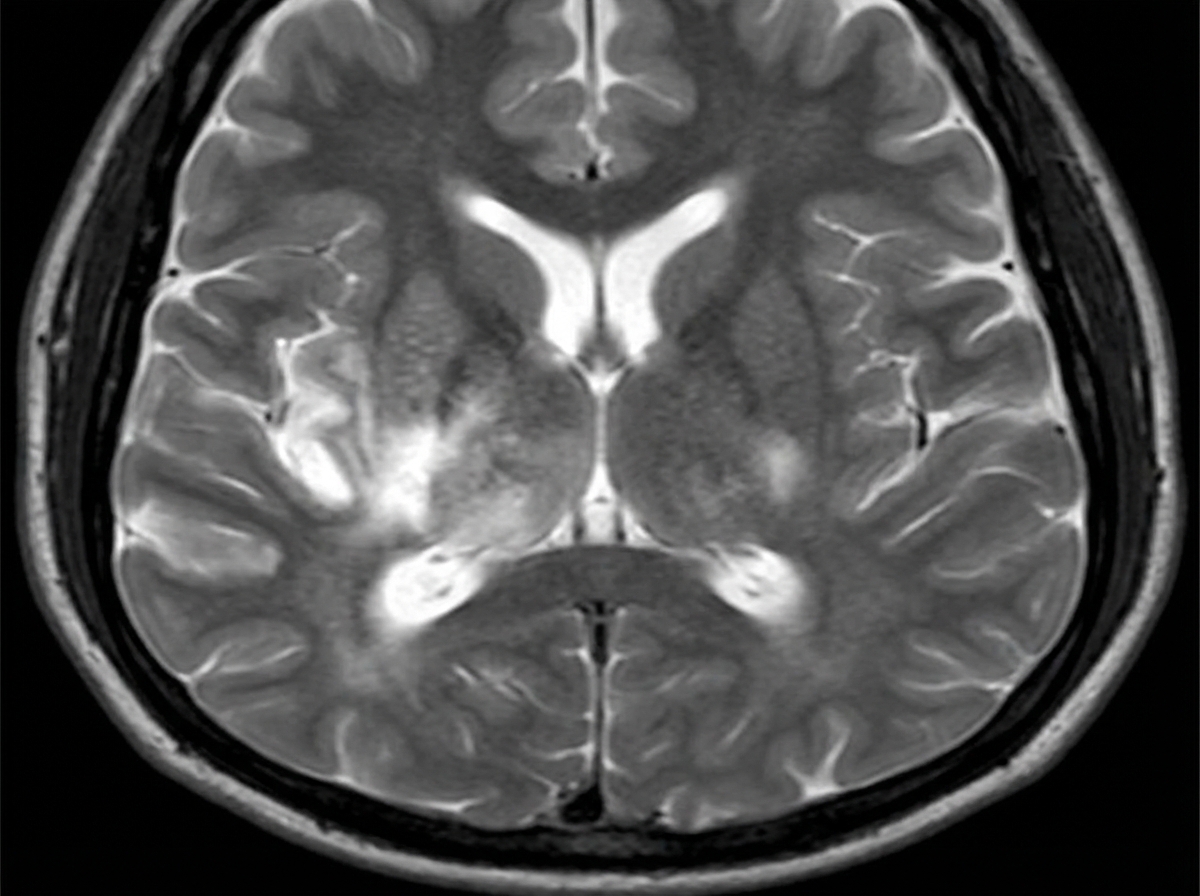
A 28-year-old male presents to his primary care physician with complaints of intermittent abdominal pain and alternating bouts of constipation and diarrhea. His medical chart is not significant for any past medical problems or prior surgeries. He is not prescribed any current medications. Which of the following questions would be the most useful next question in eliciting further history from this patient?
Two days after hospital admission and surgical treatment for a cut on his right thigh from a sickle, a 35-year-old man has fever, chills, and intense pain. The wound is swollen. He had a similar injury 4 months ago that resolved following treatment with bacitracin ointment and daily dressings. He works on a farm on the outskirts of the city. He appears anxious. His temperature is 38.5°C (101.3°F), pulse is 103/min, and blood pressure is 114/76 mm Hg. Examination shows a 6-cm edematous deep, foul-smelling wound on the medial surface of the right thigh. The skin over the thigh appears darker than the skin on the lower leg. There are multiple blisters around the wound. Light palpation around the wound causes severe pain; crepitus is present. Which of the following is the most likely causal organism?
A 43-year-old man is brought to the emergency department 40 minutes after falling off a 10-foot ladder. He has severe pain and swelling of his right ankle and is unable to walk. He did not lose consciousness after the fall. He has no nausea. He appears uncomfortable. His temperature is 37°C (98.6°F), pulse is 98/min, respirations are 16/min, and blood pressure is 110/80 mm Hg. He is alert and oriented to person, place, and time. Examination shows multiple abrasions over both lower extremities. There is swelling and tenderness of the right ankle; range of motion is limited by pain. The remainder of the examination shows no abnormalities. An x-ray of the ankle shows an extra-articular calcaneal fracture. Intravenous analgesia is administered. Which of the following is the most appropriate next step in the management of this patient?
Want unlimited practice?
Get full access to all questions, explanations, and performance tracking.
Scan to download app