
Sexually transmitted infections — MCQs

A 35-year-old woman visits the office with complaints of yellowish vaginal discharge and increased urinary frequency for a week. She also complains of pain during urination. Past medical history is irrelevant. She admits to having multiple sexual partners in the past few months. Physical examination is within normal limits except for lower abdominal tenderness. Urine culture yields Chlamydia trachomatis. What is the most appropriate next step in the management of this patient?
A 28-year-old woman comes to the physician because of a 4-day history of lower abdominal pain and pain with urination. Five months ago, she was treated for gonococcal urethritis. She recently moved in with her newlywed husband. She is sexually active with her husband and they do not use condoms. Her only medication is an oral contraceptive. Her temperature is 37.5°C (99.7°F) and blood pressure is 120/74 mm Hg. There is tenderness to palpation over the pelvic region. Pelvic examination shows a normal-appearing vulva and vagina. Laboratory studies show: Leukocyte count 8,400/mm3 Urine pH 6.7 Protein trace WBC 60/hpf Nitrites positive Bacteria positive Which of the following is the most likely causal organism?
A 24-year-old man presents with a painless genital ulcer for the past 2 weeks. He reports that he recently has been having unprotected sex with multiple partners. Past medical history is unremarkable. On physical examination, a single ulcer is present on the dorsal shaft of the penis which is circumscribed, indurated, and partially healed. There is moderate inguinal lymphadenopathy but no buboes. Which of the following tests would confirm the most likely diagnosis in this patient?
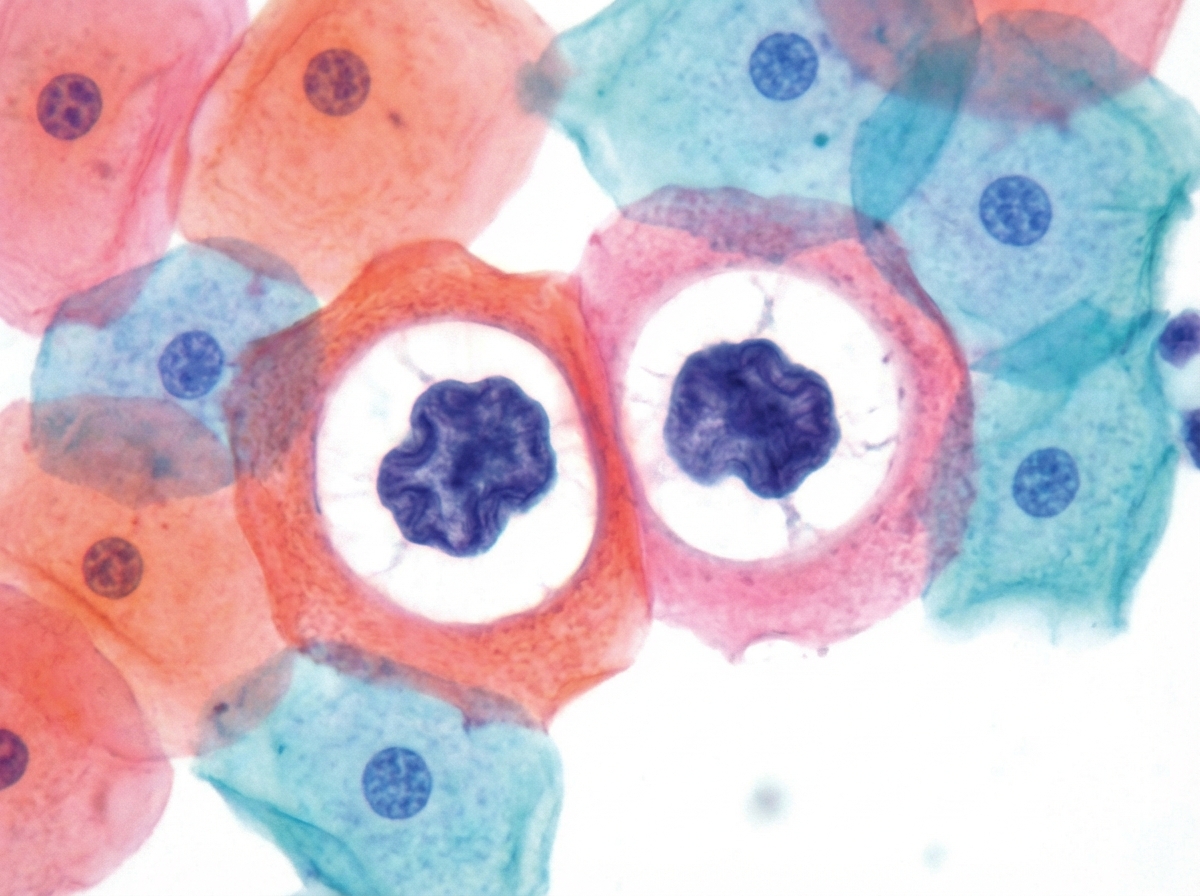
A 36-year-old woman comes to the physician for an annual pelvic examination and Pap smear. Her last Pap smear was 3 years ago. She has been sexually active with multiple male partners and takes an oral contraceptive. She has smoked one pack of cigarettes daily for 10 years. Pelvic examination shows no abnormalities. A photomicrograph of cervical cells from the Pap smear specimen is shown. Cells similar to the one indicated by the arrow are most likely to be seen in which of the following conditions?
A 28-year-old woman comes to the emergency department for a rash that began 3 days ago. She has low-grade fever and muscle aches. She has no history of serious illness and takes no medications. She has had 5 male sexual partners over the past year and uses condoms inconsistently. Her temperature is 38.1°C (100.6° F), pulse is 85/min, and blood pressure is 126/89 mm Hg. Examination shows a diffuse maculopapular rash that includes the palms and soles. The remainder of the examination shows no abnormalities. A venereal disease research laboratory (VDRL) test is positive. Which of the following is the next appropriate step in management?
A 22-year-old female college student presents to the clinic with complaints of intense vaginal itching and a painful sensation when urinating. She also notes that she has felt more lethargic and has additionally been experiencing recent fevers and headaches. She says that she is sexually active and occasionally uses condoms. On physical exam, she is found to have red, vesicular ulcers on her labia that are painful to palpation and tender inguinal lymphadenopathy. What is the most likely pathogen causing her presentation?
An endocervical swab is performed and nucleic acid amplification testing via polymerase chain reaction is conducted. It is positive for Chlamydia trachomatis and negative for Neisseria gonorrhoeae. Which of the following is the most appropriate pharmacotherapy?
A 34-year-old man presents with multiple painful ulcers on his penis. He says that the ulcers all appeared suddenly at the same time 3 days ago. He reports that he is sexually active with multiple partners and uses condoms inconsistently. He is afebrile and his vital signs are within normal limits. Physical examination reveals multiple small shallow ulcers with an erythematous base and without discharge. There is significant inguinal lymphadenopathy present. Which of the following is the most likely etiologic agent of this patient’s ulcers?
A 27-year-old woman visits your office with a 3-day complaint of fever, malaise, myalgias, and headaches associated with vulvar itching, vulvar soreness, dysuria, and urethral discharge. The pain when urinating is so severe that she has attempted to avoid the use of the toilet. She just returned from a spring break in the tropics and explains that she had multiple unprotected sexual encounters with men and women. Upon physical examination, the temperature was 38.7°C (101.6°F) and the heart rate was 90/min. The pelvic examination revealed vulvar ulcers, vulvar excoriations, erythema, vaginal mucosa edema, and ulcerative cervicitis. Which of the following will best aid you in the identification of the specific organism causing the above symptoms?
A 32-year-old man comes to the physician because of severe burning with urination for the past 3 days. During this period, he has had clear urethral discharge early in the morning. He has no history of serious illness, except for a rash following treatment with erythromycin 20 years ago. The patient takes no medications. He is sexually active with one male and one female partner; they use condoms inconsistently. His younger brother was diagnosed with Crohn disease at the age of 24 years. The patient does not smoke. He drinks one to two beers on weekends. He appears well. Temperature is 36.8°C (98°F), pulse is 75/min, and blood pressure is 135/78 mm Hg. Physical examination shows no abnormalities. Gram stain of a urethral swab shows neutrophils but no organisms. Which of the following is the most likely causal pathogen?
Want unlimited practice?
Get full access to all questions, explanations, and performance tracking.
Scan to download app