
Pneumonia (community-acquired, hospital-acquired) — MCQs

A 65-year-old woman is brought to the emergency department by her daughter for fever and cough. She just returned from a cruise trip to the Bahamas with her family 5 days ago and reports that she has been feeling ill since then. She endorses fever, productive cough, and general malaise. Her daughter also mentions that the patient has been having some diarrhea but reports that the rest of her family has been experiencing similar symptoms. Physical examination was significant for localized crackles at the right lower lobe. Laboratory findings are as follows: Serum Na+: 130 mEq/L K+: 3.9 mEq/L Cl-: 98 mEq/L HCO3-: 27 mEq/L Mg2+: 1.8 mEq/L What findings would you expect in this patient?
A patient is hospitalized for pneumonia. Gram-positive cocci in clusters are seen on sputum gram stain. Which of the following clinical scenarios is most commonly associated with this form of pneumonia?
A 59-year-old man comes to the clinic for an annual well-exam. He was lost to follow-up for the past 3 years due to marital issues but reports that he feels fine. The patient reports, “I feel tired but it is probably because I am getting old. I do feel a little feverish today - I think I got a cold.” His past medical history is significant for hypertension that is controlled with hydrochlorothiazide. He reports fatigue, congestion, cough, and night sweats. He denies any sick contacts, recent travel, weight changes, chest pain, or dizziness. His temperature is 101°F (38.3°C), blood pressure is 151/98 mmHg, pulse is 97/min, and respirations are 15/min. His laboratory values are shown below: Hemoglobin: 13.5 g/dL Hematocrit: 41% Leukocyte count: 25,000/mm^3 Segmented neutrophils: 73% Bands: 8% Eosinophils: 1% Basophils: 2% Lymphocytes: 15% Monocytes: 2% Platelet count: 200,000/mm^3 What diagnostic test would be helpful in distinguishing this patient’s condition from pneumonia?
A 43-year-old woman comes to the physician because of a fever, nausea, and a nonproductive cough for 7 days. During this period, she has had headaches, generalized fatigue, and muscle and joint pain. She has also had increasing shortness of breath for 2 days. She has type 2 diabetes mellitus and osteoarthritis of her left knee. Current medications include insulin and ibuprofen. She had smoked two packs of cigarettes daily for 20 years but stopped 10 years ago. Her temperature is 38.1°C (100.6°F), pulse is 94/min, respirations are 18/min, and blood pressure is 132/86 mm Hg. The lungs are clear to auscultation. There are multiple skin lesions with a blue livid center, pale intermediate zone, and a dark red peripheral rim on the upper and lower extremities. Laboratory studies show: Hemoglobin 14.6 g/dL Leukocyte count 11,100/mm3 Serum Na+ 137 mEq/L K+ 4.1 mEq/L Cl- 99 mEq/L Urea nitrogen 17 mg/dL Glucose 123 mg/dL Creatinine 0.9 mg/dL Which of the following is the most likely causal organism?
A 57-year-old man comes to the physician for a follow-up examination. During the last 6 months, he has had recurring pneumonia after undergoing a surgical operation. He reports that, when food has gone down his windpipe, he has not automatically coughed. Examination shows normal voluntary coughing, but an impaired cough reflex. The nerve responsible for this patient's symptoms is most likely damaged at which of the following anatomical sites?
A 59-year-old woman comes to the emergency department because of a 2-day history of worsening fever, chills, malaise, productive cough, and difficulty breathing. Three days ago, she returned from a trip to South Africa. She has type 2 diabetes mellitus, hypertension, and varicose veins. Her current medications include metformin, lisinopril, and atorvastatin. Her temperature is 39.4°C (102.9°F), pulse is 102/minute, blood pressure is 94/68 mm Hg, and respirations are 31/minute. Pulse oximetry on 2 L of oxygen via nasal cannula shows an oxygen saturation of 91%. Examination reveals decreased breath sounds and dull percussion over the left lung base. The skin is very warm and well-perfused. The remainder of the examination shows no abnormalities. Laboratory studies show: Hemoglobin 11.6 g/dL Leukocyte count 15,400/mm3 platelet count 282,000/mm3 Serum Na+ 144 mEq/L Cl- 104 mEq/L K+ 4.9 mEq/L Creatinine 1.5 mg/dL Blood and urine for cultures are obtained. Intravenous fluid resuscitation is begun. Which of the following is the next best step in management?
A 55-year-old man is brought to the emergency department by ambulance after being found disoriented. He has limited ability to communicate in English but indicates that he has left flank pain and a fever. Chart review reveals that he has diabetes and sleep apnea but both are well controlled. He also has a 30-pack-year smoking history and has lost about 20 pounds since his last presentation. Physical exam reveals a bulge in his left scrotum and ultrasound reveals bilateral kidney stones. Which of the following findings is also associated with the most likely cause of this patient's symptoms?
A 34-year-old woman comes to the emergency department because of right flank pain and vomiting for 5 hours. She has had fever and chills for the past 2 days. She attended a barbecue 3 days ago, where she ate egg salad. She underwent surgery for left ovarian torsion a year ago. Menses occur at regular 28-day intervals and last 5 days. She is sexually active with 2 male partners and uses condoms inconsistently. Her only medication is an oral contraceptive pill. She is 163 cm (5 ft 4 in) tall and weighs 72.5 kg (160 lb); BMI is 27.5 kg/m2. She appears uncomfortable. Her temperature is 38.9°C (102°F), pulse is 101/min, and blood pressure is 118/76 mm Hg. The lungs are clear to auscultation. The right lower quadrant and right flank show severe tenderness to palpation. Pelvic examination shows no abnormalities. Laboratory studies show: Hemoglobin 12.8 g/dL Leukocyte count 14,200/mm3 Platelet count 230,000/mm3 Serum Na+ 136 mEq/L K+ 3.8 mEq/L Cl- 103 mEq/L Urea nitrogen 23 mg/dL Creatinine 1.2 mg/dL Urine Blood 1+ Protein 1+ Glucose negative Leukocyte esterase positive Nitrites negative RBC 6–8/hpf WBC 80–85/hpf Which of the following is the most likely diagnosis?
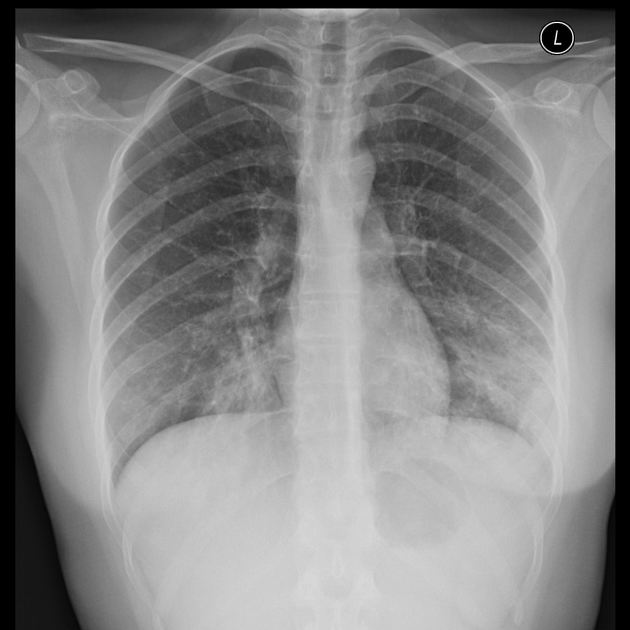
A 24-year-old woman, otherwise healthy, presents with a non-productive cough, sore throat, and myalgia. The patient reports that her symptoms started gradually 2 weeks ago and have not improved. She has no significant past medical history and no current medications. She is a college student and denies any recent overseas travel. The patient received the flu vaccine this year, and her 2-part PPD required for school was negative. She does not smoke, drink, or use recreational drugs. The patient denies being sexually active. The vital signs include: temperature 37.0°C (98.6°F), blood pressure 110/75 mm Hg, pulse 98/min, respirations 20/min, and oxygen saturation 99% on room air. On physical exam, the patient is alert and cooperative. The cardiac exam is normal. There are rales present bilaterally over both lung fields. The skin and conjunctiva are pale. The laboratory tests are pending. The chest X-ray is shown in the image. Which of the following laboratory findings would also commonly be found in this patient?
A 43-year-old woman visits her primary care physician complaining of abdominal pain for the past 6 months. She reports that the pain is localized to her lower abdomen and often resolves with bowel movements. She states that some days she has diarrhea while other times she will go 4-5 days without having a bowel movement. She started a gluten-free diet in hopes that it would help her symptoms, but she has not noticed much improvement. She denies nausea, vomiting, hematochezia, or melena. Her medical history is significant for generalized anxiety disorder and hypothyroidism. Her father has a history of colon cancer. The patient takes citalopram and levothyroxine. Physical examination reveals mild abdominal tenderness with palpation of lower quadrant but no guarding or rebound. A guaiac test is negative. A complete blood count is pending. Which of the following is the next best step in management?
Want unlimited practice?
Get full access to all questions, explanations, and performance tracking.
Scan to download app