
Medical management of Crohn's disease — MCQs

A 22-year-old woman comes to the physician because of abdominal pain and diarrhea for 2 months. The pain is intermittent, colicky and localized to her right lower quadrant. She has anorexia and fears eating due to the pain. She has lost 4 kg (8.8 lb) during this time. She has no history of a serious illness and takes no medications. Her temperature is 37.8°C (100.0°F), blood pressure 125/65 mm Hg, pulse 75/min, and respirations 14/min. An abdominal examination shows mild tenderness of the right lower quadrant on deep palpation without guarding. Colonoscopy shows small aphthous-like ulcers in the right colon and terminal ileum. Biopsy from the terminal ileum shows noncaseating granulomas in all layers of the bowel wall. Which of the following is the most appropriate pharmacotherapy at this time?
A 33-year-old woman with Crohn’s disease colitis presents to her physician after 2 days of photophobia and blurred vision. She has had no similar episodes in the past. She has no abdominal pain or diarrhea and takes mesalazine, azathioprine, and prednisone as maintenance therapy. Her vital signs are within normal range. Examination of the eyes shows conjunctival injection. The physical examination is otherwise normal. Slit-lamp examination by an ophthalmologist shows evidence of inflammation in the anterior chamber. Which of the following is the most appropriate modification to this patient’s medication at this time?
A 25-year-old man presents with abdominal pain and bloody diarrhea. His symptoms have been recurrent for the past few months, and, currently, he says he is having on average four bowel movements daily, often bloody. He describes the pain as cramping and localized to the left side of his abdomen. He also says that he has lost around 4.5 kg (10 lb) over the past 3 months. There is no other significant past medical history and the patient is not on current medications. His temperature is 37.7° C (100.0° F), pulse rate is 100/min, respiratory rate is 18/min, and blood pressure is 123/85 mm Hg. On physical examination, there is mild tenderness to palpation in the lower left quadrant of the abdomen with no rebound or guarding. Laboratory studies show anemia and thrombocytosis. Colonoscopy is performed, which confirms the diagnosis of ulcerative colitis (UC). What is the mechanism of action of the recommended first-line medication for the treatment of this patient’s condition?
A 31-year-old man presents to an urgent care clinic with symptoms of lower abdominal pain, bloating, bloody diarrhea, and fullness, all of which have become more frequent over the last 3 months. His vital signs are as follows: blood pressure is 121/81 mm Hg, heart rate is 87/min, and respiratory rate is 15/min. Rectal examination reveals a small amount of bright red blood. Lower endoscopy is performed, showing extensive mucosal erythema, induration, and pseudopolyps extending from the rectum to the splenic flexure. Given the following options, what is the most appropriate initial treatment for this patient's underlying disease?
A 28-year-old male presents to his primary care physician with complaints of intermittent abdominal pain and alternating bouts of constipation and diarrhea. His medical chart is not significant for any past medical problems or prior surgeries. He is not prescribed any current medications. Which of the following questions would be the most useful next question in eliciting further history from this patient?
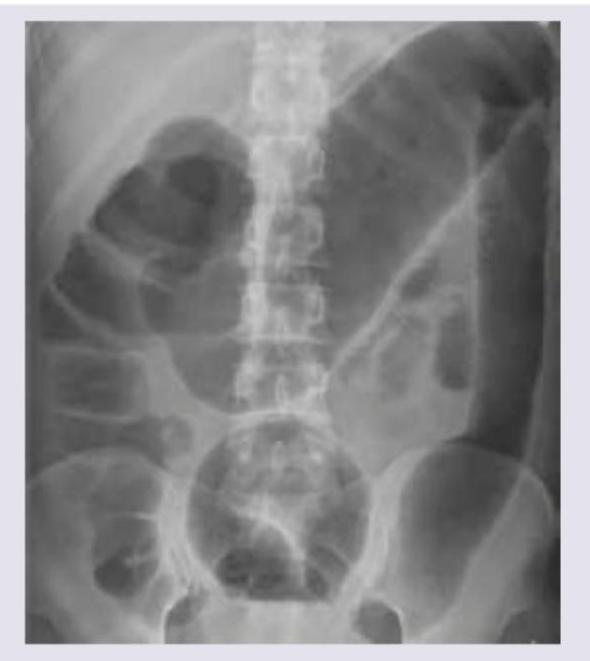
A 53 year-old woman with history of ulcerative colitis presents to the emergency department with a severe flare. The patient reports numerous bloody loose stools, and has been febrile for two days. Vital signs are: T 101.9 HR 98 BP 121/86 RR 17 Sat 100%. Abdominal exam is notable for markedly distended abdomen with tympani and tenderness to palpation without guarding or rebound. KUB is shown in figure A. CT scan shows markedly dilated descending and sigmoid colon with no perforations. What is the next best step in management for this patient?
A 25-year-old man presents to the emergency department for severe abdominal pain. The patient states that for the past week he has felt fatigued and had a fever. He states that he has had crampy lower abdominal pain and has experienced several bouts of diarrhea. The patient states that his pain is somewhat relieved by defecation. The patient returned from a camping trip 2 weeks ago in the Rocky Mountains. He is concerned that consuming undercooked meats on his trip may have caused this. He admits to consuming beef and chicken cooked over a fire pit. The patient is started on IV fluids and morphine. His temperature is 99.5°F (37.5°C), blood pressure is 130/77 mmHg, pulse is 90/min, respirations are 12/min, and oxygen saturation is 98% on room air. Laboratory studies are ordered and are seen below. Hemoglobin: 10 g/dL Hematocrit: 28% Leukocyte count: 11,500 cells/mm^3 with normal differential Platelet count: 445,000/mm^3 Serum: Na+: 140 mEq/L Cl-: 102 mEq/L K+: 4.1 mEq/L HCO3-: 24 mEq/L BUN: 24 mg/dL Glucose: 145 mg/dL Creatinine: 1.4 mg/dL Ca2+: 9.6 mg/dL Erythrocyte sedimentation rate (ESR): 75 mm/hour Physical exam is notable for a patient who appears to be uncomfortable. Gastrointestinal (GI) exam is notable for abdominal pain upon palpation. Ear, nose, and throat exam is notable for multiple painful shallow ulcers in the patient's mouth. Inspection of the patient's lower extremities reveals a pruritic ring-like lesion. Cardiac and pulmonary exams are within normal limits. Which of the following best describes this patient's underlying condition?
A 22-year-old man presents to the emergency department with abdominal pain. The patient states that he has had right lower quadrant abdominal pain for "a while now". The pain comes and goes, and today it is particularly painful. The patient is a college student studying philosophy. He drinks alcohol occasionally and is currently sexually active. He states that sometimes he feels anxious about school. The patient's father died of colon cancer at the age of 55, and his mother died of breast cancer when she was 57. The patient has a past medical history of anxiety and depression which is not currently treated. Review of systems is positive for bloody diarrhea. His temperature is 99.5°F (37.5°C), blood pressure is 100/58 mmHg, pulse is 120/min, respirations are 17/min, and oxygen saturation is 98% on room air. Cardiopulmonary exam is within normal limits. Abdominal exam reveals diffuse tenderness. A fecal occult blood test is positive. Which of the following is the most likely diagnosis?
A 28-year-old woman comes to the physician because of a 2-month history of multiple right inframammary lumps. They are tender and have a foul-smelling odor. She has had previous episodes of painful swellings in the axillae 12 months ago that resolved with antibiotic therapy, leaving some scarring. She has Crohn disease. Menses occur at irregular 18- to 40-day intervals and last 1–5 days. The patient's only medication is mesalamine. She appears anxious. She is 162 cm (5 ft 4 in) tall and weighs 87 kg (192 lb); BMI is 33 kg/m2. Vital signs are within normal limits. Examination of the right inframammary fold shows multiple tender, erythematous nodules and fistulas with purulent discharge. Hirsutism is present. Her fasting glucose concentration is 136 mg/dL. Which of the following areas is most likely to also be affected by this patient's condition?
A 44-year-old woman comes to the physician with increasingly yellow sclera and pruritus over the past 3 months. She has intermittent right-upper-quadrant pain and discomfort. She has no history of any serious illnesses and takes no medications. Her vital signs are within normal limits. Her sclera are icteric. Skin examination shows linear scratch marks on the trunk and limbs. The remainder of the physical examination is unremarkable. Laboratory studies show: Complete blood count Hemoglobin 15 g/dL Mean corpuscular volume 95 μm3 Leukocyte count 6,000/mm3 with a normal differential Serum Alkaline phosphatase 470 U/L Aspartate aminotransferase (AST, GOT) 38 U/L Alanine aminotransferase (ALT, GPT) 45 U/L γ-Glutamyltransferase (GGT) 83 U/L (N=5–50 U/L) Bilirubin, total 2.7 mg/dL Bilirubin, direct 1.4 mg/dL Magnetic resonance cholangiopancreatography (MRCP) shows a multifocal and diffuse beaded appearance of the intrahepatic and extrahepatic biliary ducts. Which of the following is the most appropriate diagnostic study at this time?
Want unlimited practice?
Get full access to all questions, explanations, and performance tracking.
Scan to download app