
Coagulation factor disorders — MCQs

A 14-year-old boy presents with his mother complaining of a swollen, red, painful left knee. His physician aspirates the joint and discovers frank blood. The patient denies a recent history of trauma to the knee. Upon further discussion, the mother describes that her son has had multiple swollen painful joints before, often without evidence of trauma. She also mentions a history of frequent nosebleeds and gum bleeding following visits to the dentist. Which of the following is the most likely underlying diagnosis?
An otherwise healthy 23-year-old man comes to the physician because of a 3-day history of mild persistent bleeding from the site of a tooth extraction. He has no prior history of medical procedures or surgeries and no history of easy bruising. He appears well. Vital signs are within normal limits. Laboratory studies show: Hemoglobin 12.4 g/dL Platelets 200,000/mm3 Serum Prothrombin time 25 seconds Partial thromboplastin time (activated) 35 seconds Deficiency of which of the following coagulation factors is the most likely cause of this patient’s condition?
A graduate student at the biochemistry laboratory decides to research the different effects of vitamin deficiencies in mice by completely depriving the mice of one vitamin. The symptoms of this deficiency include posterior column and spinocerebellar tract demyelination, as well as hemolytic anemia. Further analysis is negative for megaloblastic anemia, hypersegmented neutrophils, and elevated serum methylmalonic acid. What characteristic of the vitamin is causing the symptoms in the mice?
A 46-year-old man diagnosed with pancreatic adenocarcinoma is admitted with fever, malaise, and dyspnea. He says that symptoms onset 2 days ago and have progressively worsened. Past medical history is significant for multiple abdominal surgeries including stenting of the pancreatic duct. Current inpatient medications are rosuvastatin 20 mg orally daily, aspirin 81 mg orally daily, esomeprazole 20 mg orally daily, oxycontin 10 mg orally twice daily, lorazepam 2 mg orally 3 times daily PRN, and ondansetron 10 mg IV. On admission, his vital signs include blood pressure 105/75 mm Hg, respirations 22/min, pulse 90/min, and temperature 37.0°C (98.6°F). On his second day after admission, the patient acutely becomes obtunded. Repeat vital signs show blood pressure 85/55 mm Hg, respirations 32/min, pulse 115/min. Physical examination reveals multiple ecchymoses on the trunk and extremities and active bleeding from all IV and venipuncture sites. There is also significant erythema and swelling of the posterior aspect of the left leg. Laboratory findings are significant for thrombocytopenia, prolonged PT and PTT, and an elevated D-dimer. Blood cultures are pending. Which of the following is most likely responsible for this patient’s current condition?
A 2-year-old boy had increased bleeding during a circumcision. His birth and delivery were uncomplicated, and his mother had no issues with prolonged bleeding during labor. Of note, his maternal grandfather has a history of bleeding complications. The boy's vital signs are stable and physical examination is notable for scattered bruises on his lower extremities. The lab results are as follows: Hemoglobin 12.8 gm % Hematocrit 35.4% WBC 8400/mm3 Platelets 215 x 109/L PT 14 s PTT 78 s What is the most likely diagnosis?
A 12-year-old boy presents to the emergency department with a swollen and painful knee. He says that he was exploring with his friends when he tripped and hit his knee against the ground. He didn't feel like he hit it very hard but it started swelling and becoming very painful. His mom reports that he has always been prone to bleeding from very minor trauma and that others in the family have had similar problems. Based on clinical suspicion a coagulation panel was obtained showing a prothrombin time (PT) of 10 seconds (normal range 9-11 seconds), a partial thromboplastin time (PTT) of 45 seconds (normal 20-35 seconds), and a normal ristocetin cofactor assay (equivalent to bleeding time). Mixing tests with factor IX and XI do not show complementation, but mixing with factor VIII reverses the coagulation abnormality. Which of the following is the most likely diagnosis for this patient?
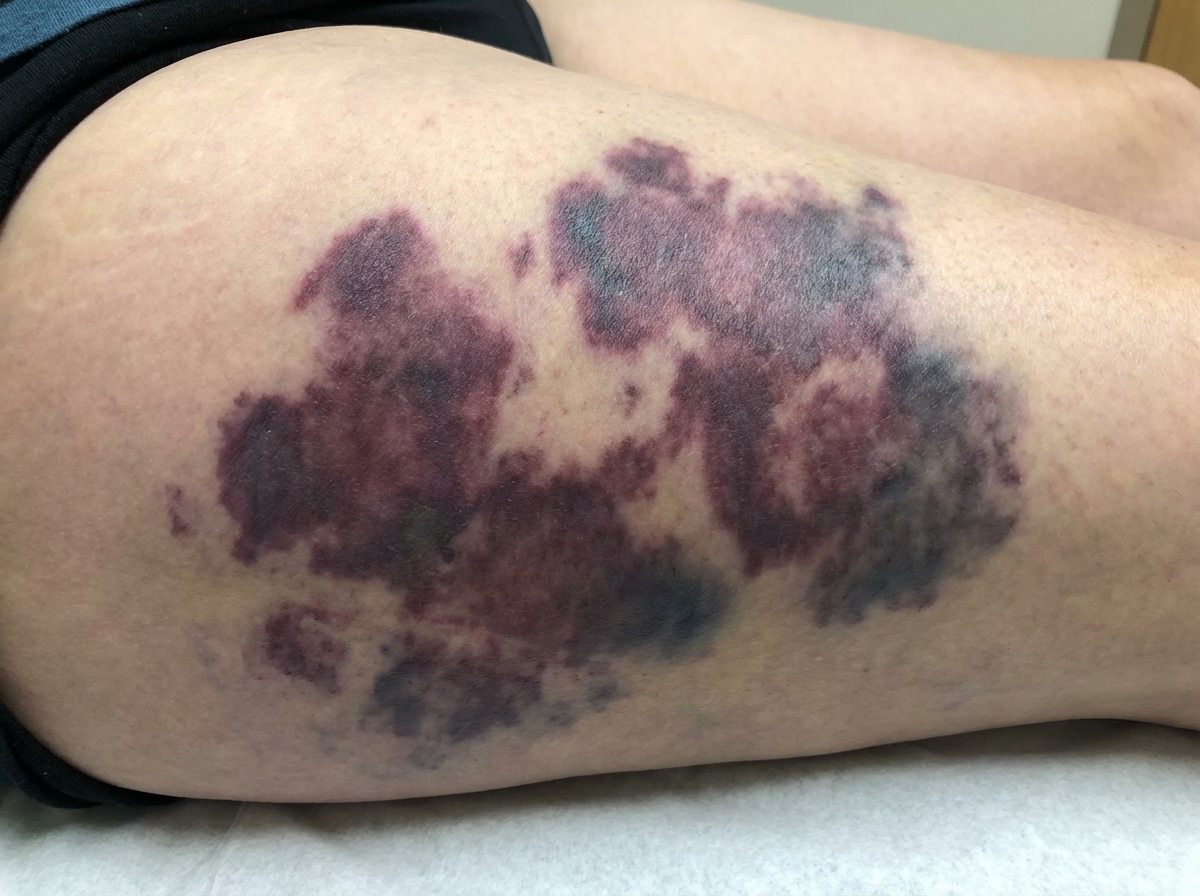
A 68-year-old man comes to the emergency department 12 hours after the appearance of tender, purple discolorations on his thighs and lower abdomen. He began taking a medication 4 days ago after failed cardioversion for atrial fibrillation, but he cannot remember the name. Physical examination shows a tender bluish-black discoloration on the anterior abdominal wall. A photograph of the right thigh is shown. Which of the following is the most likely explanation for this patient's skin findings?
A 29-year-old woman comes to the office with the complaints of severe bleeding after a dental extraction which required local hemostatic therapy. She has a long-term excessive menstrual bleeding and iron-deficiency anemia that required treatment with iron supplement since the age of 17. In addition, she states that her mother also has a history of frequent nosebleeds. The vital signs include: pulse rate 107/min, respiratory rate 17/min, temperature 37.2°C (99.0°F), and blood pressure 90/60 mm Hg. Her physical exam shows generalized pallor. The complete blood count results are as follows: Hemoglobin 10.7 g/dL Hematocrit 41% Leukocyte count 8,000/mm3 Neutrophils 54% Bands 3% Eosinophils 1% Basophils 0% Lymphocytes 32% Monocytes 2% Mean corpuscular hemoglobin 25.4 pg/cell Mean corpuscular hemoglobin concentration 31% Hb/cell Mean corpuscular volume 76 μm3 Platelet count 380,000/mm³ The coagulation test results are as follows: Partial thromboplastin time (activated) 48.0 s Prothrombin time 14.0 s International normalized ratio 0.9 What is the most likely diagnosis?
A 46-year-old female with estrogen receptor positive invasive ductal carcinoma is prescribed tamoxifen. Which of the following is the MOST concerning side effect that requires patient counseling regarding potentially life-threatening complications?
A 35-year-old patient is brought into the emergency department post motor vehicle crash. Stabilization of the patient in the trauma bay requires endotracheal intubation. The patient has a laceration on the femoral artery from shrapnel and seems to have lost large quantities of blood. The patient is transfused with 13 units of packed red blood cells. His vitals are T 96.5, HR 150, BP 90/40. Even with the direct pressure on the femoral artery, the patient continues to bleed. Results of labs drawn within the last hour are pending. Which of the following is most likely to stop the bleeding in this patient?
Want unlimited practice?
Get full access to all questions, explanations, and performance tracking.
Scan to download app