
Heart failure — MCQs

On this page
A 68-year-old man with a history of hypertension and type 2 diabetes presents to the emergency department with 2 hours of crushing substernal chest pain radiating to his left arm, diaphoresis, and nausea. BP is 88/60 mmHg, HR is 112 bpm, RR is 22/min, and SpO₂ is 94% on room air. The ECG shows ST elevations in leads II, III, and aVF with reciprocal ST depressions in leads I and aVL, consistent with an acute inferior STEMI. Crackles are heard at both lung bases. The nearest cardiac catheterization laboratory is 3 hours away by transport. Which of the following is the most appropriate immediate reperfusion strategy?
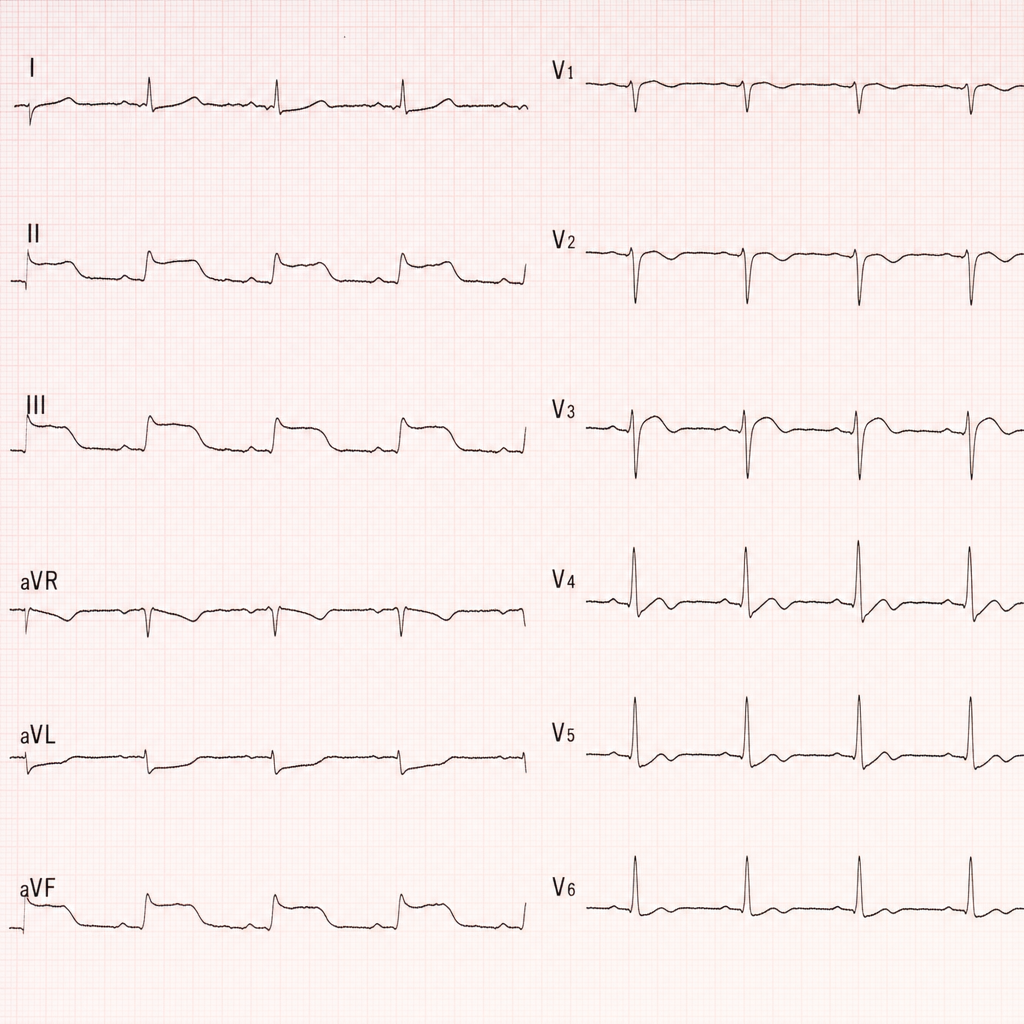
A 55-year-old woman comes to the emergency department because of epigastric pain, sweating, and breathlessness for 45 minutes. She has hypertension treated with hydrochlorothiazide. She has smoked 1 pack of cigarettes daily for the past 30 years and drinks 1 glass of wine daily. Her pulse is 105/min and blood pressure is 100/70 mm Hg. Arterial blood gas analysis on room air shows: pH 7.49 pCO2 32 mm Hg pO2 57 mm Hg Which of the following is the most likely cause of hypoxemia in this patient?
A 34-year-old woman, gravida 2, para 2, is admitted to the hospital because of shortness of breath and fatigue 2 weeks after delivery of a full-term female newborn. She has no history of major medical illness. Cardiac examination on admission shows an S3 gallop and a grade 2/6 holosystolic murmur heard best at the apex. Treatment is initiated with intravenous furosemide and captopril. Her symptoms resolve, and 3 weeks later, cardiac examination shows no murmur. Which of the following is the most likely explanation for the initial auscultation findings?
A 25-year-old man comes to the emergency department because of a 1-week-history of progressively worsening dyspnea and intermittent chest pain that increases on inspiration. He had an upper respiratory tract infection 2 weeks ago. His pulse is 115/min and blood pressure is 100/65 mm Hg. Examination shows inspiratory crackles bilaterally. His serum troponin I is 0.21 ng/mL (N < 0.1). An x-ray of the chest shows an enlarged cardiac silhouette and prominent vascular markings in both lung fields; costophrenic angles are blunted. A rhythm strip shows inverted T waves. Which of the following additional findings is most likely in this patient's condition?
A 65-year-old man comes to the physician for a follow-up examination. He has chronic obstructive pulmonary disease and was recently discharged from the hospital for an exacerbation. His cough and chills have since improved, but his mobility is still severely limited by dyspnea and fatigue. He smoked 2 packs of cigarettes daily for 30 years, but quit 5 years ago. His medications include inhaled daily budesonide, formoterol, and tiotropium bromide plus ipratropium/albuterol as needed. Pulmonary function testing shows an FEV1 of 27% of predicted. Resting oxygen saturation ranges from 84–88%. Which of the following steps in management is most likely to increase the chance of survival in this patient?
A 60-year-old Caucasian man comes to the physician because of progressive fatigue, shortness of breath, and leg swelling for the past 4 months. He has to pause several times when climbing one flight of stairs. For the past 10 years, he has had joint pain in his hands, wrists, and knees. He has diabetes mellitus and hypertension controlled with daily insulin injections and a strict low-calorie, low-sodium diet. He takes ibuprofen as needed for his joint pain. His wife says that he snores at night. He drinks two to three beers daily. He has smoked half a pack of cigarettes daily for the past 40 years. He went camping in northern New York one week ago. His vital signs are within normal limits. Physical examination shows jugular venous distention, pitting edema around the ankles, and tanned skin. Crackles are heard at both lung bases. An S3 is heard at the apex. The liver is palpated 2 to 3 cm below the right costal margin. His skin appears dark brown. An ECG shows a left bundle branch block. Echocardiography shows left atrial and ventricular enlargement, reduced left ventricular ejection fraction, and mild mitral regurgitation. Which of the following is most likely to have prevented this patient's condition?
A 63-year-old man comes to the physician because of a 3-week history of fatigue and shortness of breath. Physical examination shows diminished breath sounds at the right lung base. An x-ray of the chest shows blunting of the right costophrenic angle. Thoracentesis shows clear, yellow-colored fluid with a protein concentration of 1.9 g/dL. Which of the following is the most likely underlying cause of this patient's pleural effusion?
A 65-year-old man is brought to the emergency department for a 1-week history of worsening shortness of breath. The symptoms occur when he climbs the stairs to his apartment on the 3rd floor and when he goes to bed. He gained 2.3 kg (5 lbs) in the past 5 days. He has a history of hypertension, hyperlipidemia, alcoholic steatosis, and osteoarthritis. He received surgical repair of a ventricular septal defect when he was 4 months old. He started taking ibuprofen for his osteoarthritis and simvastatin for his hyperlipidemia one week ago. He drinks 2–3 beers daily after work. His temperature is 37.0°C (98.6°F), his pulse is 114/min, and his blood pressure is 130/90 mmHg. Physical examination reveals jugular venous distention and 2+ pitting edema in his lower legs. On cardiac auscultation, an additional, late-diastolic heart sound is heard. Bilateral crackles are heard over the lung bases. Echocardiography shows concentric hypertrophy of the left ventricle. Which of the following is the most likely underlying cause of this patient's condition?
A 65-year-old man is brought to the emergency department after loss of consciousness. He is accompanied by his wife. He is started on intravenous fluids, and his vital signs are assessed. His blood pressure is 85/50 mm Hg, pulse 50/min, and respiratory rate 10/min. He has been admitted in the past for a heart condition. His wife is unable to recall the name of the condition, but she does know that the doctor recommended some medications at that time in case his condition worsened. She has brought with her the test reports from previous medical visits over the last few months. She says that she has noticed that he often has difficulty breathing and requires three pillows to sleep at night to avoid being short of breath. He can only walk for a few kilometers before he has to stop and rest. His wife also reports that he has had occasional severe coughing spells with pinkish sputum production. She also mentions that he has been drinking alcohol for the past 30 years. Which of the following medications will improve the prognosis of this patient?
Two days after emergency treatment for acute decompensated heart failure in the coronary care unit (CCU), a 68-year-old man develops palpitations. He has a history of ischemic heart disease and congestive heart failure for the last 10 years. His current medications include intravenous furosemide and oral medications as follows: carvedilol, aspirin, lisinopril, nitroglycerin, and morphine. He has received no intravenous fluids. The vital signs include: blood pressure 90/70 mm Hg, pulse 98/min, respiratory rate 18/min, and temperature 36.8°C (98.2°F). On physical examination, he appears anxious. The lungs are clear to auscultation. Cardiac examination reveals no change compared to the initial exam, and his peripheral edema has become less significant. There is no edema in the back or sacral area. Urine output is 1.5 L/12h. Serial electrocardiogram (ECG) reveals no dynamic changes. The laboratory test results are as follows: Laboratory test Serum Urea nitrogen 46 mg/dL Creatinine 1.9 mg/dL Na+ 135 mEq/L K+ 3.1 mEq/L Arterial blood gas analysis on room air: pH 7.50 PCO2 44 mm Hg PO2 88 mm Hg HCO3− 30 mEq/L Which of the following is the most likely explanation for this patient’s current condition?
Practice by Chapter
Classification of heart failure (HFrEF vs HFpEF)
Practice Questions
Heart failure pathophysiology
Practice Questions
Acute decompensated heart failure
Practice Questions
Chronic heart failure management
Practice Questions
Guideline-directed medical therapy
Practice Questions
Device therapy for heart failure
Practice Questions
Cardiomyopathies
Practice Questions
Valvular heart disease and heart failure
Practice Questions
Right heart failure
Practice Questions
Pulmonary hypertension
Practice Questions
Cardio-renal syndrome
Practice Questions
Advanced heart failure and transplantation
Practice Questions
Quality measures in heart failure
Practice Questions
Want unlimited practice?
Get full access to all questions, explanations, and performance tracking.
Scan to download app