
Gastroenterology — MCQs

On this page
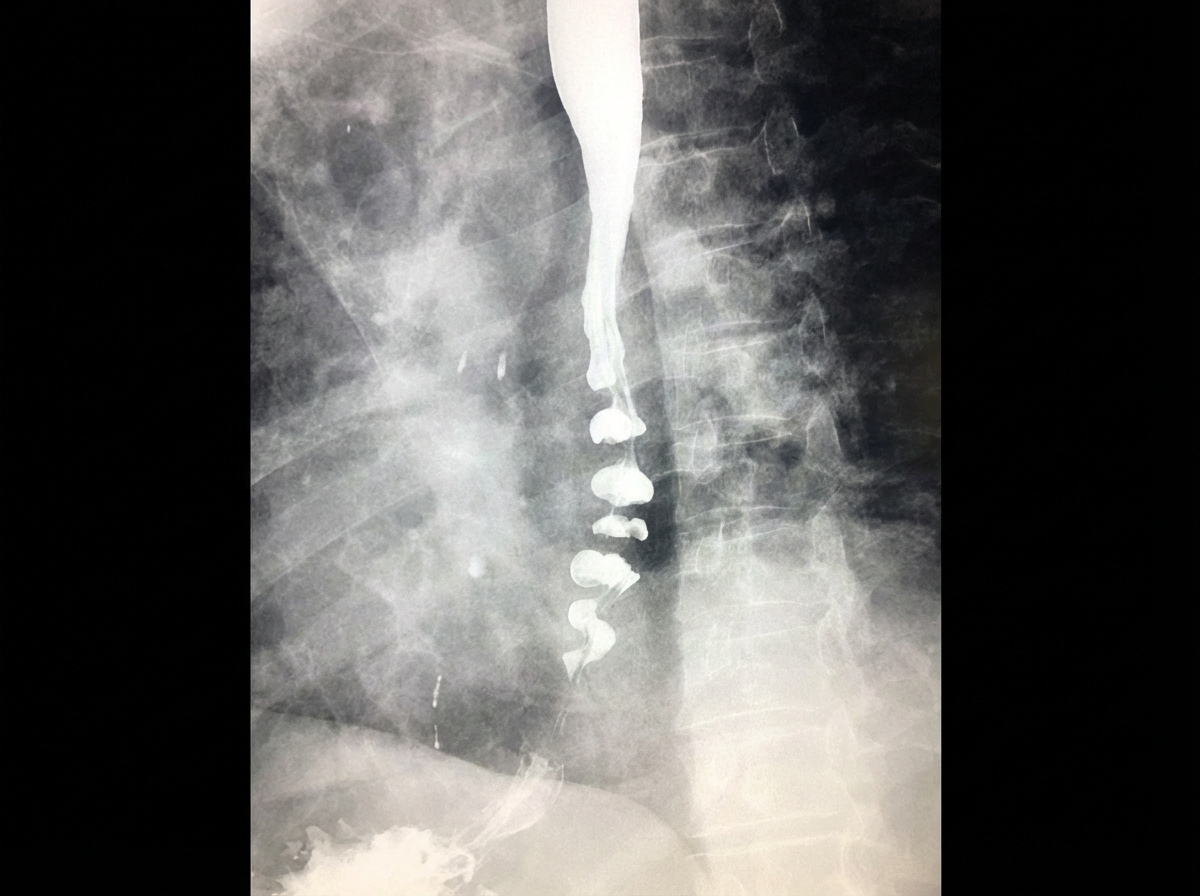
A 64-year-old Caucasian male presents to the cardiologist complaining of chest pain. He describes the pain as spontaneous and radiating to his back, ears, and neck. He denies dyspnea on exertion. The patient is referred for an upper GI barium swallow, shown in image A. Which of the following would you most expect to find during further workup of this patient?
A 55-year-old man presents to the office with a complaint of generalized pain particularly in the back. This pain is also present in his knees, elbows, and shoulders bilaterally. He has stage 4 chronic kidney disease and is on weekly hemodialysis; he is waiting for a renal transplant. On physical examination, there is peripheral pitting edema and scratch marks over the forearms and trunk. The vital signs include: blood pressure 146/88 mm Hg, pulse 84/min, temperature 36.6°C (97.9°F), and respiratory rate 9/min. Complete blood count results are as follows: Hemoglobin 11 g/dL RBC 4.5 million cells/µL Hematocrit 40% Total leukocyte count 6,500 cells/µL Neutrophil 71% Lymphocyte 34% Monocyte 4% Eosinophil 1% Basophil 0% Platelet 240,000 cells/µL Renal function test shows: Sodium 136 mEq/L Potassium 5.9 mEq/L Chloride 101 mEq/L Bicarbonate 21 mEq/L Albumin 2.8 mg/dL Urea nitrogen 31 mg/dL Creatinine 2.9 mg/dL Uric Acid 6.8 mg/dL Glucose 111 mg/dL Which of the following sets of findings would be expected in this patient in his current visit?
A 56-year-old woman presents to her physician for a routine health maintenance examination. Recently, she has felt weak, and she has dyspnea when she performs her daily exercise routine. She has no significant past medical history. She has not had any menstrual bleeding for more than 6 years. She has smoked half a pack of cigarettes for more than 20 years, and she occasionally drinks a beer or a glass of wine. She takes ibuprofen for occasional headaches, which she has had for many years. Her blood pressure is 115/60 mm Hg, pulse is 68/min, respirations are 14/min, and temperature is 36.8℃ (98.2℉). The physical examination shows no abnormalities except for conjunctival pallor. The laboratory test results are as follows: Hemoglobin 7.5 g/dL Mean corpuscular volume 75 μm³ Leukocyte count 5500/mm³ (with a normal differential) Platelet 520,000/mm³ Reticulocyte count 9% Serum iron 30 μg/dL (50–170 μg/dL) Ferritin 4 μg/L (12–150 μg/L) Total iron-binding capacity 450 μg/dL The peripheral blood smear shows microcytic, hypochromic red blood cells with occasional polychromatophilic cells. Which of the following is the most appropriate next step in evaluation?
A 40-year-old man comes to the physician because of lower back pain that has become progressively worse over the past 2 months. The pain is also present at night and does not improve if he changes his position. He has stiffness for at least 1 hour each morning that improves throughout the day. Over the past 3 months, he has had 3 episodes of acute gout and was started on allopurinol. His vital signs are within normal limits. Physical examination shows reduced lumbar flexion and tenderness over the sacroiliac joints. Passive flexion of the hip with the knee extended does not elicit pain on either side. Muscle strength and sensation to pinprick and light touch are normal. A pelvic x-ray confirms the diagnosis. The patient is started on indomethacin and an exercise program. Six weeks later, the patient reports no improvement in symptoms. Before initiating further pharmacotherapy, which of the following is the most appropriate next step in management of this patient?
A 70-year-old man is admitted with fever, chills, and rigor which have lasted for 4 days. He also complains of associated recent-onset fatigue. Past medical history is insignificant. He drinks a can of beer every night. His temperature is 39.0°C (102.2°F), pulse is 120/min, blood pressure is 122/80 mm Hg, and respirations are 14/min. Physical examination reveals splinter hemorrhages in the fingernails, and a 2/6 apical pansystolic murmur is heard which was not present during his last visit a month ago. A transoesophageal echocardiogram shows evidence of vegetations over the mitral valve. Blood cultures are taken from 3 different sites, which reveal the growth of Streptococcus gallolyticus. The patient is started on the appropriate antibiotic therapy which results in rapid clinical improvement. Which of the following would be the best next step in management in this patient after he is discharged?
A 33-year-old man comes to the physician 1 hour after he slipped in the shower and fell on his back. Since the event, he has had severe neck pain. He rates the pain as an 8–9 out of 10. On questioning, he has had lower back pain for the past 2 years that radiates to the buttocks bilaterally. He reports that the pain sometimes awakens him at night and that it is worse in the morning or when he has been resting for a while. His back is very stiff in the morning and he is able to move normally only after taking a hot shower. His temperature is 36.3°C (97.3°F), pulse is 94/min, and blood pressure is 145/98 mm Hg. Range of motion of the neck is limited due to pain; the lumbar spine has a decreased range of motion. There is tenderness over the sacroiliac joints. Neurologic examination shows no abnormalities. An x-ray of the cervical spine shows decreased bone density of the vertebrae. An MRI shows a C2 vertebral fracture as well as erosions and sclerosis of the sacroiliac joints bilaterally. The patient's condition is most likely associated with which of the following findings?
Two days after undergoing emergent laparotomy with splenectomy for a grade IV splenic laceration sustained in a motor vehicle collision, a 54-year-old man develops decreased urinary output. His urine output is < 350 mL/day despite aggressive fluid resuscitation. During the emergent laparotomy, he required three units of packed RBCs. He has type 2 diabetes mellitus and is on an insulin sliding scale. His vital signs are within normal limits. Physical examination shows a healing surgical incision in the upper abdomen and multiple large ecchymoses of the superior right and left abdominal wall. His hematocrit is 28%, platelet count is 400,000/mm3, serum creatinine is 3.9 mg/dL, and serum urea nitrogen concentration is 29 mg/dL. Urinalysis shows brown granular casts. Which of the following is the most likely underlying cause of these findings?
A 32-year-old man recently visiting from Thailand presents with diarrhea and fatigue for the past 6 days, which began before leaving Thailand. The patient denies any recent history of laxatives, nausea, or vomiting. His vital signs include: blood pressure 80/50 mm Hg, heart rate 105/min, and temperature 37.7°C (99.8°F). On physical examination, the patient is pale with dry mucous membranes. A stool sample is obtained for culture, which is copious and appears watery. Which of the following is the correct categorization of this diarrheal disease?
A 72-year-old woman presents to her primary care provider complaining of fatigue for the last 6 months. She can barely complete her morning chores before having to take a long break in her chair. She rarely climbs the stairs to the second floor of her house anymore because it is too tiring. Past medical history is significant for Hashimoto's thyroiditis, hypertension, and hyperlipidemia. She takes levothyroxine, chlorthalidone, and atorvastatin. Her daughter developed systemic lupus erythematosus. She is retired and lives by herself in an old house built in 1945 and does not smoke and only occasionally drinks alcohol. She eats a well-balanced diet with oatmeal in the morning and some protein such as a hardboiled egg in the afternoon and at dinner. Today, her blood pressure is 135/92 mm Hg, heart rate is 110/min, respiratory rate is 22/min, and temperature is 37.0°C (98.6°F). On physical exam, she appears frail and her conjunctiva are pale. Her heart is tachycardic with a regular rhythm and her lungs are clear to auscultation bilaterally. A complete blood count (CBC) shows that she has macrocytic anemia. Peripheral blood smear shows a decreased red blood cell count, anisocytosis, and poikilocytosis with occasional hypersegmented neutrophils. An endoscopy and colonoscopy are performed to rule out an occult GI bleed. Her colonoscopy was normal. Endoscopy shows thin and smooth gastric mucosa without rugae. Which of the following is the most likely cause of this patient's condition?
A 49-year-old man presents to his primary care physician complaining of heartburn and mild epigastric pain after eating for the past 6 months. He reports that his symptoms occur within an hour of eating a meal and persist for approximately an hour. He admits his symptoms have been progressively worsening. He recently began having these symptoms when he lies in the supine position. He has tried eating smaller meals and avoiding spicy food to no avail. He denies vomiting, difficulty swallowing, recent weight loss, or changes in stool color. He does admit to having a "sour" taste in his mouth when symptomatic. His temperature is 99.0°F (37.2°C), blood pressure is 149/82 mmHg, pulse is 86/min, respirations are 18/min, and BMI is 32 kg/m^2. His abdomen is soft, non-tender, and bowel sounds are auscultated in all quadrants. Laboratory results demonstrate the following: Serum: Hemoglobin: 13.5 g/dL Hematocrit: 41% Leukocyte count: 4,500/mm^3 with normal differential Platelet count: 257,000/mm^3 Fecal occult blood test (FOBT): Negative Which of the following is the next best step in management?
Practice by Chapter
GERD and esophageal disorders
Practice Questions
Peptic ulcer disease
Practice Questions
Helicobacter pylori infection
Practice Questions
Celiac disease
Practice Questions
Irritable bowel syndrome
Practice Questions
Diverticular disease
Practice Questions
GI bleeding (upper and lower)
Practice Questions
Small intestinal bacterial overgrowth
Practice Questions
Malabsorption syndromes
Practice Questions
Colorectal cancer screening
Practice Questions
Functional GI disorders
Practice Questions
Anorectal disorders
Practice Questions
GI motility disorders
Practice Questions
Want unlimited practice?
Get full access to all questions, explanations, and performance tracking.
Scan to download app