
Sudden cardiac death — MCQs

A previously healthy 19-year-old man is brought to the emergency department by his girlfriend after briefly losing consciousness. He passed out while moving furniture into her apartment. She said that he was unresponsive for a minute but regained consciousness and was not confused. The patient did not have any chest pain, palpitations, or difficulty breathing before or after the episode. He has had episodes of dizziness when exercising at the gym. His blood pressure is 125/75 mm Hg while supine and 120/70 mm Hg while standing. Pulse is 70/min while supine and 75/min while standing. On examination, there is a grade 3/6 systolic murmur at the left lower sternal border and a systolic murmur at the apex, both of which disappear with passive leg elevation. Which of the following is the most likely cause?
A 16-year-old male presents to the cardiologist after passing out during a basketball practice. An echocardiogram confirmed the diagnosis of hypertrophic cardiomyopathy. The cardiologist advises that a pacemaker must be implanted to prevent any further complications and states the player cannot play basketball anymore. Unfortunately, the coach objects to sidelining the player since a big game against their rivals is next week. The coach asks if the pacemaker can be implanted after the game, which of the following steps should the physician take?
A previously healthy 20-year-old man is brought to the emergency department 15 minutes after collapsing while playing basketball. He has no history of serious illness. On arrival, there is no palpable pulse or respiratory effort observed. He is declared dead. The family agrees to an autopsy. Cardiac workup prior to this patient's death would most likely have shown which of the following findings?
One week after an aortic valve replacement surgery, a 55-year-old man is brought to the emergency room 30 minutes after the onset of severe, sharp chest pain. He appears pale and dyspneic but is alert, oriented, and speaks in full sentences. His temperature is 38°C (100.4°F), pulse is 192/min and thready, respirations are 22/min, and blood pressure is 80/50 mm Hg. Faint rales can be heard in the lower lung fields on both sides on auscultation. There is a midline thoracotomy scar with mild reddening but without warmth or discharge. A portion of an ECG is shown. The pattern remains unchanged after 1 minute. Which of the following is the most appropriate intervention?
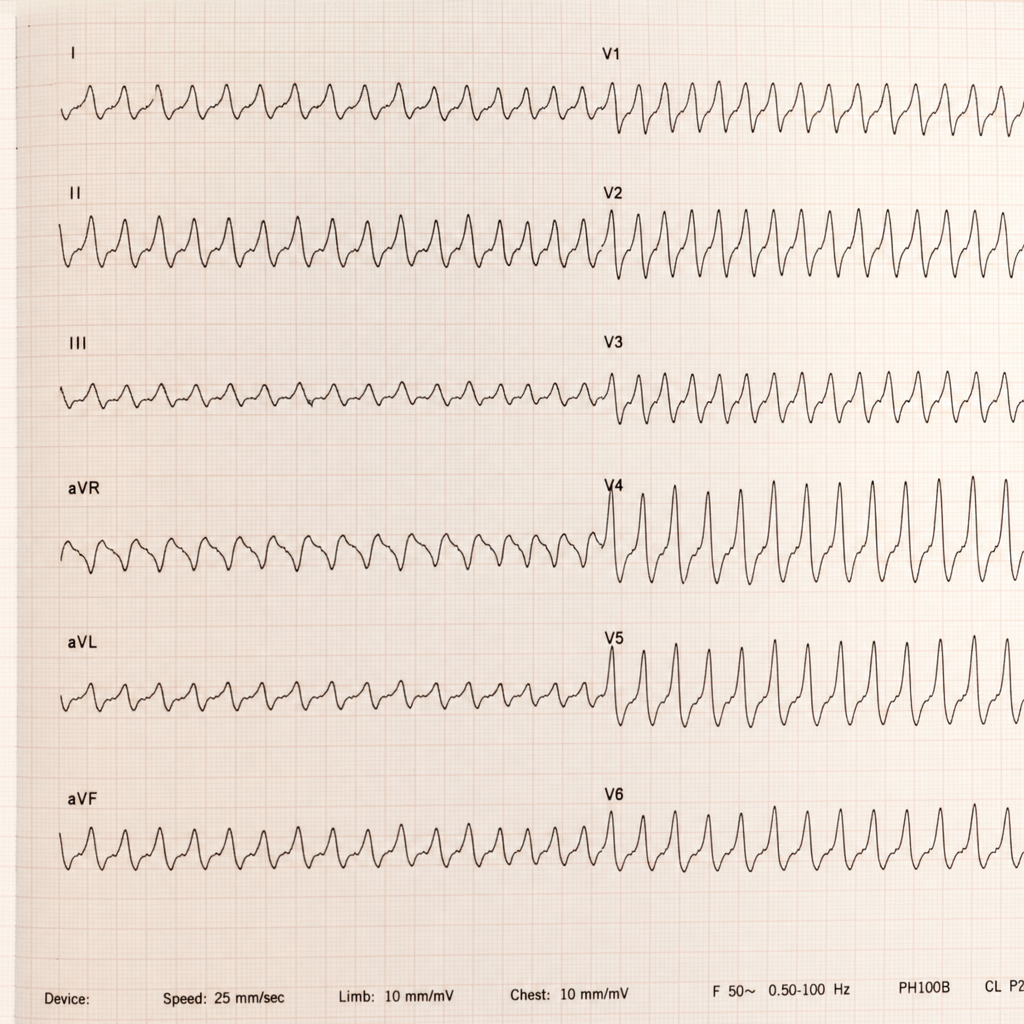
A 19-year-old woman is brought to the emergency department by ambulance 30 minutes after her neighbor found her unconscious on a running trail. Her neighbor reports that she has been training for a marathon since the beginning of the summer. She is alert and oriented but becomes irritable when realizing that she is at a hospital and refuses to answer questions. She appears tired. She is 174 cm (5 ft 7 in) tall and weighs 51 kg (112 lb). Her temperature is 35.5°C (96°F), pulse is 44/min, respirations are 20/min, and blood pressure is 84/48 mm Hg. Examination shows dry, scaly skin and dry mucous membranes. Cardiopulmonary examination shows a high-frequency, mid-to-late systolic murmur that is heard best at the apex. Her hemoglobin concentration is 11.9 g/dL. Which of the following is the most likely diagnosis?
You are the team physician for an NBA basketball team. On the morning of an important playoff game, an EKG of a star player, Mr. P, shows findings suspicious for hypertrophic cardiomyopathy (HCM). Mr. P is an otherwise healthy, fit, professional athlete. The playoff game that night is the most important of Mr. P's career. When you inform the coach that you are thinking of restricting Mr. P's participation, he threatens to fire you. Later that day you receive a phone call from the owner of the team threatening a lawsuit should you restrict Mr. P's ability to play. Mr. P states that he will be playing in the game "if it's the last thing I do." Which of the following is the most appropriate next step?
A 72-year-old man is taken to the emergency room after losing consciousness. According to his wife, he suddenly complained of fluttering in his chest, lightheadedness, and profuse sweating while walking to the grocery store. He then turned gray, lost consciousness, and collapsed onto the ground. His medical history is significant for a prior anterior wall myocardial infarction 2 years ago that was complicated by severe left ventricular systolic dysfunction. His blood pressure is 80/50 mm Hg, the temperature is 36.7°C (98.0°F), and the carotid pulse is not palpable. An ECG was obtained and the results are shown in the picture. Cardiopulmonary resuscitation is initiated and the patient is cardioverted to sinus rhythm with an external defibrillator. The patient regains consciousness and states there was no antecedent chest discomfort. Cardiac enzymes are negative and serum electrolytes are normal. Which of the following is the best next step for this patient?
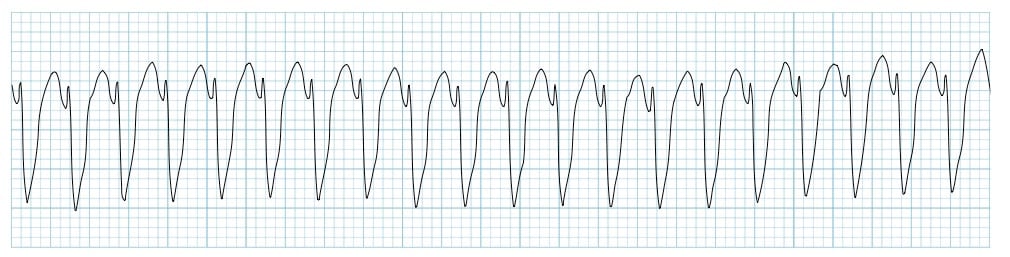
A 22-year-old woman presents to the emergency department feeling lightheaded and states that her heart is racing. She does not have a history of any chronic medical conditions. She is a college sophomore and plays club volleyball. Although she feels stressed about her upcoming final exams next week, she limits her caffeine intake to 3 cups of coffee per day to get a good night sleep. She notes that her brother takes medication for some type of heart condition, but she does not know the name of it. Both her parents are alive and well. She denies recent illness, injuries, or use of cigarettes, alcohol, or recreational drugs. The pertinent negatives from the review of systems include an absence of fever, nausea, vomiting, sweating, fatigue, or change in bowel habits. The vital signs include: temperature 36.8°C (98.2°F), heart rate 125/min, respiratory rate 15/min, blood pressure 90/75 mm Hg, and oxygen saturation of 100% on room air. The laboratory results are within normal limits. The ECG is significant for a shortened PR interval and widened QRS. Which of the following medications should the patient avoid in this scenario?
A previously healthy 21-year-old man is brought to the emergency department for the evaluation of an episode of unconsciousness that suddenly happened while playing football 30 minutes ago. He was not shaking and regained consciousness after about 30 seconds. Over the past three months, the patient has had several episodes of shortness of breath while exercising as well as sensations of a racing heart. He does not smoke or drink alcohol. He takes no medications. His vital signs are within normal limits. On mental status examination, he is oriented to person, place, and time. Cardiac examination shows a systolic ejection murmur that increases with valsalva maneuver and standing and an S4 gallop. The remainder of the examination shows no abnormalities. An ECG shows a deep S wave in lead V1 and tall R waves in leads V5 and V6. Echocardiography is most likely to show which of the following findings?
A 55-year-old man with a past medical history of obesity and hyperlipidemia suddenly develops left-sided chest pain and shortness of breath while at work. He relays to coworkers that the pain is intense and has spread to his upper left arm over the past 10 minutes. He reports it feels a lot like the “heart attack” he had a year ago. He suddenly collapses and is unresponsive. Coworkers perform cardiopulmonary resuscitation for 18 minutes until emergency medical services arrives. Paramedics pronounce him dead at the scene. Which of the following is the most likely cause of death in this man?
Want unlimited practice?
Get full access to all questions, explanations, and performance tracking.
Scan to download app