
Red flags in neurological complaints — MCQs

A 58-year-old woman is brought to the emergency room by her husband complaining, “I can’t see out of my right eye.” She was watching television last night when she covered her left eye due to an itch and discovered that she could not see. The patient denies any precipitating event, pain, swelling, flashes, floaters, or headaches. Her past medical history is significant for uncontrolled hypertension and angina. Her medications include hydrochlorothiazide, lisinopril, atorvastatin, and nitroglycerin as needed. Her physical examination is unremarkable. Fundus examination demonstrates generalized pallor and slight disc edema with no hemorrhages. What is the most likely explanation for this patient’s symptoms?
A 67-year-old man presents to the emergency department for a headache. The patient states his symptoms started thirty minutes ago. He states he experienced a sudden and severe headache while painting his house, causing him to fall off the ladder and hit his head. He has also experienced two episodes of vomiting and difficulty walking since the fall. The patient has a past medical history of hypertension, obesity, and atrial fibrillation. His current medications include lisinopril, rivaroxaban, atorvastatin, and metformin. His temperature is 99.5°F (37.5°C), blood pressure is 150/105 mmHg, pulse is 90/min, respirations are 15/min, and oxygen saturation is 98% on room air. On physical exam, the patient localizes his headache to the back of his head. Cardiac exam reveals a normal rate and rhythm. Pulmonary exam reveals minor bibasilar crackles. Neurological exam is notable for minor weakness of the muscles of facial expression. Examination of cranial nerve three reveals a notable nystagmus. Heel to shin exam is abnormal bilaterally. The patient's gait is notably ataxic. A non-contrast CT scan of the head is currently pending. Which of the following is the most likely diagnosis?
A 25-year-old male patient presents to your clinic in significant distress. He states he has excruciating, stabbing pain around the left side of his head, and his left eye will not stop tearing. These types of headaches have been occurring for the past week every morning when he awakens and last around 60 minutes. He denies any aura, nausea, or vomiting. He denies any other past medical history. What is this patient's diagnosis?
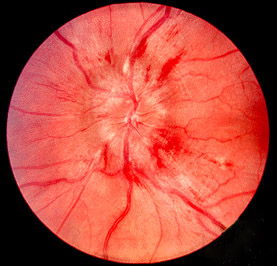
A 72-year-old woman comes to the emergency department 1 hour after the sudden onset of a diffuse, dull, throbbing headache. She also reports blurred vision, nausea, and one episode of vomiting. She has a history of poorly controlled hypertension. A photograph of her fundoscopic examination is shown. Which of the following is the most likely underlying cause of this patient's symptoms?
A 73-year-old man noted a rapid onset of severe dizziness and difficulty swallowing while watching TV at home. His wife reports that he had difficulty forming sentences and his gait was unsteady at this time. Symptoms were severe within 1 minute and began to improve spontaneously after 10 minutes. He has had type 2 diabetes mellitus for 25 years and has a 50 pack-year smoking history. On arrival to the emergency department 35 minutes after the initial development of symptoms, his manifestations have largely resolved with the exception of a subtle nystagmus and ataxia. His blood pressure is 132/86 mm Hg, the heart rate is 84/min, and the respiratory rate is 15/min. After 45 minutes, his symptoms are completely resolved, and neurological examination is unremarkable. Which of the following is the most likely cause of this patient’s condition?
A 69-year-old male presents to the emergency room with back pain. He has a history of personality disorder and metastatic prostate cancer and was not a candidate for surgical resection. He began chemotherapy but discontinued due to unremitting nausea. He denies any bowel or bladder incontinence. He has never had pain like this before and is demanding morphine. The nurse administers IV morphine and he feels more comfortable. Vital signs are stable. On physical examination you note tenderness to palpation along the lower spine, weakness in the bilateral lower extremities, left greater than right. Neurological examination is also notable for hyporeflexia in the knee and ankle jerks bilaterally. You conduct a rectal examination, which reveals saddle anesthesia. Regarding this patient, what is the most likely diagnosis and the appropriate next step in management?
A 56-year-old woman presents with sudden-onset severe headache, nausea, vomiting, and neck pain for the past 90 minutes. She describes her headache as a ‘thunderclap’, followed quickly by severe neck pain and stiffness, nausea and vomiting. She denies any loss of consciousness, seizure, or similar symptoms in the past. Her past medical history is significant for an episode 6 months ago where she suddenly had trouble putting weight on her right leg, which resolved within hours. The patient denies any history of smoking, alcohol or recreational drug use. On physical examination, the patient has significant nuchal rigidity. Her muscle strength in the lower extremities is 4/5 on the right and 5/5 on the left. The remainder of the physical examination is unremarkable. A noncontrast CT scan of the head is normal. Which of the following is the next best step in the management of this patient?
A 78-year-old woman with a history of cerebrovascular accident (CVA) presents to the emergency department with slurred speech, diplopia and dizziness that has persisted for eight hours. Upon further questioning you find that since her CVA one year ago, she has struggled with depression and poor nutrition. Her dose of paroxetine has been recently increased. Additionally, she is on anti-seizure prophylaxis due to sequelae from her CVA. CT scan reveals an old infarct with no acute pathology. Vital signs are within normal limits. On physical exam you find the patient appears frail. She is confused and has nystagmus and an ataxic gait. What would be an appropriate next step?
A 75-year-old woman presents with sudden loss of vision. She says that she was reading when suddenly she was not able to see the print on half of the page. Her symptoms started 4 hours ago and are accompanied by a severe posterior headache. Vital signs reveal the following: blood pressure 119/76 mm Hg, pulse 89/min, SpO2 98% on room air. The patient was unable to recognize her niece when she arrived to see her. A noncontrast CT of the head shows no evidence of hemorrhagic stroke. What is the most likely diagnosis in this patient?
A previously healthy 40-year-old woman comes to the physician because of a 3-day history of fever, headaches, and fatigue. She also reports a persistent tingling sensation in her right hand and numbness in her right arm that started this morning. Physical examination shows pallor, mild scleral icterus, and petechiae on her forearms and legs. On mental status examination, she appears confused and is only oriented to person. Laboratory studies show: Hemoglobin 11.1 g/dL Platelet count 39,500/mm3 Bleeding time 9 minutes Prothrombin time 14 seconds Partial thromboplastin time 35 seconds Serum Creatinine 1.7 mg/dL Total bilirubin 2.1 mg/dL A peripheral blood smear shows fragmented erythrocytes. Which of the following is the most likely underlying cause of this patient's condition?
Want unlimited practice?
Get full access to all questions, explanations, and performance tracking.
Scan to download app