
Syndrome recognition — MCQs

A 66-year old man with a 45-pack-year smoking history presents with abdominal pain and constipation. He reports that he has had a worsening cough for several months and has lost 20 pounds over this time period. You order a complete metabolic profile, which demonstrates hypercalcemia. A chest radiograph shows a centrally located mass suspicious for malignancy. Which of the following is the most likely explanation?
A 24-year-old man presents with a complaint of breathlessness while jogging. He says that he recently started marathon training. He does not have any family history of asthma nor has any allergies. He currently takes no medication. The blood pressure is 120/80 mm Hg, and the heart rate is 67/min. With each heartbeat, he experiences pounding in his chest, and his head bobs. On physical examination, he has long fingers, funnel chest, and disproportionate body proportions with a decreased upper-to-lower segment ratio. On auscultation over the 2nd right intercostal space, an early diastolic murmur is heard, and 3rd and 4th heart sounds are heard. Echocardiography shows aortic root dilatation. The patient is scheduled for surgery. Which of the following is associated with this patient's condition?
A 2720-g (6-lb) female newborn is delivered at term to a 39-year-old woman, gravida 3, para 2. Examination in the delivery room shows micrognathia, prominent occiput with flattened nasal bridge, and pointy low-set ears. The eyes are upward slanting with small palpebral fissures. The fists are clenched with fingers tightly flexed. The index finger overlaps the third finger and the fifth finger overlaps the fourth. A 3/6 holosystolic murmur is heard at the lower left sternal border. The nipples are widely spaced and the feet have prominent heels and convex, rounded soles. Which of the following is the most likely cause of these findings?
A 68-year-old man presents to his primary care provider after noticing that his urine has been pink for the last week. He does not have any pain with urination, nor has he had any associated fevers or infections. On his review of systems, the patient notes that he thinks he has lost some weight since his belt is looser, and he has also had occasional dull pressure in his back for the past two months. His temperature is 98.8°F (37.1°C), blood pressure is 132/90 mmHg, pulse is 64/min, and respirations are 12/min. The patient weighs 210 lbs (95.3 kg, BMI 31.9 kg/m²), compared to his weight of 228 lbs (103.4 kg, BMI 34.7 kg/m²) at his last visit 2 years prior. On exam, the patient does not have any back or costovertebral angle tenderness. On abdominal palpation, a firm mass can be appreciated deep in the left abdomen. Given the suspected diagnosis, the clinical workup should also assess for which of the following paraneoplastic syndromes?
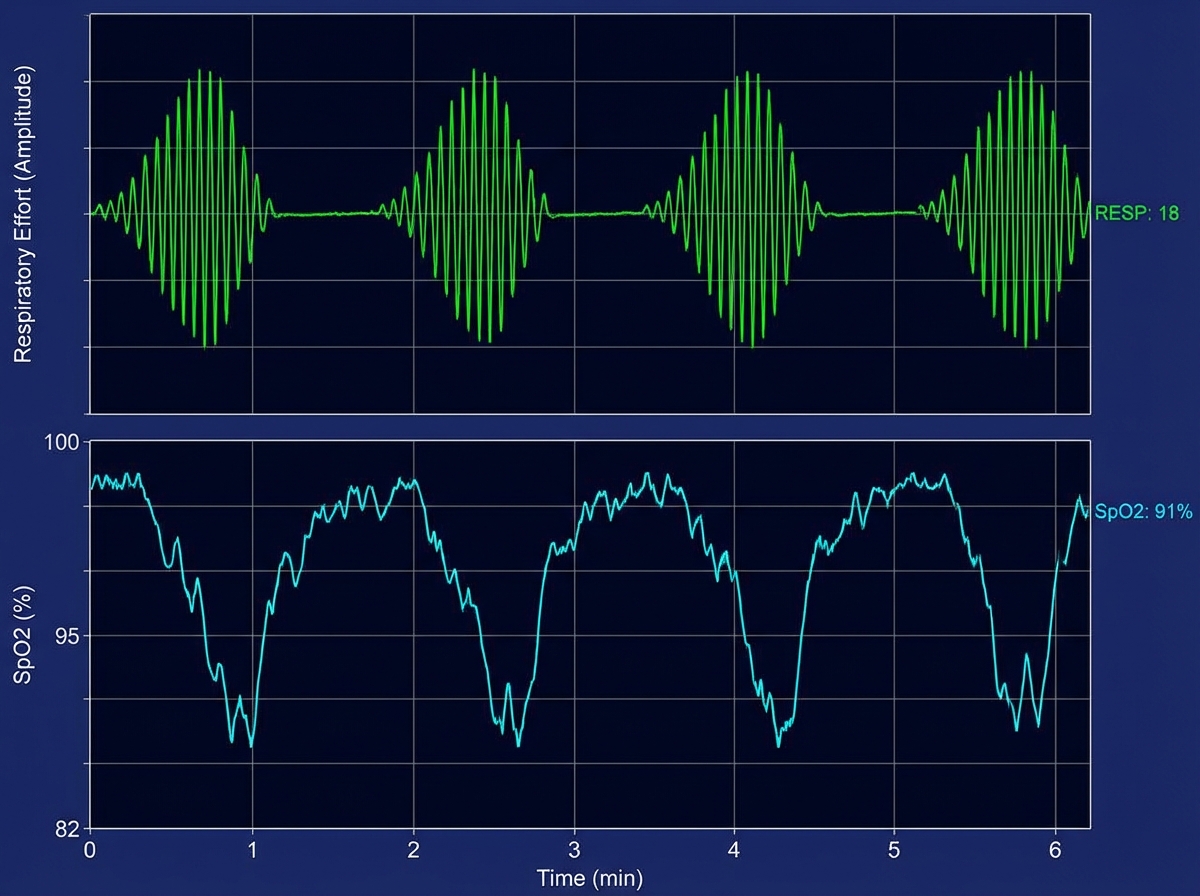
A 66-year-old man is brought to the emergency department because of shortness of breath and confusion. His pulse is 98/min, and blood pressure is 109/73 mm Hg. He is oriented to person but not time or place. A graph of his breathing pattern and oxygen saturation is shown. Which of the following additional findings is most likely present in this patient?
A 65-year-old man presents to the emergency department for sudden weakness. The patient states that he was at home enjoying his morning coffee when his symptoms began. He says that his left arm suddenly felt very odd and weak thus prompting him to come to the ED. The patient has a past medical history of diabetes, COPD, hypertension, anxiety, alcohol abuse, and PTSD. He recently fell off a horse while horseback riding but claims to not have experienced any significant injuries. He typically drinks 5-7 drinks per day and his last drink was yesterday afternoon. His current medications include insulin, metformin, atorvastatin, lisinopril, albuterol, and fluoxetine. His temperature is 99.5°F (37.5°C), blood pressure is 177/118 mmHg, pulse is 120/min, respirations are 18/min, and oxygen saturation is 93% on room air. On physical exam, you note an elderly man who is mildly confused. Cardiopulmonary exam demonstrates bilateral expiratory wheezes and a systolic murmur along the right upper sternal border that radiates to the carotids. Neurological exam reveals cranial nerves II-XII as grossly intact with finger-nose exam mildly abnormal on the left and heel-shin exam within normal limits. The patient has 5/5 strength in his right arm and 3/5 strength in his left arm. The patient struggles to manipulate objects such as a pen with his left hand. The patient is given a dose of diazepam and started on IV fluids. Which of the following is the most likely diagnosis in this patient?
A 75-year-old gentleman is brought to the ED with confusion that started earlier this morning. His family notes that he was complaining of feeling weak last night and also had a slight tremor at the time. He is afebrile and he has no known chronic medical conditions. Physical exam reveals a cooperative but confused gentleman. His mucous membranes are moist, he has no focal neurological deficits, and his skin turgor is within normal limits. His lab results are notable for: Serum Na+: 123 mEq/L Plasma osmolality: 268 mOsm/kg Urine osmolality: 349 mOsm/kg Urine Na+: 47 mEq/L Which of the following malignancies is most likely to be responsible for this patient's presentation?
A 9-year-old boy is brought to the physician because his parents are concerned that he has been unable to keep up with his classmates at school. He is at the 4th percentile for height and at the 15th percentile for weight. Physical examination shows dysmorphic facial features. Psychologic testing shows impaired intellectual and adaptive functions. Genetic analysis shows a deletion of the long arm of chromosome 7. Which of the following is the most likely additional finding in this patient?
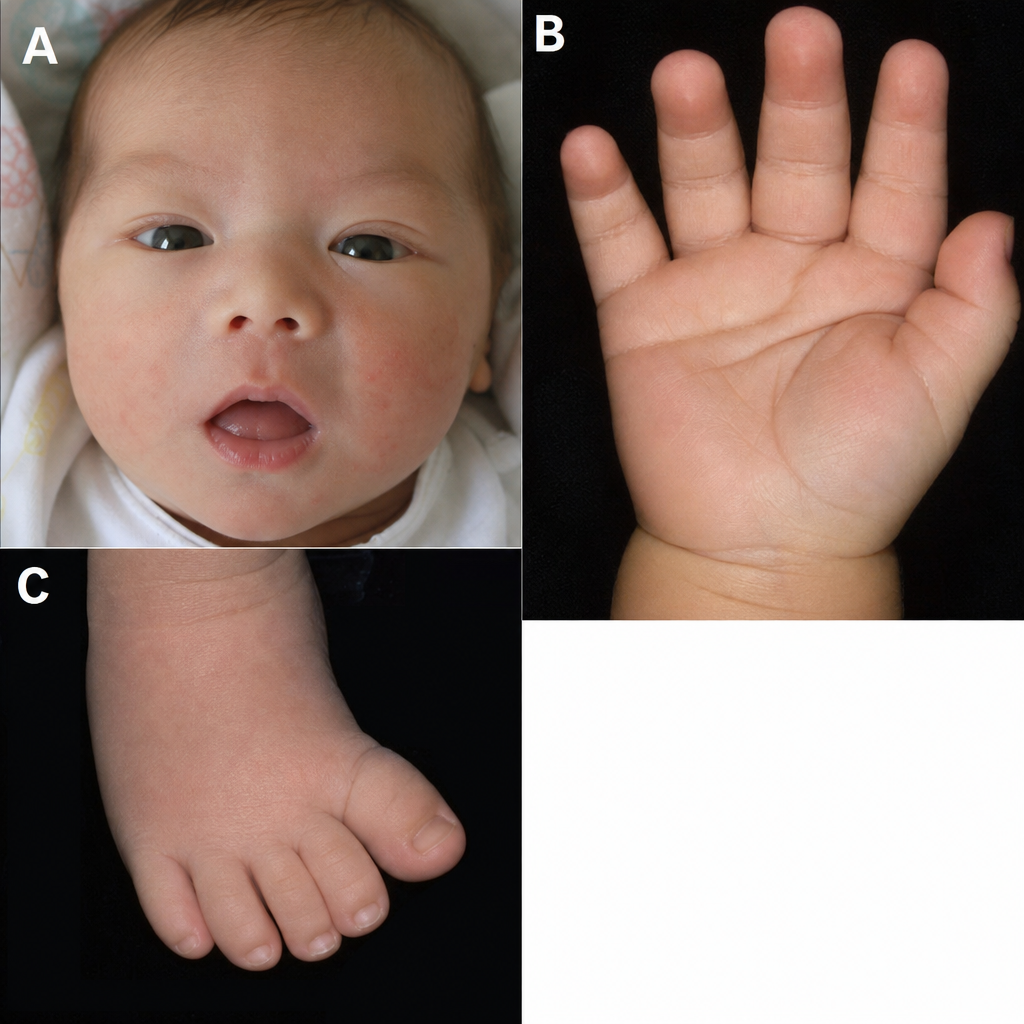
You are called to evaluate a newborn. The patient was born yesterday to a 39-year-old mother. You observe the findings illustrated in Figures A-C. What is the most likely mechanism responsible for these findings?
A 28-year-old male presents to his primary care physician with complaints of intermittent abdominal pain and alternating bouts of constipation and diarrhea. His medical chart is not significant for any past medical problems or prior surgeries. He is not prescribed any current medications. Which of the following questions would be the most useful next question in eliciting further history from this patient?
Want unlimited practice?
Get full access to all questions, explanations, and performance tracking.
Scan to download app