
Symptom-based differential diagnosis approach — MCQs

A 55-year-old man with a past medical history of obesity and hyperlipidemia suddenly develops left-sided chest pain and shortness of breath while at work. He relays to coworkers that the pain is intense and has spread to his upper left arm over the past 10 minutes. He reports it feels a lot like the “heart attack” he had a year ago. He suddenly collapses and is unresponsive. Coworkers perform cardiopulmonary resuscitation for 18 minutes until emergency medical services arrives. Paramedics pronounce him dead at the scene. Which of the following is the most likely cause of death in this man?
A 16-year-old boy presents to the emergency department with abdominal pain and tenderness. The pain began approximately 2 days ago in the area just above his umbilicus and was crampy in nature. Earlier this morning, the pain moved laterally to his right lower abdomen. At that time, the pain in the right lower quadrant became severe and constant and woke him up from sleep. He decided to come to the hospital. The patient is nauseous and had a low-grade fever of 37.8°C (100.1°F). Other vitals are normal. Upon physical examination, the patient has rebound tenderness but a negative psoas sign while the remaining areas of his abdomen are non-tender. His rectal exam is normal. Laboratory tests show a white cell count of 15,000/mm3. Urinalysis and other laboratory findings were negative. What conclusion can be drawn about the nerves involved in the transmission of this patient’s pain during the physical exam?
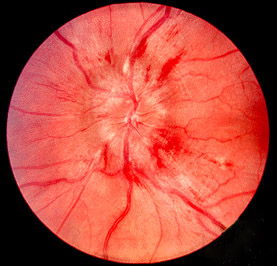
A 72-year-old woman comes to the emergency department 1 hour after the sudden onset of a diffuse, dull, throbbing headache. She also reports blurred vision, nausea, and one episode of vomiting. She has a history of poorly controlled hypertension. A photograph of her fundoscopic examination is shown. Which of the following is the most likely underlying cause of this patient's symptoms?
A 75-year-old woman presents to her primary care physician with her son because she is convinced that people are stealing from her. Her son claims she has been misplacing her medications and money throughout the house. She recently lost her husband to old age and has become reclusive and no longer wants people to visit. Physical examination is unremarkable and the patient is oriented to person, time, and place. A mini-mental status examination (MMSE) is performed and she has difficulty recalling words after 5 minutes and also has problems with serial subtraction. Which of the following is the most likely diagnosis in this patient?
A 72-year-old woman comes to the emergency department 4 hours after the sudden onset of a diffuse, dull, throbbing headache. During this time, she also reports blurred vision, nausea, and one episode of vomiting. She has a history of hypertension and type 2 diabetes mellitus. Her medications include hydrochlorothiazide, lisinopril, atorvastatin, and metformin. She has smoked 1 pack of cigarettes daily for the past 30 years and drinks 1–2 glasses of wine per day. Her temperature is 36.6 °C (97.9 °F), pulse is 90/min, respirations are 14/min, and blood pressure is 185/110 mm Hg. Fundoscopic examination shows bilateral blurring of the optic disc margins. Physical and neurologic examinations show no other abnormalities. A complete blood count and serum concentrations of electrolytes, urea nitrogen, and creatinine are within the reference range. Urinalysis shows 2+ protein but no WBCs or RBCs. Which of the following is the most likely diagnosis?
A 28-year-old male presents to his primary care physician with complaints of intermittent abdominal pain and alternating bouts of constipation and diarrhea. His medical chart is not significant for any past medical problems or prior surgeries. He is not prescribed any current medications. Which of the following questions would be the most useful next question in eliciting further history from this patient?
A 55-year-old woman presents to the emergency department with retrosternal pain that started this evening. The patient states that her symptoms started as she was going to bed after taking her medications. She describes the pain as sudden in onset, worse with swallowing, and not associated with exertion. The patient has a past medical history of diabetes, anemia, and congestive heart failure and is currently taking metoprolol, insulin, metformin, iron, and lisinopril. Her temperature is 99.2°F (37.3°C), blood pressure is 125/63 mmHg, pulse is 90/min, respirations are 14/min, and oxygen saturation is 100% on room air. Physical exam is notable for an obese woman who appears uncomfortable. An initial electrocardiogram (ECG) demonstrates sinus rhythm, and a set of troponins are pending. Which of the following is the most likely diagnosis?
A 43-year-old woman presents to the neurology clinic in significant pain. She reports a sharp, stabbing electric-like pain on the right side of her face. The pain started suddenly 2 weeks ago. The pain is so excruciating that she can no longer laugh, speak, or eat her meals as these activities cause episodes of pain. She had to miss work last week as a result. Her attacks last about 3 minutes and go away when she goes to sleep. She typically has 2–3 attacks per day now. The vital signs include: blood pressure 132/84 mm Hg, heart rate 79/min, and respiratory rate 14/min. A neurological examination shows no loss of crude touch, tactile touch, or pain sensations on the right side of the face. The pupillary light and accommodation reflexes are normal. There is no drooping of her mouth, ptosis, or anhidrosis noted. Which of the following is the most likely diagnosis?
A previously healthy 33-year-old woman comes to the physician because of pain and sometimes numbness in her right thigh for the past 2 months. She reports that her symptoms are worse when walking or standing and are better while sitting. Three months ago, she started going to a fitness class a couple times a week. She is 163 cm (5 ft 4 in) tall and weighs 88 kg (194 lb); BMI is 33.1 kg/m2. Her vital signs are within normal limits. Examination of the skin shows no abnormalities. Sensation to light touch is decreased over the lateral aspect of the right anterior thigh. Muscle strength is normal. Tapping the right inguinal ligament leads to increased numbness of the affected thigh. The straight leg test is negative. Which of the following is the most appropriate next step in management of this patient?
A 27-year-old woman presents to her primary care physician for minor aches and pains in her bones and muscles. She states that these symptoms have persisted throughout her entire life but have worsened recently when she moved to attend college. The patient is physically active, and states that she eats a balanced diet. She is currently a full-time student and is sexually active with 1 partner. She states that she has been particularly stressed lately studying for final exams and occasionally experiences diarrhea. She has been taking acyclovir for a dermatologic herpes simplex virus infection with minimal improvement. On physical exam, the patient exhibits 4/5 strength in her upper and lower extremities, and diffuse tenderness over her limbs that is non-specific. Laboratory values are ordered as seen below: Serum: Na+: 144 mEq/L Cl-: 102 mEq/L K+: 4.7 mEq/L HCO3-: 24 mEq/L Ca2+: 5.0 Urea nitrogen: 15 mg/dL Glucose: 81 mg/dL Creatinine: 1.0 mg/dL Alkaline phosphatase: 225 U/L Aspartate aminotransferase (AST, GOT): 11 U/L Alanine aminotransferase (ALT, GPT): 15 U/L Which of the following is most likely associated with this patient’s presentation?
Want unlimited practice?
Get full access to all questions, explanations, and performance tracking.
Scan to download app