A 37-year-old man comes to the physician because of increasing swelling and pain of his right knee for the past month. He has not had any trauma to the knee or previous problems with his joints. He has hypertension. His only medication is hydrochlorothiazide. He works as a carpet installer. He drinks two to three beers daily. He is 170 cm (5 ft 7 in) tall and weighs 97 kg (214 lb); BMI is 33.6 kg/m2. His temperature is 37°C (98.6°F), pulse is 88/min, and blood pressure is 122/82 mm Hg. Examination of the right knee shows swelling and erythema; there is fluctuant edema over the lower part of the patella. The range of flexion is limited because of the pain. The skin over the site of his pain is not warm. There is tenderness on palpation of the patella; there is no joint line tenderness. The remainder of the examination shows no abnormalities. Which of the following is the most likely diagnosis?
Q62
A 65-year-old woman comes to the physician for the evaluation of sharp, stabbing pain in the lower back for 3 weeks. The pain radiates to the back of her right leg and is worse at night. She reports decreased sensation around her buttocks and inner thighs. During the last several days, she has had trouble urinating. Three years ago, she was diagnosed with breast cancer and was treated with lumpectomy and radiation. Her only medication is anastrozole. Her temperature is 37°C (98.6°F), pulse is 80/min, respirations are 12/min, and blood pressure is 130/70 mm Hg. Neurologic examination shows 4/5 strength in the left lower extremity and 2/5 strength in her right lower extremity. Knee and ankle reflexes are 1+ on the right. The resting anal sphincter tone is normal but the squeeze tone is reduced. Which of the following is the most likely diagnosis?
Q63
A 35-year-old male presents to his primary care physician with pain along the bottom of his foot. The patient is a long-time runner but states that the pain has been getting worse recently. He states that when running and at rest he has a burning and aching pain along the bottom of his foot that sometimes turns to numbness. Taking time off from training does not improve his symptoms. The patient has a past medical history of surgical repair of his Achilles tendon, ACL, and medial meniscus. He is currently not taking any medications. The patient lives with his wife and they both practice a vegan lifestyle. On physical exam the patient states that he is currently not experiencing any pain in his foot but rather is experiencing numbness/tingling along the plantar surface of his foot. Strength is 5/5 and reflexes are 2+ in the lower extremities. Which of the following is the most likely diagnosis?
Q64
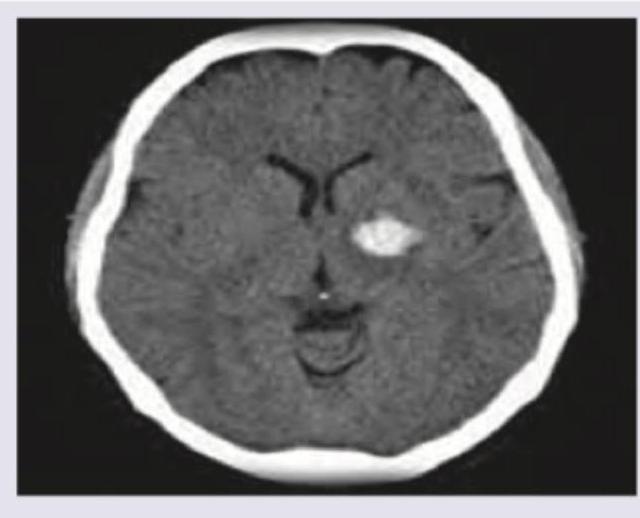
A 53-year-old man is brought to the emergency department for confusion. He was in his usual state of health until about 3 hours ago when he tried to use his sandwich to turn off the TV. He also complained to his wife that he had a severe headache. Past medical history is notable for hypertension, which has been difficult to control on multiple medications. His temperature is 36.7°C (98°F), the pulse is 70/min, and the blood pressure is 206/132 mm Hg. On physical exam he is alert and oriented only to himself, repeating over and over that his head hurts. The physical exam is otherwise unremarkable and his neurologic exam is nonfocal. The noncontrast CT scan of the patient's head is shown and reveals an acute intraparenchymal hemorrhage in the basal ganglia. Which of the following diagnostic tests would be most helpful in determining the underlying cause of this patient's hemorrhage?
Q65
A 29-year-old woman comes to the physician because of a 2-day history of intermittent dark urine and mild flank pain. She has also had a cough, sore throat, and runny nose for the past 5 days. She has not had dysuria. She takes no medications. She has no known allergies. Her temperature is 37°C (98.6°F). Examination of the back shows no costovertebral angle tenderness. Laboratory studies show:
Hemoglobin 10.4 g/dL
Leukocyte count 8,000/mm3
Platelet count 200,000/mm3
Serum
Na+ 135 mEq/L
K+ 4.9 mEq/L
Cl- 101 mEq/L
HCO3- 22 mEq/L
Urea nitrogen 18 mg/dL
Creatinine 1.1 mg/dL
Urine
Color yellow
Blood 3+
Protein 1+
Leukocyte esterase negative
An ultrasound of the kidney and bladder shows no abnormalities. Which of the following is the most likely cause of this patient's symptoms?
Q66
A 45-year-old woman presents to her primary care physician for knee pain. She states that she has been experiencing a discomfort and pain in her left knee that lasts for several hours but tends to improve with use. She takes ibuprofen occasionally which has been minimally helpful. She states that this pain is making it difficult for her to work as a cashier. Her temperature is 98.6°F (37.0°C), blood pressure is 117/58 mmHg, pulse is 90/min, respirations are 14/min, and oxygen saturation is 97% on room air. Physical exam reveals a stable gait that the patient claims causes her pain. The patient has a non-pulsatile, non-erythematous, palpable mass over the posterior aspect of her left knee that is roughly 3 to 4 cm in diameter and is hypoechoic on ultrasound. Which of the following is associated with this patient's condition?
Q67
A 43-year-old woman presents to the neurology clinic in significant pain. She reports a sharp, stabbing electric-like pain on the right side of her face. The pain started suddenly 2 weeks ago. The pain is so excruciating that she can no longer laugh, speak, or eat her meals as these activities cause episodes of pain. She had to miss work last week as a result. Her attacks last about 3 minutes and go away when she goes to sleep. She typically has 2–3 attacks per day now. The vital signs include: blood pressure 132/84 mm Hg, heart rate 79/min, and respiratory rate 14/min. A neurological examination shows no loss of crude touch, tactile touch, or pain sensations on the right side of the face. The pupillary light and accommodation reflexes are normal. There is no drooping of her mouth, ptosis, or anhidrosis noted. Which of the following is the most likely diagnosis?
Q68
A 60-year-old male is admitted to the ICU for severe hypertension complicated by a headache. The patient has a past medical history of insulin-controlled diabetes, hypertension, and hyperlipidemia. He smokes 2 packs of cigarettes per day. He states that he forgot to take his medications yesterday and started getting a headache about one hour ago. His vitals on admission are the following: blood pressure of 160/110 mmHg, pulse 95/min, temperature 98.6 deg F (37.2 deg C), and respirations 20/min. On exam, the patient has an audible abdominal bruit. After administration of antihypertensive medications, the patient has a blood pressure of 178/120 mmHg. The patient reports his headache has increased to a 10/10 pain level, that he has trouble seeing, and he can't move his extremities. After stabilizing the patient, what is the best next step to diagnose the patient's condition?
Q69
A 33-year-old man presents to his primary care physician for left-sided knee pain. The patient has a history of osteoarthritis but states that he has been unable to control his pain with escalating doses of ibuprofen and naproxen. His past medical history includes diabetes mellitus and hypertension. His temperature is 102.0°F (38.9°C), blood pressure is 167/108 mmHg, pulse is 100/min, respirations are 14/min, and oxygen saturation is 98% on room air. Physical exam reveals a warm and tender joint that is very tender to the touch and with passive range of motion. The patient declines a gait examination secondary to pain. Which of the following is the best next step in management?
Q70
A 23-year-old woman presents with a painful lesion in her mouth. She denies tooth pain, bleeding from the gums, nausea, vomiting, diarrhea, or previous episodes similar to this in the past. She states that her last normal menstrual period was 12 days ago, and she has not been sexually active since starting medical school 2 years ago. On physical examination, the patient has good dentition with no signs of infection with the exception of a solitary ulcerated lesion on the oral mucosa. The nonvesicular lesion has a clean gray-white base and is surrounded by erythema. Which of the following is correct concerning the most likely etiology of the oral lesion in this patient?
Differential diagnosis US Medical PG Practice Questions and MCQs
Question 61: A 37-year-old man comes to the physician because of increasing swelling and pain of his right knee for the past month. He has not had any trauma to the knee or previous problems with his joints. He has hypertension. His only medication is hydrochlorothiazide. He works as a carpet installer. He drinks two to three beers daily. He is 170 cm (5 ft 7 in) tall and weighs 97 kg (214 lb); BMI is 33.6 kg/m2. His temperature is 37°C (98.6°F), pulse is 88/min, and blood pressure is 122/82 mm Hg. Examination of the right knee shows swelling and erythema; there is fluctuant edema over the lower part of the patella. The range of flexion is limited because of the pain. The skin over the site of his pain is not warm. There is tenderness on palpation of the patella; there is no joint line tenderness. The remainder of the examination shows no abnormalities. Which of the following is the most likely diagnosis?
A. Prepatellar bursitis (Correct Answer)
B. Septic arthritis
C. Gout
D. Osteoarthritis
E. Osgood-Schlatter disease
Explanation: ***Prepatellar bursitis***
- This patient's occupation as a **carpet installer** places him at high risk for **prepatellar bursitis**, which is often caused by repetitive kneeling, leading to inflammation of the bursa.
- The examination findings of **swelling, erythema, and fluctuant edema over the lower part of the patella** with **no joint line tenderness** are highly consistent with prepatellar bursitis.
*Septic arthritis*
- **Septic arthritis** typically presents with severe pain, swelling, and **marked warmth** of the affected joint, along with systemic symptoms like fever, which are absent here.
- While swelling is present, the **lack of warmth** and **fever**, and absence of joint line tenderness, make septic arthritis less likely.
*Gout*
- **Gout** typically presents with sudden onset of severe pain, redness, and swelling, most commonly affecting the **first metatarsophalangeal joint**, though it can affect the knee.
- While factors like obesity, alcohol intake, and hydrochlorothiazide use increase gout risk, the **fluctuant edema** and absence of significant joint warmth are less characteristic of acute gouty arthritis.
*Osteoarthritis*
- **Osteoarthritis** usually presents with **gradual onset of joint pain** that worsens with activity and is relieved by rest, often with crepitus and limited range of motion.
- It typically involves the **joint space** and would present with joint line tenderness, which is explicitly absent in this case.
*Osgood-Schlatter disease*
- **Osgood-Schlatter disease** is an **apophysitis of the tibial tubercle** involving inflammation where the patellar tendon attaches to the tibia, primarily seen in adolescents during growth spurts.
- This condition is rare in adults, particularly in a 37-year-old male, and would typically present with pain localized to the **tibial tubercle**, not the patella itself.
Question 62: A 65-year-old woman comes to the physician for the evaluation of sharp, stabbing pain in the lower back for 3 weeks. The pain radiates to the back of her right leg and is worse at night. She reports decreased sensation around her buttocks and inner thighs. During the last several days, she has had trouble urinating. Three years ago, she was diagnosed with breast cancer and was treated with lumpectomy and radiation. Her only medication is anastrozole. Her temperature is 37°C (98.6°F), pulse is 80/min, respirations are 12/min, and blood pressure is 130/70 mm Hg. Neurologic examination shows 4/5 strength in the left lower extremity and 2/5 strength in her right lower extremity. Knee and ankle reflexes are 1+ on the right. The resting anal sphincter tone is normal but the squeeze tone is reduced. Which of the following is the most likely diagnosis?
A. Anterior spinal cord syndrome
B. Cauda equina syndrome (Correct Answer)
C. Conus medullaris syndrome
D. Central cord syndrome
E. Brown-sequard syndrome
Explanation: ***Cauda equina syndrome***
- The patient's presentation with **severe low back pain**, **saddle anesthesia** (decreased sensation around buttocks and inner thighs), **bladder dysfunction** (trouble urinating), and **motor weakness** in the lower extremities is highly indicative of cauda equina syndrome. This can be caused by **spinal metastases** from her breast cancer.
- The **reduced squeeze tone** of the anal sphincter, despite normal resting tone, further supports the diagnosis, indicating dysfunction of the sacral nerve roots which are compressed in cauda equina syndrome.
*Anterior spinal cord syndrome*
- This syndrome typically presents with **motor paralysis**, loss of **pain** and **temperature** sensation below the lesion, but preservation of **proprioception** and **vibration sense**.
- It does not typically cause **saddle anesthesia** or **bladder dysfunction** to the extent seen in this patient.
*Conus medullaris syndrome*
- Conus medullaris syndrome involves the lower part of the spinal cord (T12-L2) and typically presents with **symmetric motor weakness**, **early onset bladder and bowel dysfunction**, and often **perianal numbness**.
- While there is bladder dysfunction, the described **asymmetric weakness** and prominent **radicular pain** radiating down one leg are more characteristic of cauda equina syndrome, which affects nerve roots rather than the spinal cord itself.
*Central cord syndrome*
- This syndrome usually results from hyperextension injuries and leads to **greater motor impairment in the upper extremities** than in the lower extremities.
- It is often associated with a **'shawl-like' distribution** of sensory loss and does not typically present with the same severe lower extremity weakness, saddle anesthesia, or bladder dysfunction as seen in this patient.
*Brown-Sequard syndrome*
- This syndrome is characterized by **hemisection of the spinal cord**, resulting in **ipsilateral motor paralysis** and loss of **proprioception and vibration sensation** below the level of the lesion.
- It also causes **contralateral loss of pain and temperature sensation** starting a few segments below the lesion, which does not match the patient's symptoms of bilateral sensory and motor deficits with saddle anesthesia.
Question 63: A 35-year-old male presents to his primary care physician with pain along the bottom of his foot. The patient is a long-time runner but states that the pain has been getting worse recently. He states that when running and at rest he has a burning and aching pain along the bottom of his foot that sometimes turns to numbness. Taking time off from training does not improve his symptoms. The patient has a past medical history of surgical repair of his Achilles tendon, ACL, and medial meniscus. He is currently not taking any medications. The patient lives with his wife and they both practice a vegan lifestyle. On physical exam the patient states that he is currently not experiencing any pain in his foot but rather is experiencing numbness/tingling along the plantar surface of his foot. Strength is 5/5 and reflexes are 2+ in the lower extremities. Which of the following is the most likely diagnosis?
A. Vitamin B12 deficiency
B. Common fibular nerve compression
C. Tarsal tunnel syndrome (Correct Answer)
D. Plantar fasciitis
E. Herniated disc
Explanation: ***Tarsal tunnel syndrome***
- The patient presents with **burning/aching pain** and **numbness/tingling along the plantar surface of the foot**, symptoms highly indicative of **tarsal tunnel syndrome**, which involves compression of the **posterior tibial nerve**.
- His history of being a **long-time runner** and pain that doesn't improve with rest points to an overuse injury or nerve entrapment, fitting with tarsal tunnel syndrome.
*Vitamin B12 deficiency*
- While a vegan lifestyle can predispose to **vitamin B12 deficiency**, which causes neuropathy, the symptoms of **burning pain** and **numbness localized to the plantar foot** are more specific to nerve entrapment.
- Neuropathy due to B12 deficiency typically presents as a more generalized **stocking-glove distribution**, rather than being confined to the sole of the foot.
*Common fibular nerve compression*
- Compression of the **common fibular nerve** (also known as the common peroneal nerve) typically affects the **dorsum of the foot** and the lateral aspect of the lower leg, leading to **foot drop** or weakness in dorsiflexion, which is not described.
- The patient's symptoms are specifically on the **plantar surface**, inconsistent with common fibular nerve compression.
*Plantar fasciitis*
- **Plantar fasciitis** is characterized by **heel pain** that is typically worse with the **first steps in the morning** or after periods of rest, which improves with activity.
- While it causes foot pain in runners, the prominent **numbness and tingling** described by the patient are not typical symptoms of plantar fasciitis.
*Herniated disc*
- A **herniated disc** causing radiating pain (sciatica) would involve symptoms that typically originate in the **lower back** or buttock and radiate down the leg.
- While it can cause numbness, the **localization to the plantar foot** without accompanying back pain or proximal leg symptoms makes a herniated disc less likely.
Question 64: A 53-year-old man is brought to the emergency department for confusion. He was in his usual state of health until about 3 hours ago when he tried to use his sandwich to turn off the TV. He also complained to his wife that he had a severe headache. Past medical history is notable for hypertension, which has been difficult to control on multiple medications. His temperature is 36.7°C (98°F), the pulse is 70/min, and the blood pressure is 206/132 mm Hg. On physical exam he is alert and oriented only to himself, repeating over and over that his head hurts. The physical exam is otherwise unremarkable and his neurologic exam is nonfocal. The noncontrast CT scan of the patient's head is shown and reveals an acute intraparenchymal hemorrhage in the basal ganglia. Which of the following diagnostic tests would be most helpful in determining the underlying cause of this patient's hemorrhage?
A. Lumbar puncture
B. Electroencephalogram (EEG)
C. MRI of the brain
D. CT angiography of the neck
E. CT angiography of the brain (Correct Answer)
Explanation: ***CT angiography of the brain***
- Following identification of an **intracerebral hemorrhage** on noncontrast CT, **CT angiography (CTA) of the brain** is the most appropriate next diagnostic test to identify underlying vascular abnormalities such as **arteriovenous malformations (AVMs)**, **aneurysms**, **dural arteriovenous fistulas**, or **moyamoya disease**.
- While this patient has severe hypertension (a common cause of basal ganglia hemorrhage), CTA should still be performed to rule out secondary causes, particularly in patients under 70 years old or those with atypical features.
- CTA can be performed rapidly in the acute setting and has high sensitivity for detecting vascular lesions that may require specific treatment.
*MRI of the brain*
- MRI with specialized sequences (GRE, SWI, FLAIR) can provide detailed information about **chronic microhemorrhages**, **cerebral amyloid angiopathy**, **underlying tumors**, or **cavernomas**.
- However, MRI is typically performed **after CTA** in the workup of intracerebral hemorrhage, not as the immediate next step.
- MRI is less readily available in the acute setting and takes longer to perform than CTA.
*CT angiography of the neck*
- This test visualizes the **carotid and vertebral arteries** in the neck to detect **stenosis**, **dissection**, or **atherosclerotic disease**.
- It is not directly useful for identifying the cause of an **intraparenchymal hemorrhage** within the brain substance itself.
*Lumbar puncture*
- Lumbar puncture analyzes **cerebrospinal fluid (CSF)** and is primarily used for suspected **subarachnoid hemorrhage** (when CT is negative), **meningitis**, or **encephalitis**.
- It is **contraindicated** in patients with significant intraparenchymal hemorrhage due to risk of herniation from increased intracranial pressure.
*Electroencephalogram (EEG)*
- EEG measures **electrical activity in the brain** and is used to diagnose **seizure disorders** or evaluate altered mental status from metabolic or epileptic causes.
- While confusion can result from seizures, the primary pathology is the **intracerebral hemorrhage** identified on CT, which EEG cannot diagnose or characterize.
Question 65: A 29-year-old woman comes to the physician because of a 2-day history of intermittent dark urine and mild flank pain. She has also had a cough, sore throat, and runny nose for the past 5 days. She has not had dysuria. She takes no medications. She has no known allergies. Her temperature is 37°C (98.6°F). Examination of the back shows no costovertebral angle tenderness. Laboratory studies show:
Hemoglobin 10.4 g/dL
Leukocyte count 8,000/mm3
Platelet count 200,000/mm3
Serum
Na+ 135 mEq/L
K+ 4.9 mEq/L
Cl- 101 mEq/L
HCO3- 22 mEq/L
Urea nitrogen 18 mg/dL
Creatinine 1.1 mg/dL
Urine
Color yellow
Blood 3+
Protein 1+
Leukocyte esterase negative
An ultrasound of the kidney and bladder shows no abnormalities. Which of the following is the most likely cause of this patient's symptoms?
A. Ischemic tubular injury
B. Urothelial neoplasia
C. Renal papillary necrosis
D. Renal glomerular damage (Correct Answer)
E. Interstitial renal inflammation
Explanation: ***Renal glomerular damage***
- The patient's symptoms (dark urine, mild flank pain) occurring shortly after an **upper respiratory infection** (cough, sore throat, runny nose) are highly suggestive of **acute glomerulonephritis**.
- The urinalysis showing **hematuria (blood 3+) and proteinuria (protein 1+)** in the absence of dysuria or bacterial infection (leukocyte esterase negative, no CVA tenderness) points to glomerular inflammation as the cause of kidney involvement.
*Ischemic tubular injury*
- This condition typically presents with signs of **acute kidney injury**, such as elevated creatinine and blood urea nitrogen (BUN), which are not significantly altered here.
- Urinalysis usually shows **muddy brown casts** and signs of tubular damage, rather than prominent hematuria and proteinuria alone.
*Urothelial neoplasia*
- While it can cause painless hematuria, it is less likely to present with concurrent **flu-like symptoms** and the rapid onset described.
- Urothelial neoplasms are more common in older individuals or those with specific risk factors (e.g., smoking), and an **ultrasound revealed no abnormalities**.
*Renal papillary necrosis*
- This is typically seen in patients with **analgesic nephropathy**, sickle cell disease, or diabetes, none of which are indicated here.
- It often leads to **gross hematuria** and passage of tissue fragments, and can be associated with severe pain, but the clinical picture does not fit this diagnosis.
*Interstitial renal inflammation*
- Acute interstitial nephritis is often caused by **drug reactions** or infections and is characterized by a significant inflammatory infiltrate in the renal interstitium.
- While it can cause flank pain and hematuria, it more commonly presents with **fever, rash, and eosinophiluria**, and less often with prominent proteinuria like glomerulonephritis.
Question 66: A 45-year-old woman presents to her primary care physician for knee pain. She states that she has been experiencing a discomfort and pain in her left knee that lasts for several hours but tends to improve with use. She takes ibuprofen occasionally which has been minimally helpful. She states that this pain is making it difficult for her to work as a cashier. Her temperature is 98.6°F (37.0°C), blood pressure is 117/58 mmHg, pulse is 90/min, respirations are 14/min, and oxygen saturation is 97% on room air. Physical exam reveals a stable gait that the patient claims causes her pain. The patient has a non-pulsatile, non-erythematous, palpable mass over the posterior aspect of her left knee that is roughly 3 to 4 cm in diameter and is hypoechoic on ultrasound. Which of the following is associated with this patient's condition?
A. Venous valve failure
B. Herniated nucleus pulposus
C. Inflammation of the pes anserinus bursa
D. Artery aneurysm
E. Baker's cyst (Correct Answer)
Explanation: ***Baker's cyst***
- The patient's presentation of a **palpable, non-pulsatile, non-erythematous mass** in the posterior knee that is **hypoechoic on ultrasound** is highly suggestive of a Baker's cyst.
- A Baker's cyst (popliteal cyst) is often associated with **underlying knee joint pathology**, such as osteoarthritis or meniscal tears, which can cause knee pain that improves with use and is worse with activity like standing for a cashier.
*Venous valve failure*
- **Venous valve failure** leads to **chronic venous insufficiency**, presenting as varicose veins, edema, skin changes (hyperpigmentation, lipodermatosclerosis), and ulcers, typically in the lower leg and ankle.
- While it can cause leg discomfort, it does not typically manifest as a discreet, non-pulsatile mass in the posterior knee or be hypoechoic on ultrasound.
*Herniated nucleus pulposus*
- A **herniated nucleus pulposus** (slipped disc) causes **radicular pain** (sciatica) that radiates down the leg, numbness, tingling, and weakness, often exacerbated by sitting, coughing, or sneezing.
- It would not present with a palpable mass in the posterior knee and is a spinal condition, not a direct knee pathology.
*Inflammation of the pes anserine bursa*
- **Pes anserine bursitis** causes pain and tenderness specifically on the **medial aspect of the knee**, about 2-3 inches below the joint line, where the pes anserinus tendons insert.
- It would not cause a mass in the posterior knee and the pain location is distinct.
*Artery aneurysm*
- An **artery aneurysm**, particularly a popliteal artery aneurysm, would present as a **pulsatile mass** in the popliteal fossa.
- Its pulsatile nature and the risk of rupture or thrombus formation distinguish it from the described non-pulsatile mass.
Question 67: A 43-year-old woman presents to the neurology clinic in significant pain. She reports a sharp, stabbing electric-like pain on the right side of her face. The pain started suddenly 2 weeks ago. The pain is so excruciating that she can no longer laugh, speak, or eat her meals as these activities cause episodes of pain. She had to miss work last week as a result. Her attacks last about 3 minutes and go away when she goes to sleep. She typically has 2–3 attacks per day now. The vital signs include: blood pressure 132/84 mm Hg, heart rate 79/min, and respiratory rate 14/min. A neurological examination shows no loss of crude touch, tactile touch, or pain sensations on the right side of the face. The pupillary light and accommodation reflexes are normal. There is no drooping of her mouth, ptosis, or anhidrosis noted. Which of the following is the most likely diagnosis?
A. Atypical facial pain
B. Cluster headache
C. Trigeminal neuralgia (Correct Answer)
D. Bell’s palsy
E. Basilar migraine
Explanation: ***Trigeminal neuralgia***
- The patient's presentation of sudden, sharp, stabbing, electric-shock-like pain on one side of the face, triggered by activities like speaking, eating, and laughing, is highly characteristic of **trigeminal neuralgia**.
- The attacks are typically brief (lasting seconds to minutes), severe, and can cause significant functional impairment, consistent with the patient's report of missed work and inability to eat or speak.
*Atypical facial pain*
- This condition involves persistent, aching, or burning facial pain without clear neurological deficits, and it often does not have the paroxysmal, electric-shock quality seen in trigeminal neuralgia.
- Unlike **trigeminal neuralgia**, atypical facial pain is usually continuous rather than episodic and is not typically triggered by specific activities.
*Cluster headache*
- Characterized by severe, unilateral pain, often periorbital or temporal, accompanied by autonomic symptoms such as **lacrimation, conjunctival injection, nasal congestion, rhinorrhea, sweating, miosis, ptosis, and eyelid edema**.
- While very painful, the pain quality is usually deep and boring, not typically described as sharp, electric-shock like, and it is not triggered by facial movements like eating or speaking.
*Bell’s palsy*
- This condition involves **acute unilateral facial weakness or paralysis** due to inflammation of the facial nerve (CN VII), not pain as the primary symptom.
- While some patients may experience mild pain around the ear, the hallmark is facial muscle weakness leading to drooping of the mouth and inability to close the eye, which are absent in this patient.
*Basilar migraine*
- A rare type of migraine with aura symptoms originating from the brainstem, including **vertigo, dysarthria, tinnitus, bilateral visual symptoms, ataxia, and sometimes decreased level of consciousness**.
- While it can cause severe headache, it does not typically present with the described electric-shock-like facial pain triggered by movement, and the neurological examination did not reveal brainstem symptoms.
Question 68: A 60-year-old male is admitted to the ICU for severe hypertension complicated by a headache. The patient has a past medical history of insulin-controlled diabetes, hypertension, and hyperlipidemia. He smokes 2 packs of cigarettes per day. He states that he forgot to take his medications yesterday and started getting a headache about one hour ago. His vitals on admission are the following: blood pressure of 160/110 mmHg, pulse 95/min, temperature 98.6 deg F (37.2 deg C), and respirations 20/min. On exam, the patient has an audible abdominal bruit. After administration of antihypertensive medications, the patient has a blood pressure of 178/120 mmHg. The patient reports his headache has increased to a 10/10 pain level, that he has trouble seeing, and he can't move his extremities. After stabilizing the patient, what is the best next step to diagnose the patient's condition?
A. Doppler ultrasound of the carotids
B. CT head with intravenous contrast
C. MRI head without intravenous contrast
D. CT head without intravenous contrast (Correct Answer)
E. MRI head with intravenous contrast
Explanation: ***CT head without intravenous contrast***
- The sudden onset of severe headache, visual disturbances, and neurological deficits (inability to move extremities), coupled with uncontrolled severe hypertension despite initial treatment, is highly suggestive of an **intracranial pathology**, most likely a **hemorrhagic stroke**.
- A **non-contrast CT scan of the head** is the **gold standard** for rapidly identifying acute intracranial hemorrhage, as it can be performed quickly and is readily available in emergency settings.
*Doppler ultrasound of the carotids*
- This test is primarily used to evaluate **carotid artery stenosis** due to atherosclerosis, which can lead to ischemic stroke.
- While the patient has risk factors for atherosclerosis, his acute presentation with severe central neurological symptoms points more towards an acute intracranial event rather than carotid disease.
*CT head with intravenous contrast*
- While a contrast CT can be useful for identifying tumors, abscesses, or vascular malformations, it is **contraindicated in the initial assessment of acute stroke** if an intracranial hemorrhage is suspected.
- Contrast can sometimes obscure subtle bleeds or complicate the interpretation of acute hemorrhage, and it also carries a risk of **contrast-induced nephropathy**, especially in a patient with diabetes.
*MRI head without intravenous contrast*
- An MRI provides superior soft tissue resolution compared to CT and is excellent for detecting ischemic strokes in later stages, as well as subtle hemorrhages, tumors, and other conditions.
- However, it is **less available, takes longer to perform**, and is often not the first choice in an acute neurological emergency where time is critical, particularly when differentiating between ischemic and hemorrhagic stroke.
*MRI head with intravenous contrast*
- Similar to a contrast CT, an MRI with contrast is generally **not the initial imaging choice for acute stroke** due to time constraints and the need to quickly rule out hemorrhage before considering contrast administration.
- Contrast agents for MRI, such as gadolinium, have their own risks, including **nephrogenic systemic fibrosis** in patients with renal impairment, which is a concern in a diabetic patient.
Question 69: A 33-year-old man presents to his primary care physician for left-sided knee pain. The patient has a history of osteoarthritis but states that he has been unable to control his pain with escalating doses of ibuprofen and naproxen. His past medical history includes diabetes mellitus and hypertension. His temperature is 102.0°F (38.9°C), blood pressure is 167/108 mmHg, pulse is 100/min, respirations are 14/min, and oxygen saturation is 98% on room air. Physical exam reveals a warm and tender joint that is very tender to the touch and with passive range of motion. The patient declines a gait examination secondary to pain. Which of the following is the best next step in management?
A. Colchicine
B. Antibiotics
C. Arthrocentesis (Correct Answer)
D. IV steroids
E. Rest, elevation, and ice
Explanation: ***Arthrocentesis***
- The patient presents with unilateral, **acutely painful**, **warm**, and **tender joint** along with **fever**, suggesting a possible **septic joint**.
- **Arthrocentesis** is the definitive diagnostic procedure to rule out **septic arthritis** by analyzing synovial fluid for cell count, culture, and crystal analysis.
*Colchicine*
- Colchicine is used to treat **gout flares**; however, a definitive diagnosis of gout requires **synovial fluid analysis** for crystals, and **septic arthritis** must be ruled out first.
- The patient's presentation with **fever** and **unilateral warmth/tenderness** makes **septic arthritis** a critical concern that takes precedence over presumptive gout treatment.
*Antibiotics*
- While **septic arthritis** is highly suspected, initiating antibiotics without **synovial fluid culture** is premature and can compromise diagnostic accuracy.
- **Arthrocentesis** is necessary to identify the causative organism and guide appropriate **antibiotic therapy**.
*IV steroids*
- **Systemic steroids** could potentially worsen an underlying **septic infection** by suppressing the immune response.
- They are used in inflammatory arthropathies, but **septic arthritis** must be excluded before considering such treatment.
*Rest, elevation, and ice*
- These are supportive measures for joint pain but do not address the underlying cause of the patient's acute, febrile joint pain, especially the potential for **septic arthritis**.
- Delaying proper diagnosis and treatment of a **septic joint** can lead to significant morbidity including **joint destruction** and **sepsis**.
Question 70: A 23-year-old woman presents with a painful lesion in her mouth. She denies tooth pain, bleeding from the gums, nausea, vomiting, diarrhea, or previous episodes similar to this in the past. She states that her last normal menstrual period was 12 days ago, and she has not been sexually active since starting medical school 2 years ago. On physical examination, the patient has good dentition with no signs of infection with the exception of a solitary ulcerated lesion on the oral mucosa. The nonvesicular lesion has a clean gray-white base and is surrounded by erythema. Which of the following is correct concerning the most likely etiology of the oral lesion in this patient?
A. This lesion is non-contagious but will most likely recur. (Correct Answer)
B. This lesion is associated with an autoimmune disease characterized by a sensitivity to gluten.
C. This lesion may progress to squamous cell carcinoma.
D. This lesion is due to a fungal infection and may mean you're immunocompromised.
E. This lesion is highly contagious and is due to reactivation of a dormant virus.
Explanation: ***This lesion is non-contagious but will most likely recur.***
- The description of a **solitary, non-vesicular ulcerated lesion** with a **gray-white base** and surrounding **erythema** in the oral mucosa of a 23-year-old woman is highly characteristic of an **aphthous ulcer** (canker sore).
- Aphthous ulcers are **non-contagious** and are well-known for their **recurrent nature**, often appearing periodically throughout a person's life.
*This lesion is associated with an autoimmune disease characterized by a sensitivity to gluten.*
- While **celiac disease** (an autoimmune condition triggered by gluten) can be associated with recurrent aphthous ulcers, it is not the **most likely direct etiology** of the lesion itself, especially without other gastrointestinal symptoms or a history of celiac disease.
- The primary cause of aphthous ulcers in this context is typically unknown or related to minor trauma, stress, or nutritional deficiencies.
*This lesion may progress to squamous cell carcinoma.*
- Aphthous ulcers are **benign** and do not carry a risk of malignant transformation into **squamous cell carcinoma**.
- Risk factors for squamous cell carcinoma of the oral cavity include prolonged tobacco and alcohol use, and chronic irritation from ill-fitting dentures.
*This lesion is due to a fungal infection and may mean you're immunocompromised.*
- A fungal infection like **oral candidiasis** (thrush) typically presents as **white patches** that can be scraped off, often associated with immunocompromise or antibiotic use.
- The description of a well-demarcated ulcer with a gray-white base surrounded by erythema does not fit the typical presentation of a fungal infection.
*This lesion is highly contagious and is due to reactivation of a dormant virus.*
- Lesions caused by a dormant virus, such as **herpes simplex virus (HSV)**, typically present as **vesicles** that rupture to form ulcers, often appearing in clusters (cold sores).
- Aphthous ulcers are distinctly **non-viral** in origin and **not contagious**, differentiating them from herpetic lesions.