
Integration of diagnostic information — MCQs

Group of 100 medical students took an end of the year exam. The mean score on the exam was 70%, with a standard deviation of 25%. The professor states that a student's score must be within the 95% confidence interval of the mean to pass the exam. Which of the following is the minimum score a student can have to pass the exam?
A 26-year-old medical student comes to the physician with a 3-week history of night sweats and myalgias. During this time, he has also had a 3.6-kg (8-lb) weight loss. He returned from a 6-month tropical medicine rotation in Cambodia 1 month ago. A chest x-ray (CXR) shows reticulonodular opacities suggestive of active tuberculosis (TB). The student is curious about his likelihood of having active TB. He reads a study that compares sputum testing results between 2,800 patients with likely active TB on a basis of history, clinical symptoms, and CXR pattern and 2,400 controls. The results are shown: Sputum testing positive for TB Sputum testing negative for TB Total Active TB likely on basis of history, clinical symptoms, and CXR pattern 700 2100 2,800 Active TB not likely on basis of history, clinical symptoms, and CXR pattern 300 2100 2,400 Total 1000 4200 5,200 Which of the following values reflects the probability that a patient with a diagnosis of active TB on the basis of history, clinical symptoms, and CXR pattern actually has active TB?
You are developing a new diagnostic test to identify patients with disease X. Of 100 patients tested with the gold standard test, 10% tested positive. Of those that tested positive, the experimental test was positive for 90% of those patients. The specificity of the experimental test is 20%. What is the positive predictive value of this new test?
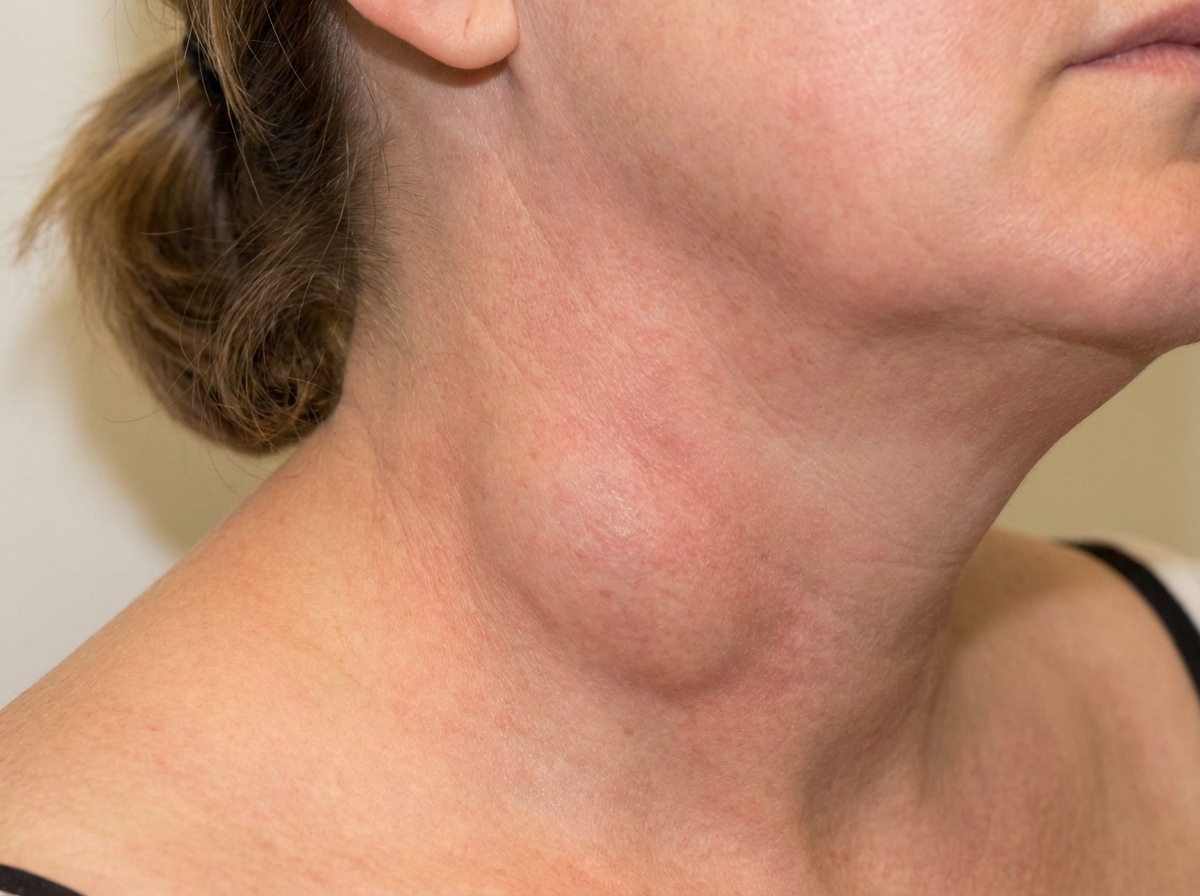
A 42-year-old woman presents because of a painful mass she first noticed on her neck 1 week ago (see image). The mass has grown over the last few days. She has no history of serious illness and takes no medications. On physical exam, her temperature is 38.0°C (100.4°F), pulse is 86/min, respirations are 12/min, blood pressure is 135/80 mm Hg. The mass is tender and relatively soft and mobile. The overlying skin is warm. On her right ear, there is a series of small and healing skin punctures left by the bite of her neighbor's kitten 3 weeks ago. No other mass is detected in the neck, supraclavicular, axillary, or inguinal regions. Oral examination reveals several discolored teeth. Her lungs are clear to auscultation and heart sounds are normal. A biopsy of the neck mass is performed. Which of the following would be most useful in establishing the diagnosis?
A 57-year-old man presents to the clinic for a chronic cough over the past 4 months. The patient reports a productive yellow/green cough that is worse at night. He denies any significant precipitating event prior to his symptoms. He denies fever, chest pain, palpitations, weight changes, or abdominal pain, but endorses some difficulty breathing that waxes and wanes. He denies alcohol usage but endorses a 35 pack-year smoking history. A physical examination demonstrates mild wheezes, bibasilar crackles, and mild clubbing of his fingertips. A pulmonary function test is subsequently ordered, and partial results are shown below: Tidal volume: 500 mL Residual volume: 1700 mL Expiratory reserve volume: 1500 mL Inspiratory reserve volume: 3000 mL What is the functional residual capacity of this patient?
A student health coordinator plans on leading a campus-wide HIV screening program that will be free for the entire undergraduate student body. The goal is to capture as many correct HIV diagnoses as possible with the fewest false positives. The coordinator consults with the hospital to see which tests are available to use for this program. Test A has a sensitivity of 0.92 and a specificity of 0.99. Test B has a sensitivity of 0.95 and a specificity of 0.96. Test C has a sensitivity of 0.98 and a specificity of 0.93. Which of the following testing schemes should the coordinator pursue?
You submit a paper to a prestigious journal about the effects of coffee consumption on mesothelioma risk. The first reviewer lauds your clinical and scientific acumen, but expresses concern that your study does not have adequate statistical power. Statistical power refers to which of the following?
You are reviewing raw data from a research study performed at your medical center examining the effectiveness of a novel AIDS screening examination. The study enrolled 250 patients with confirmed AIDS, and 240 of these patients demonstrated a positive screening examination. The control arm of the study enrolled 250 patients who do not have AIDS, and only 5 of these patients tested positive on the novel screening examination. What is the NPV of this novel test?
A 43-year-old woman presents to the neurology clinic in significant pain. She reports a sharp, stabbing electric-like pain on the right side of her face. The pain started suddenly 2 weeks ago. The pain is so excruciating that she can no longer laugh, speak, or eat her meals as these activities cause episodes of pain. She had to miss work last week as a result. Her attacks last about 3 minutes and go away when she goes to sleep. She typically has 2–3 attacks per day now. The vital signs include: blood pressure 132/84 mm Hg, heart rate 79/min, and respiratory rate 14/min. A neurological examination shows no loss of crude touch, tactile touch, or pain sensations on the right side of the face. The pupillary light and accommodation reflexes are normal. There is no drooping of her mouth, ptosis, or anhidrosis noted. Which of the following is the most likely diagnosis?
A previously healthy 33-year-old woman comes to the physician because of pain and sometimes numbness in her right thigh for the past 2 months. She reports that her symptoms are worse when walking or standing and are better while sitting. Three months ago, she started going to a fitness class a couple times a week. She is 163 cm (5 ft 4 in) tall and weighs 88 kg (194 lb); BMI is 33.1 kg/m2. Her vital signs are within normal limits. Examination of the skin shows no abnormalities. Sensation to light touch is decreased over the lateral aspect of the right anterior thigh. Muscle strength is normal. Tapping the right inguinal ligament leads to increased numbness of the affected thigh. The straight leg test is negative. Which of the following is the most appropriate next step in management of this patient?
Want unlimited practice?
Get full access to all questions, explanations, and performance tracking.
Scan to download app