
Common vs rare disease considerations — MCQs

A study is performed to determine the prevalence of a particular rare fungal pneumonia. A sample population of 100 subjects is monitored for 4 months. Every month, the entire population is screened and the number of new cases is recorded for the group. The data from the study are given in the table below: Time point New cases of fungal pneumonia t = 0 months 10 t = 1 months 4 t = 2 months 2 t = 3 months 5 t = 4 months 4 Which of the following is correct regarding the prevalence of this rare fungal pneumonia in this sample population?
A geriatric investigator is evaluating the consistency of Alzheimer dementia diagnoses based on clinical symptoms. Patients with known chart diagnoses of Alzheimer dementia were evaluated by multiple physicians during a fixed time interval. Each evaluator was blinded to the others' assessments. The extent to which the diagnosis by one physician was replicated by another clinician examining the same patient is best described by which of the following terms?
A 28-year-old woman dies shortly after receiving a blood transfusion. Autopsy reveals widespread intravascular hemolysis and acute renal failure. Investigation reveals that she received type A blood, but her medical record indicates she was type O. In a malpractice lawsuit, which of the following elements must be proven?
A 3-year-old is brought to the pediatrician by his mother because she is concerned about recent changes to his behavior. She states that he has seemed to regress in his motor development and has been having occasional brief episodes of uncontrollable shaking. During the subsequent work up, a muscle biopsy is obtained which demonstrates red ragged fibers and a presumptive diagnosis of a genetic disease made. The mother asks if her other son will be affected. What should be the physician's response?
A 28-year-old male presents to his primary care physician with complaints of intermittent abdominal pain and alternating bouts of constipation and diarrhea. His medical chart is not significant for any past medical problems or prior surgeries. He is not prescribed any current medications. Which of the following questions would be the most useful next question in eliciting further history from this patient?
A 35-year-old woman presents to her dermatologist with complaints of discoloration of the skin on her hands and wrists. She says her symptoms started about 6-months ago. Around this time, she recalls moving into her new house with her husband and children. She had to quit her job to relocate and says she is having difficulty maintaining a clean and happy household. She admits to being stressed most of the time. She was previously in good health. No significant past medical history. The patient is afebrile and vital signs are within normal limits. Physical examination reveals patchy red, scaly skin on both hands. Upon further questioning, the patient admits to having to continuously wash her hands because she has this irrational idea that her hands are dirty. She tries her best to ignore these thoughts but eventually succumbs to wash her hands over and over to ease the anxiety. Which of the following statements is correct concerning this patient’s most likely condition?
A 35-year-old man presents to his primary care provider in Philadelphia with a skin rash on his right thigh. He reports that the rash appeared 3 days ago. He recently returned from a weeklong trip to his vacation home in central Pennsylvania. He denies pain, numbness, paresthesias, itchiness, or burning around the rash. He does not recall finding any ticks on his body. He otherwise feels well. His past medical history is notable for gout. He takes allopurinol. He is an avid hiker and spends 3 months out of the year hiking. He does not smoke and drinks alcohol socially. On exam, he has a bullseye-like circular erythematous rash on the anterolateral aspect of his right thigh. The doctor decides to perform a new serum test for Lyme disease that was trialed at the same hospital in Philadelphia, where it was shown to have a sensitivity of 91% and specificity of 94%. The prevalence of Lyme disease in the area is among the highest in the country. How would the sensitivity and specificity of this new test change if it were performed on a patient in Texas, an area with a very low prevalence of Lyme disease?
A 57-year-old woman comes to the physician because of a 6-month history of tinnitus and progressive hearing loss in the left ear. She has type 2 diabetes mellitus and Raynaud syndrome. Her current medications include metformin, nifedipine, and a multivitamin. She appears well. Vital signs are within normal limits. Physical examination shows no abnormalities. A vibrating tuning fork is placed on the left mastoid process. Immediately after the patient does not hear a tone, the tuning fork is held over the left ear and she reports hearing the tuning fork again. The same test is repeated on the right side and shows the same pattern. The vibration tuning fork is then placed on the middle of the forehead and the patient hears the sound louder in the right ear. Which of the following is the most likely diagnosis?
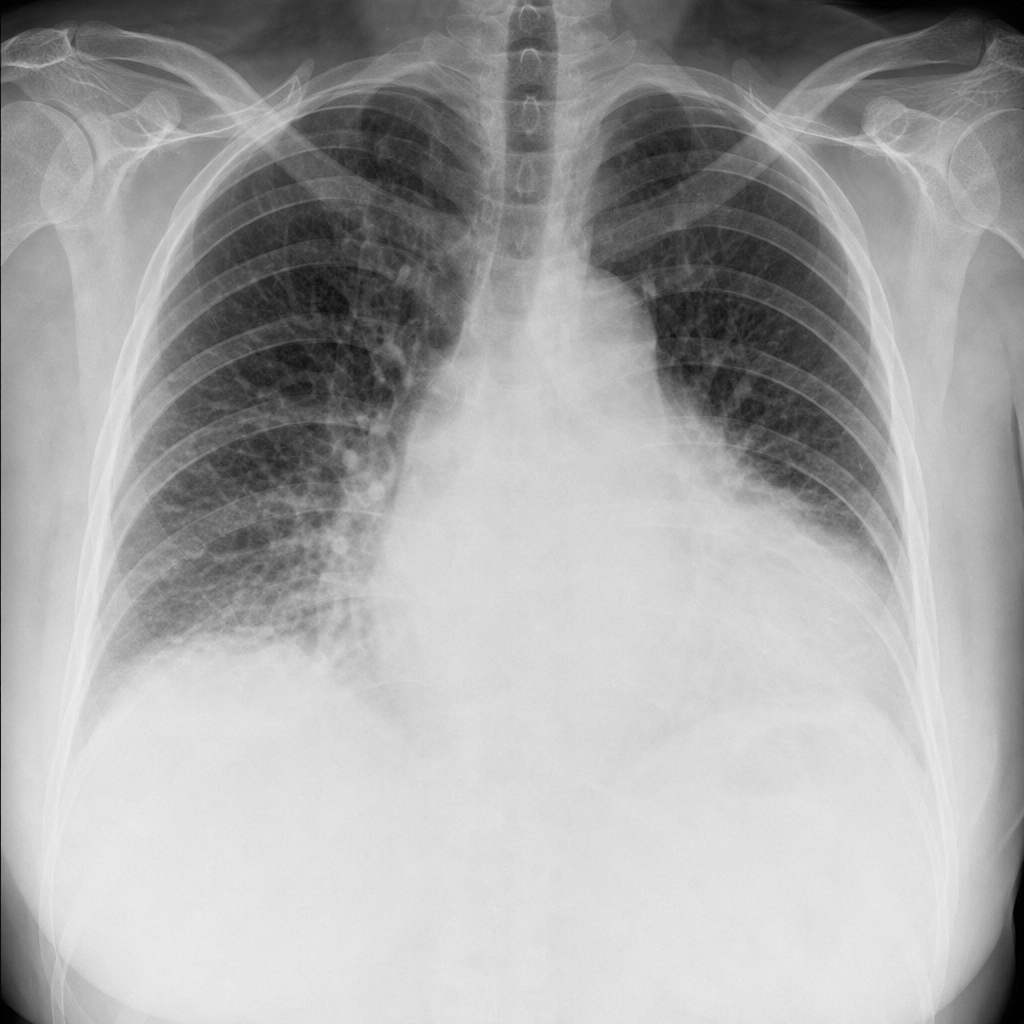
A 58-year-old woman presents with a 10-day history of progressively worsening exertional dyspnea and bilateral leg swelling. She has a history of hypertension treated with lisinopril for 6 years. She recently completed a 6-month course of doxorubicin-based chemotherapy for breast cancer, finishing 3 months ago. Temperature 37.0°C, blood pressure 148/92 mmHg, heart rate 102 bpm, oxygen saturation 91% on room air. JVP is elevated at 10 cm. Bibasilar crackles are present. An ECG shows sinus tachycardia with no ischemic changes. The chest radiograph image shown demonstrates the finding most critical to establishing the diagnosis. Which of the following is the most likely diagnosis?
A female presents with a 1 × 1 cm thyroid swelling. What is the next best step in management?
Want unlimited practice?
Get full access to all questions, explanations, and performance tracking.
Scan to download app