
Anatomical approach to differential diagnosis — MCQs

A 12-year-old boy is brought to the emergency department late at night by his worried mother. She says he has not been feeling well since this morning after breakfast. He skipped both lunch and dinner. He complains of abdominal pain as he points towards his lower abdomen but says that the pain initially started at the center of his belly. His mother adds that he vomited once on the way to the hospital. His past medical history is noncontributory and his vaccinations are up to date. His temperature is 38.1°C (100.6°F), pulse is 98/min, respirations are 20/min, and blood pressure is 110/75 mm Hg. Physical examination reveals right lower quadrant tenderness. The patient is prepared for laparoscopic abdominal surgery. Which of the following structures is most likely to aid the surgeons in finding the source of this patient's pain and fever?
A 54-year-old man comes to the physician for the evaluation of difficulty swallowing of both solids and liquids for 1 month. During the past 5 months, he has also had increased weakness of his hands and legs. He sails regularly and is unable to hold the ropes as tightly as before. Ten years ago, he was involved in a motor vehicle collision. Examination shows atrophy of the tongue. Muscle strength is decreased in the right upper and lower extremities. There is muscle stiffness in the left lower extremity. Deep tendon reflexes are 1+ in the right upper and lower extremities, 3+ in the left upper extremity, and 4+ in the left lower extremity. Plantar reflex shows an extensor response on the left foot. Sensation to light touch, pinprick, and vibration is intact. Which of the following is the most likely diagnosis?
A 74-year-old woman is brought by ambulance to the emergency department and presents with a complaint of excruciating chest pain that started about 45 minutes ago. The patient was sitting in the garden when she 1st noticed the pain in the upper abdomen. The pain has persisted and now localizes underneath of the sternum and the left shoulder. Milk of magnesia and aspirin were tried with no relief. The patient had previous episodes of chest pain that were of lesser intensity and rarely lasted more than 10 minutes. She is diabetic and has been managed for hypertension and rheumatoid arthritis in the past. On examination, the patient is breathless and sweating profusely. The vital signs include blood pressure 140/90 mm Hg and heart rate 118/min. The electrocardiogram (ECG) shows Q waves in leads V2 and V3 and raised ST segments in leads V2, V3, V4, and V5. Laboratory studies (including cardiac enzymes at 6 hours after admission show: Hematocrit 45% Troponin T 1.5 ng/mL Troponin I 0.28 ng/mL Creatine kinase (CK)-MB 0.25 ng/mL The patient is admitted and started on analgesia and reperfusion therapy. She shows initial signs of recovery until the 6th day of hospitalization when she starts vomiting and complaining of dizziness. Physical examination findings at this time included heart rate 110/min, temperature 37.7°C (99.9°F), blood pressure 90/60 mm Hg. Jugular venous pressure is 8 cm. A harsh pansystolic murmur is present at the left lower sternal border. ECG shows sinus tachycardia and ST-segment elevation with terminal negative T waves. Laboratory studies show: Hematocrit 38% Troponin T 1.15ng/mL Troponin I 0.18 ng/mL CK-MB 0.10 ng/mL Which of the following best explains the patient's current clinical condition?
A 24-year-old woman comes to the emergency department because of abdominal pain, fever, nausea, and vomiting for 12 hours. Her abdominal pain was initially dull and diffuse but has progressed to a sharp pain on the lower right side. Two years ago she had to undergo right salpingo-oophorectomy after an ectopic pregnancy. Her temperature is 38.7°C (101.7°F). Physical examination shows severe right lower quadrant tenderness with rebound tenderness; bowel sounds are decreased. Laboratory studies show leukocytosis with left shift. An abdominal CT scan shows a distended, edematous appendix. The patient is taken to the operating room for an appendectomy. During the surgery, the adhesions from the patient's previous surgery make it difficult for the resident physician to identify the appendix. Her attending mentions that she should use a certain structure for guidance to locate the appendix. The attending is most likely referring to which of the following structures?
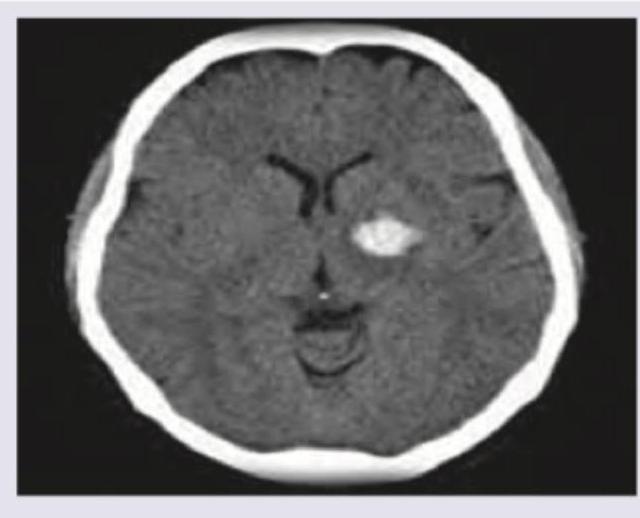
A 53-year-old man is brought to the emergency department for confusion. He was in his usual state of health until about 3 hours ago when he tried to use his sandwich to turn off the TV. He also complained to his wife that he had a severe headache. Past medical history is notable for hypertension, which has been difficult to control on multiple medications. His temperature is 36.7°C (98°F), the pulse is 70/min, and the blood pressure is 206/132 mm Hg. On physical exam he is alert and oriented only to himself, repeating over and over that his head hurts. The physical exam is otherwise unremarkable and his neurologic exam is nonfocal. The noncontrast CT scan of the patient's head is shown and reveals an acute intraparenchymal hemorrhage in the basal ganglia. Which of the following diagnostic tests would be most helpful in determining the underlying cause of this patient's hemorrhage?
A 48-year-old woman presents to the emergency department because of increasingly severe right upper abdominal pain, fever, and non-bloody vomiting for the last 5 hours. The pain is dull, intermittent, and radiates to her right shoulder. During the past 3 months, she has had recurring abdominal discomfort after meals. The patient underwent an appendectomy more than 30 years ago. She has hypertension, diabetes mellitus type 2, and chronic back pain. She takes bisoprolol, metformin, and ibuprofen daily. She is 171 cm (5 ft 6 in) tall and weighs 99 kg (218 lb). Her BMI is 35.2 kg/m2. She appears uncomfortable and is clutching her abdomen. Her temperature is 38.5°C (101.3°F), pulse is 108/min, and blood pressure is 150/82 mm Hg. Abdominal examination shows right upper quadrant abdominal tenderness and guarding. Upon deep palpation of the right upper quadrant, the patient pauses during inspiration. Laboratory studies show the following: Blood Hemoglobin 13.1 g/dL Leukocyte count 10,900/mm3 Platelet count 236,000/mm3 Mean corpuscular volume 89/µm3 Serum Urea nitrogen 28 mg/dL Glucose 89 mg/dL Creatinine 0.7 mg/dL Bilirubin Total 1.6 mg/dL Direct 1.1 mg/dL Alkaline phosphatase 79 U/L Alanine aminotransferase (ALT, GPT) 28 U/L Aspartate aminotransferase (AST, GOT) 32 U/L An X-ray of the abdomen shows no abnormalities. Further evaluation of the patient is most likely to reveal which of the following?
A 72-year-old woman is brought in to the emergency department after her husband noticed that she appeared to be choking on her dinner. He performed a Heimlich maneuver but was concerned that she may have aspirated something. The patient reports a lack of pain and temperature on the right half of her face, as well as the same lack of sensation on the left side of her body. She also states that she has been feeling "unsteady" on her feet. On physical exam you note a slight ptosis on the right side. She is sent for an emergent head CT. Where is the most likely location of the neurological lesion?
A 65-year-old man presents to the emergency department for sudden weakness. He was doing mechanical work on his car where he acutely developed right-leg weakness and fell to the ground. He is accompanied by his wife, who said that this has never happened before. He was last seen neurologically normal approximately 2 hours prior to presentation. His past medical history is significant for hypertension and type II diabetes. His temperature is 98.8°F (37.1°C), blood pressure is 177/108 mmHg, pulse is 90/min, respirations are 15/min, and oxygen saturation is 99% on room air. Neurological exam reveals that he is having trouble speaking and has profound weakness of his right upper and lower extremity. Which of the following is the best next step in management?
A 55-year-old woman presents to the emergency department with retrosternal pain that started this evening. The patient states that her symptoms started as she was going to bed after taking her medications. She describes the pain as sudden in onset, worse with swallowing, and not associated with exertion. The patient has a past medical history of diabetes, anemia, and congestive heart failure and is currently taking metoprolol, insulin, metformin, iron, and lisinopril. Her temperature is 99.2°F (37.3°C), blood pressure is 125/63 mmHg, pulse is 90/min, respirations are 14/min, and oxygen saturation is 100% on room air. Physical exam is notable for an obese woman who appears uncomfortable. An initial electrocardiogram (ECG) demonstrates sinus rhythm, and a set of troponins are pending. Which of the following is the most likely diagnosis?
A previously healthy 33-year-old woman comes to the physician because of pain and sometimes numbness in her right thigh for the past 2 months. She reports that her symptoms are worse when walking or standing and are better while sitting. Three months ago, she started going to a fitness class a couple times a week. She is 163 cm (5 ft 4 in) tall and weighs 88 kg (194 lb); BMI is 33.1 kg/m2. Her vital signs are within normal limits. Examination of the skin shows no abnormalities. Sensation to light touch is decreased over the lateral aspect of the right anterior thigh. Muscle strength is normal. Tapping the right inguinal ligament leads to increased numbness of the affected thigh. The straight leg test is negative. Which of the following is the most appropriate next step in management of this patient?
Want unlimited practice?
Get full access to all questions, explanations, and performance tracking.
Scan to download app