
Age and demographic considerations — MCQs

A 72-year-old man is brought into clinic by his daughter for increasing confusion. The daughter states that over the past 2 weeks, she has noticed that the patient “seems to stare off into space.” She reports he has multiple episodes a day during which he will walk into a room and forget why. She is also worried about his balance. She endorses that he has had several falls, the worst being 3 weeks ago when he tripped on the sidewalk getting the mail. The patient denies loss of consciousness, pre-syncope, chest pain, palpitations, urinary incontinence, or bowel incontinence. He complains of headache but denies dizziness. He reports nausea and a few episodes of non-bloody emesis but denies abdominal pain, constipation, or diarrhea. The patient’s medical history is significant for atrial fibrillation, diabetes, hypertension, hyperlipidemia, and osteoarthritis. He takes aspirin, warfarin, insulin, lisinopril, simvastatin, and ibuprofen. He drinks a half glass of whisky after dinner every night and smokes a cigar on the weekends. On physical examination, he is oriented to name and place but not to date. He is unable to spell "world" backward. When asked to remember 3 words, he recalls only 2. There are no motor or sensory deficits. Which of the following is the most likely diagnosis?
A 2-year-old boy is brought to the physician by his parents for the evaluation of an unusual cough, a raspy voice, and noisy breathing for the last 2 days. During this time, the symptoms have always occurred in the late evening. The parents also report that prior to the onset of these symptoms, their son had a low-grade fever and a runny nose for 2 days. He attends daycare. His immunizations are up-to-date. His temperature is 37.8°C (100°F) and respirations are 33/min. Physical examination shows supraclavicular retractions. There is a high-pitched breath sound on inspiration. Which of the following is the most likely location of the abnormality?
A 66-year-old man is brought into the emergency department by his daughter for a change in behavior. Yesterday the patient seemed more confused than usual and was asking the same questions repetitively. His symptoms have not improved over the past 24 hours, thus the decision to bring him in today. Last year, the patient was almost completely independent but he then suffered a "series of falls," after which his ability to care for himself declined. After this episode he was no longer able to cook for himself or pay his bills but otherwise had been fine up until this episode. The patient has a past medical history of myocardial infarction, hypertension, depression, diabetes mellitus type II, constipation, diverticulitis, and peripheral neuropathy. His current medications include metformin, insulin, lisinopril, hydrochlorothiazide, sodium docusate, atorvastatin, metoprolol, fluoxetine, and gabapentin. On exam you note a confused man who is poorly kept. He has bruises over his legs and his gait seems unstable. He is alert to person and place, and answers some questions inappropriately. The patient's pulse is 90/minute and his blood pressure is 170/100 mmHg. Which of the following is the most likely diagnosis?
A 30-year-old man comes to the physician for his annual health maintenance examination. The patient has no particular health concerns. He has a history of bilateral cryptorchidism treated with orchidopexy at 8 months of age. This patient is at increased risk for which of the following?
A 72-year-old man is brought to the physician by his wife for forgetfulness, confusion, and mood changes for the past 4 months. His symptoms started with misplacing items such as his wallet and keys around the house. Two months ago, he became unable to manage their finances as it became too difficult for him. Last week, he became lost while returning home from the grocery store. His wife reports that he shows “no emotion” and that he is seemingly not concerned by his recent symptoms. He has hypertension, type 2 diabetes mellitus, and coronary artery disease. Current medications include aspirin, metoprolol, lisinopril, metformin, and rosuvastatin. His pulse is 56/min and blood pressure is 158/76 mm Hg. Neurologic examination shows loss of sensation on his right leg and an unsteady gait. When asked to stand with his eyes closed and palms facing upward, his right arm rotates inward. An MRI of the brain shows multiple deep white matter lesions. Which of the following is the most likely diagnosis?
A 57-year-old woman comes to the physician for a routine health maintenance examination. She has well-controlled type 2 diabetes mellitus, for which she takes metformin. She is 163 cm (5 ft 4 in) tall and weighs 84 kg (185 lb); BMI is 31.6 kg/m2. Her blood pressure is 140/92 mm Hg. Physical examination shows central obesity, with a waist circumference of 90 cm. Laboratory studies show: Fasting glucose 94 mg/dl Total cholesterol 200 mg/dL High-density lipoprotein cholesterol 36 mg/dL Triglycerides 170 mg/dL Without treatment, this patient is at greatest risk for which of the following conditions?
A 21-year-old female presents to her first gynecology visit. She states that six months ago, she tried to have sexual intercourse but experienced severe pain in her genital region when penetration was attempted. This has continued until now, and she has been unable to have intercourse with her partner. The pain is not present at any other times aside from attempts at penetration. The patient is distressed that she will never be able to have sex, even though she wishes to do so. She does not recall ever having a urinary tract infection and has never been sexually active due to her religious upbringing. In addition, she has never tried to use tampons or had a Pap smear before. She denies alcohol, illicit drugs, and smoking. The patient is 5 feet 6 inches and weighs 146 pounds (BMI 23.6 kg/m^2). On pelvic exam, there are no vulvar skin changes, signs of atrophy, or evidence of abnormal discharge. The hymen is not intact. Placement of a lubricated speculum at the introitus elicits intense pain and further exam is deferred for patient comfort. Office urinalysis is negative. Which of the following is a risk factor for this patient’s condition?
A 9-year-old girl is brought to the physician by her mother because of a 3-day history of face and foot swelling, dark urine, and a rash on her hands and feet. The mother reports that her daughter has had a low-grade fever, shortness of breath, and a dry cough for the past 8 days. She has had generalized weakness and pain in her right knee and ankle. She has a ventricular septum defect that was diagnosed at birth. The patient appears lethargic. Her temperature is 38.4 (101.1°F), pulse is 130/min, respirations are 34/min, and blood pressure is 110/60 mm Hg. Examination shows small, non-blanching, purple lesions on her palms, soles, and under her fingernails. There is edema of the eyelids and feet. Funduscopic examination shows retinal hemorrhages. Holosystolic and early diastolic murmurs are heard. Laboratory studies show: Hemoglobin 11.3 g/dL Erythrocyte sedimentation rate 61 mm/h Leukocyte count 15,000/mm3 Platelet count 326,000/mm3 Urine Blood 4+ Glucose negative Protein 1+ Ketones negative Transthoracic echocardiography shows a small outlet ventricular septum defect and a mild right ventricular enlargement. There are no wall motion abnormalities, valvular heart disease, or deficits in the pump function of the heart. Blood cultures grow Streptococcus pyogenes. Which of the following is the most likely diagnosis?
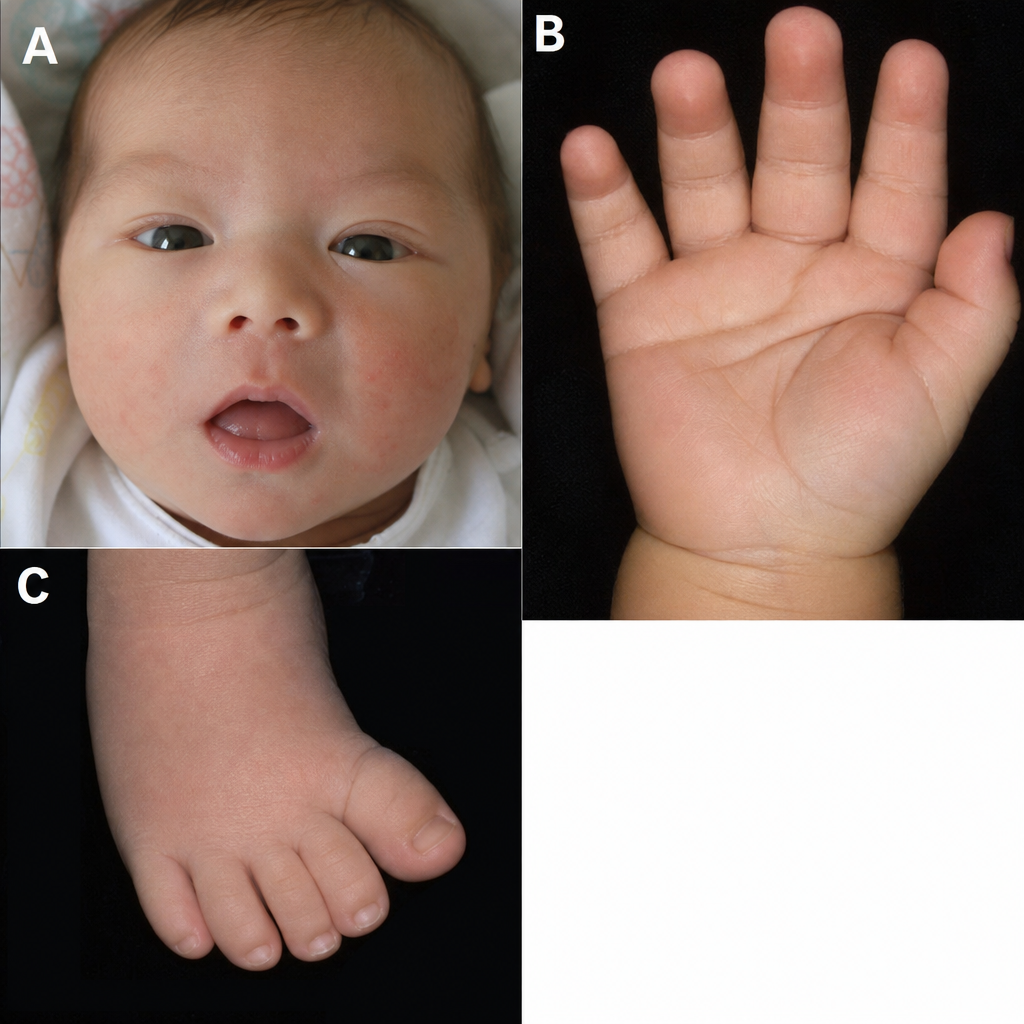
You are called to evaluate a newborn. The patient was born yesterday to a 39-year-old mother. You observe the findings illustrated in Figures A-C. What is the most likely mechanism responsible for these findings?
A 33-year-old woman comes to the physician because of vision impairment in her right eye for the past 2 weeks. During this period, she was unable to distinguish colors with her right eye. She also reports pain with eye movement. She has no double vision. She occasionally has headaches that are relieved by ibuprofen. One year ago, she had a similar episode that affected her left eye and resolved spontaneously. She has no history of serious illness. She works at a library and enjoys reading, even in poor lighting conditions. Her vital signs are within normal limits. The pupils are equal, round, and reactive to light and accommodation. Without correction, visual acuity is 20/50 in the left eye, and 20/100 in the right eye. With spectacles, the visual acuity is 20/20 in the left eye and 20/100 in the right eye. Slit lamp examination shows no abnormalities. A CT scan of the head shows no abnormalities. Which of the following is the most likely diagnosis?
Want unlimited practice?
Get full access to all questions, explanations, and performance tracking.
Scan to download app