
Bayesian approach to diagnosis — MCQs

A scientist in Chicago is studying a new blood test to detect Ab to EBV with increased sensitivity and specificity. So far, her best attempt at creating such an exam reached 82% sensitivity and 88% specificity. She is hoping to increase these numbers by at least 2 percent for each value. After several years of work, she believes that she has actually managed to reach a sensitivity and specificity much greater than what she had originally hoped for. She travels to China to begin testing her newest blood test. She finds 2,000 patients who are willing to participate in her study. Of the 2,000 patients, 1,200 of them are known to be infected with EBV. The scientist tests these 1,200 patients' blood and finds that only 120 of them tested negative with her new exam. Of the patients who are known to be EBV-free, only 20 of them tested positive. Given these results, which of the following correlates with the exam's specificity?
A researcher is trying to determine whether a newly discovered substance X can be useful in promoting wound healing after surgery. She conducts this study by enrolling the next 100 patients that will be undergoing this surgery and separating them into 2 groups. She decides which patient will be in which group by using a random number generator. Subsequently, she prepares 1 set of syringes with the novel substance X and 1 set of syringes with a saline control. Both of these sets of syringes are unlabeled and the substances inside cannot be distinguished. She gives the surgeon performing the surgery 1 of the syringes and does not inform him nor the patient which syringe was used. After the study is complete, she analyzes all the data that was collected and performs statistical analysis. This study most likely provides which level of evidence for use of substance X?
You are reading through a recent article that reports significant decreases in all-cause mortality for patients with malignant melanoma following treatment with a novel biological infusion. Which of the following choices refers to the probability that a study will find a statistically significant difference when one truly does exist?
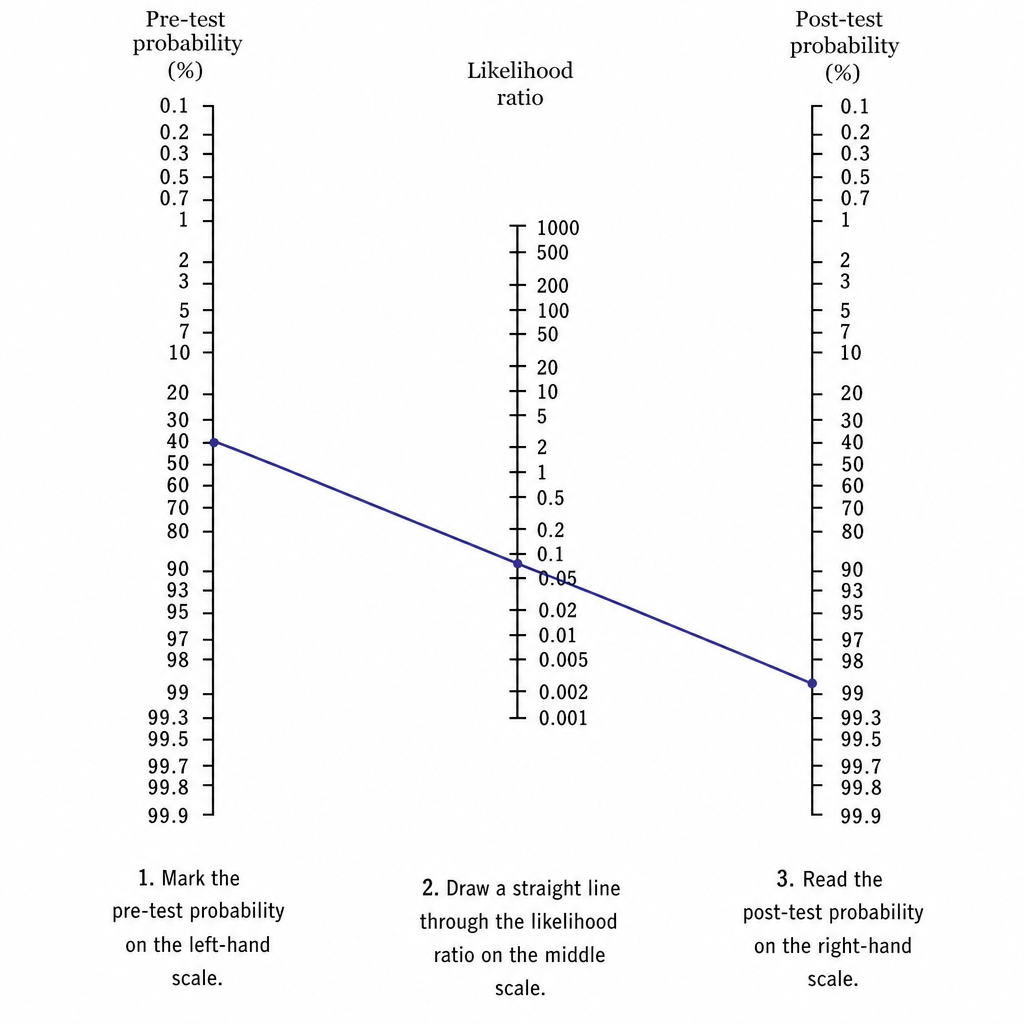
A 14-month-old Caucasian boy is admitted to the pediatric clinic with an 8-month history of diarrhea, abdominal tenderness and concomitant failure to thrive. One of the possibilities that may cause these symptoms is Crohn’s disease, and on the basis of the attending pediatrician’s experience, the pre-test probability of this diagnosis was estimated at 40%. According to Fagan’s diagram (picture), if the likelihood ratio of a negative test result (LR-) is 0.04, what is the chance that this is the right diagnosis?
A pharmaceutical corporation is developing a research study to evaluate a novel blood test to screen for breast cancer. They enrolled 800 patients in the study, half of which have breast cancer. The remaining enrolled patients are age-matched controls who do not have the disease. Of those in the diseased arm, 330 are found positive for the test. Of the patients in the control arm, only 30 are found positive. What is this test’s sensitivity?
In 2013 the national mean score on the USMLE Step 1 exam was 227 with a standard deviation of 22. Assuming that the scores for 15,000 people follow a normal distribution, approximately how many students scored above the mean but below 250?
A 27-year-old woman presents to her primary care physician for minor aches and pains in her bones and muscles. She states that these symptoms have persisted throughout her entire life but have worsened recently when she moved to attend college. The patient is physically active, and states that she eats a balanced diet. She is currently a full-time student and is sexually active with 1 partner. She states that she has been particularly stressed lately studying for final exams and occasionally experiences diarrhea. She has been taking acyclovir for a dermatologic herpes simplex virus infection with minimal improvement. On physical exam, the patient exhibits 4/5 strength in her upper and lower extremities, and diffuse tenderness over her limbs that is non-specific. Laboratory values are ordered as seen below: Serum: Na+: 144 mEq/L Cl-: 102 mEq/L K+: 4.7 mEq/L HCO3-: 24 mEq/L Ca2+: 5.0 Urea nitrogen: 15 mg/dL Glucose: 81 mg/dL Creatinine: 1.0 mg/dL Alkaline phosphatase: 225 U/L Aspartate aminotransferase (AST, GOT): 11 U/L Alanine aminotransferase (ALT, GPT): 15 U/L Which of the following is most likely associated with this patient’s presentation?
A 63-year-old woman with a past medical history significant for hypertension presents to the outpatient clinic for evaluation of vaginal dryness, loss of libido, and hot flashes. These symptoms have been progressively worsening over the past 3 months. Her vital signs are: blood pressure 131/81 mm Hg, pulse 68/min, and respiratory rate 16/min. She is afebrile. On further review of systems, she endorses having irregular periods for almost a year, and asks if she has begun menopause. Which of the following parameters is required to formally diagnosis menopause in this patient?
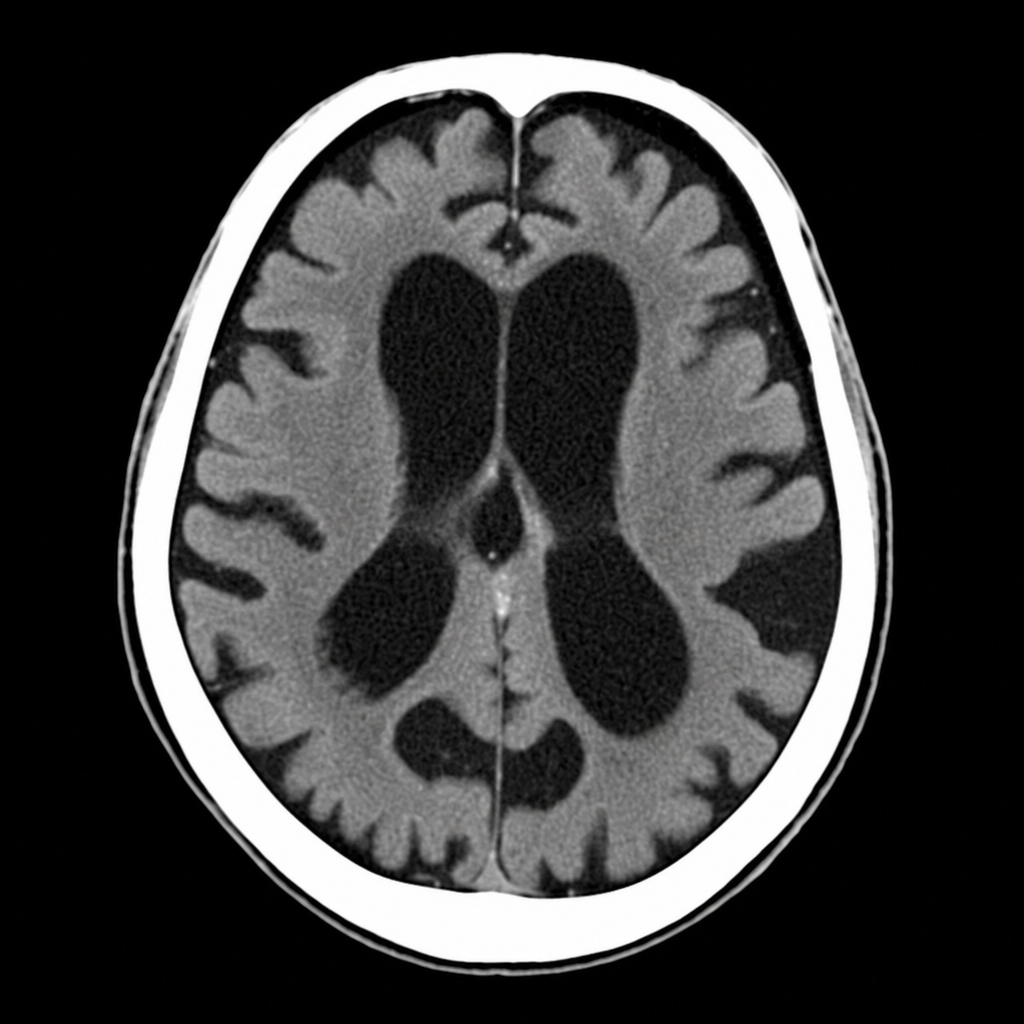
A 72-year-old woman is brought in by her daughter for progressive confusion over 4 weeks, 8 kg of unintentional weight loss over 3 months, and new-onset urinary incontinence. She has no history of psychiatric illness. Medications include amlodipine and aspirin. On examination, she is afebrile; she scores 19/30 on the MMSE. Gait is broad-based and magnetic in quality. Neurological exam shows no focal deficits and no papilledema. CBC, CMP, TSH, B12, and RPR are all within normal limits. The image shown is from her MRI brain. Which of the following diagnoses is most consistent with the clinical presentation and imaging finding?
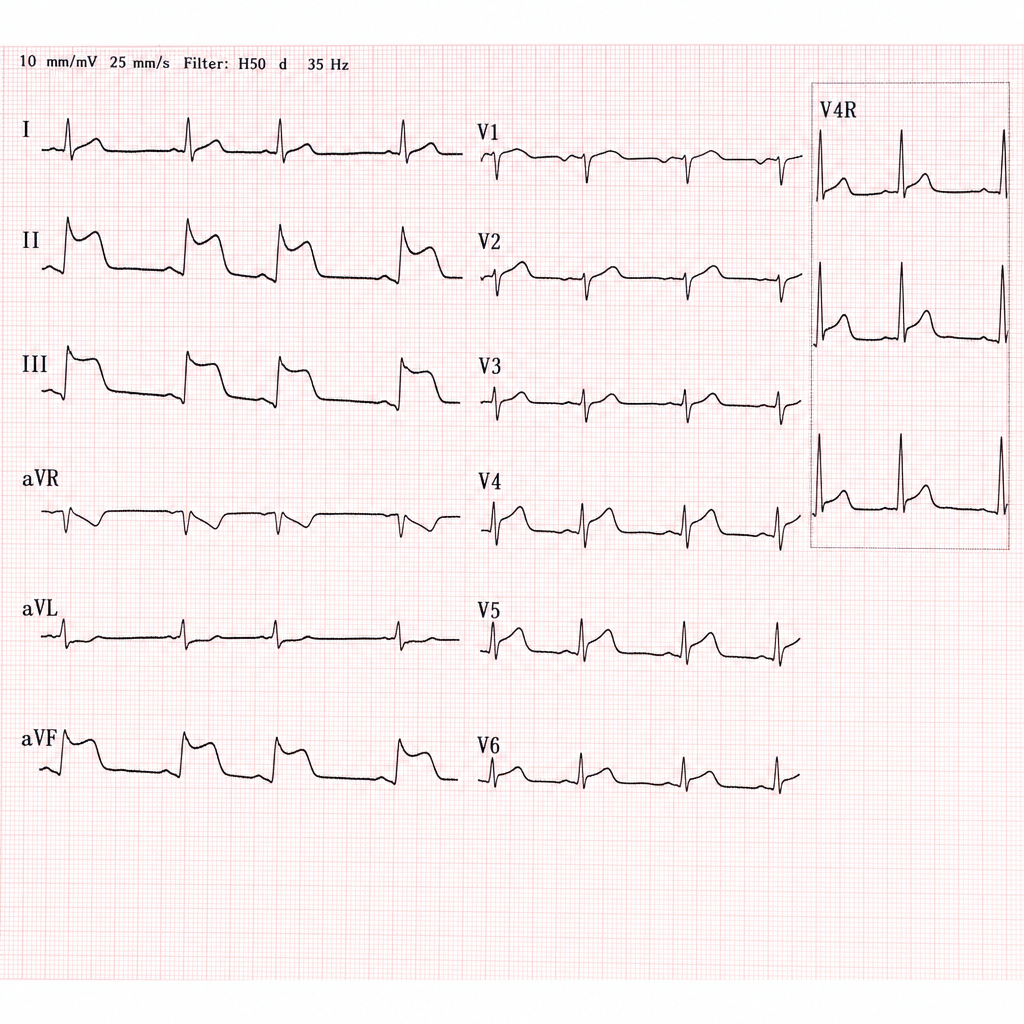
A 12-lead ECG with right-sided leads (including V4R) is shown for a 61-year-old man who presented with 40 minutes of crushing substernal chest pressure, diaphoresis, and nausea. His blood pressure is 88/60 mmHg and heart rate is 42 bpm. Lungs are clear to auscultation. Jugular venous distension is present. Based on the ECG findings, which diagnosis most precisely localizes the culprit lesion and accounts for the hemodynamic profile?
Want unlimited practice?
Get full access to all questions, explanations, and performance tracking.
Scan to download app