
Balancing thoroughness with efficiency — MCQs

A 40-year-old woman presents to her physician's home with a headache. She describes it as severe and states that her symptoms have not been improving despite her appointment yesterday at the office. Thus, she came to her physician's house on the weekend for help. The patient has been diagnosed with migraine headaches that have persisted for the past 6 months and states that her current symptoms feel like her previous headaches with a severity of 3/10. She has been prescribed multiple medications but is generally non-compliant with therapy. She is requesting an exam and urgent treatment for her symptoms. Which of the following is the best response from the physician?
A 29-year-old man is admitted to the emergency department following a motorcycle accident. The patient is severely injured and requires life support after splenectomy and evacuation of a subdural hematoma. Past medical history is unremarkable. The patient’s family members, including wife, parents, siblings, and grandparents, are informed about the patient’s condition. The patient has no living will and there is no durable power of attorney. The patient must be put in an induced coma for an undetermined period of time. Which of the following is responsible for making medical decisions for the incapacitated patient?
A 15-year-old boy is brought to the emergency department one hour after sustaining an injury during football practice. He collided head-on into another player while wearing a mouthguard and helmet. Immediately after the collision he was confused but able to use appropriate words. He opened his eyes spontaneously and followed commands. There was no loss of consciousness. He also had a headache with dizziness and nausea. He is no longer confused upon arrival. He feels well. Vital signs are within normal limits. He is fully alert and oriented. His speech is organized and he is able to perform tasks demonstrating full attention, memory, and balance. Neurological examination shows no abnormalities. There is mild tenderness to palpation over the crown of his head but no signs of skin break or fracture. Which of the following is the most appropriate next step?
A 42-year-old woman presents to the emergency department with abdominal pain. Her pain started last night during dinner and has persisted. This morning, the patient felt very ill and her husband called emergency medical services. The patient has a past medical history of obesity, diabetes, and depression. Her temperature is 104°F (40°C), blood pressure is 90/65 mmHg, pulse is 160/min, respirations are 14/min, and oxygen saturation is 98% on room air. Physical exam is notable for a very ill appearing woman. Her skin is mildly yellow, and she is in an antalgic position on the stretcher. Laboratory values are ordered as seen below. Hemoglobin: 13 g/dL Hematocrit: 38% Leukocyte count: 14,500 cells/mm^3 with normal differential Platelet count: 257,000/mm^3 Alkaline phosphatase: 227 U/L Bilirubin, total: 11.3 mg/dL Bilirubin, direct: 9.8 mg/dL AST: 42 U/L ALT: 31 U/L The patient is started on antibiotics and IV fluids. Which of the following is the best next step in management?
A 77-year-old woman is brought by ambulance to the emergency department after she developed weakness of her right arm along with a right-sided facial droop. By the time the ambulance arrived, she was having difficulty speaking. Past medical history is significant for hypertension, diabetes mellitus type II, and hyperlipidemia. She takes lisinopril, hydrochlorothiazide, metformin, and atorvastatin. On arrival to the emergency department, her vital signs are within normal limits. On physical examination, she is awake and alert but the right side of her mouth is dropping, making it difficult for her to speak clearly. Her heart has a regular rate and rhythm and her lungs are clear to auscultation bilaterally. Fingerstick glucose is 85 mg/dL. Her right upper extremity strength is 2/5 and her left upper extremity strength is 5/5. Which of the following is the best next step in management?
A 65-year-old woman presents to her primary care physician for a wellness checkup. She states that she has felt well lately and has no concerns. The patient has a 12-pack-year smoking history and has 3 drinks per week. She is retired and lives at home with her husband. She had a normal colonoscopy 8 years ago and mammography 1 year ago. She can't recall when she last had a Pap smear and believes that it was when she was 62 years of age. Her temperature is 98.1°F (36.7°C), blood pressure is 137/78 mmHg, pulse is 80/min, respirations are 13/min, and oxygen saturation is 98% on room air. Physical exam is within normal limits. Which of the following is the best next step in management?
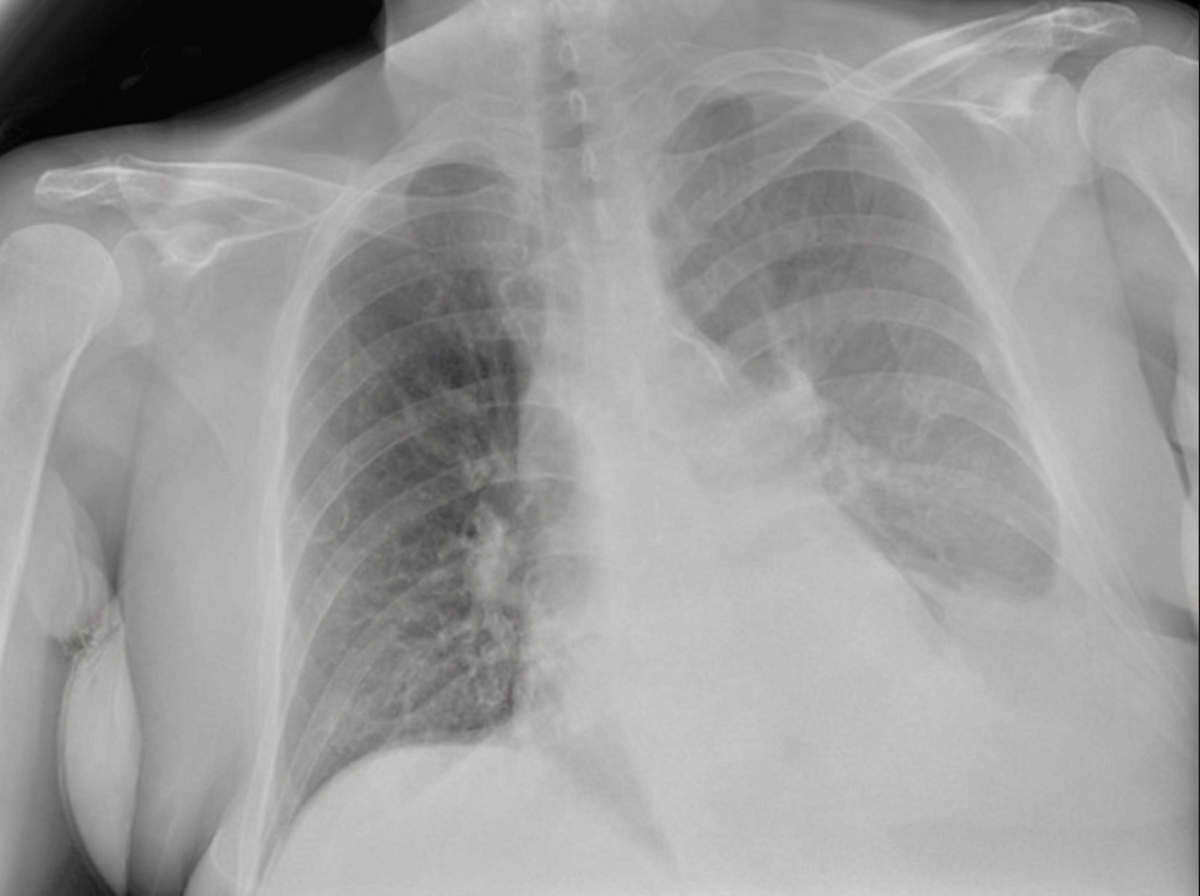
A 27-year-old soldier is brought to the emergency department of a military hospital 20 minutes after being involved in a motor vehicle accident during a training exercise. He was an unrestrained passenger. On arrival, he has shortness of breath and chest pain. He appears pale and anxious. His temperature is 37°C (98.6°F), pulse is 110/min, respirations are 20/min, and blood pressure is 100/65 mm Hg. He is alert and oriented to person, place, and time. Examination shows pale conjunctivae and mucous membranes. There is bruising on the chest, extremities, and abdomen. The lungs are clear to auscultation. He has normal heart sounds and flat neck veins. The abdomen is flat, soft, and mildly tender. The remainder of the physical examination shows no abnormalities. High-flow oxygen is applied, and intravenous fluid resuscitation is begun. A chest x-ray is obtained. Which of the following is the most appropriate next step in management?
A 65-year-old man presents to the emergency department for sudden weakness. He was doing mechanical work on his car where he acutely developed right-leg weakness and fell to the ground. He is accompanied by his wife, who said that this has never happened before. He was last seen neurologically normal approximately 2 hours prior to presentation. His past medical history is significant for hypertension and type II diabetes. His temperature is 98.8°F (37.1°C), blood pressure is 177/108 mmHg, pulse is 90/min, respirations are 15/min, and oxygen saturation is 99% on room air. Neurological exam reveals that he is having trouble speaking and has profound weakness of his right upper and lower extremity. Which of the following is the best next step in management?
Want unlimited practice?
Get full access to all questions, explanations, and performance tracking.
Scan to download app