
Laboratory test selection principles — MCQs

A scientist in Chicago is studying a new blood test to detect Ab to EBV with increased sensitivity and specificity. So far, her best attempt at creating such an exam reached 82% sensitivity and 88% specificity. She is hoping to increase these numbers by at least 2 percent for each value. After several years of work, she believes that she has actually managed to reach a sensitivity and specificity much greater than what she had originally hoped for. She travels to China to begin testing her newest blood test. She finds 2,000 patients who are willing to participate in her study. Of the 2,000 patients, 1,200 of them are known to be infected with EBV. The scientist tests these 1,200 patients' blood and finds that only 120 of them tested negative with her new exam. Of the patients who are known to be EBV-free, only 20 of them tested positive. Given these results, which of the following correlates with the exam's specificity?
A mother presents to the family physician with her 16-year-old son. She explains, "There's something wrong with him doc. His grades are getting worse, he's cutting class, he's gaining weight, and his eyes are often bloodshot." Upon interviewing the patient apart from his mother, he seems withdrawn and angry at times when probed about his social history. The patient denies abuse and sexual history. What initial test should be sent to rule out the most likely culprit of this patient's behavior?
An investigator is measuring the blood calcium level in a sample of female cross country runners and a control group of sedentary females. If she would like to compare the means of the two groups, which statistical test should she use?
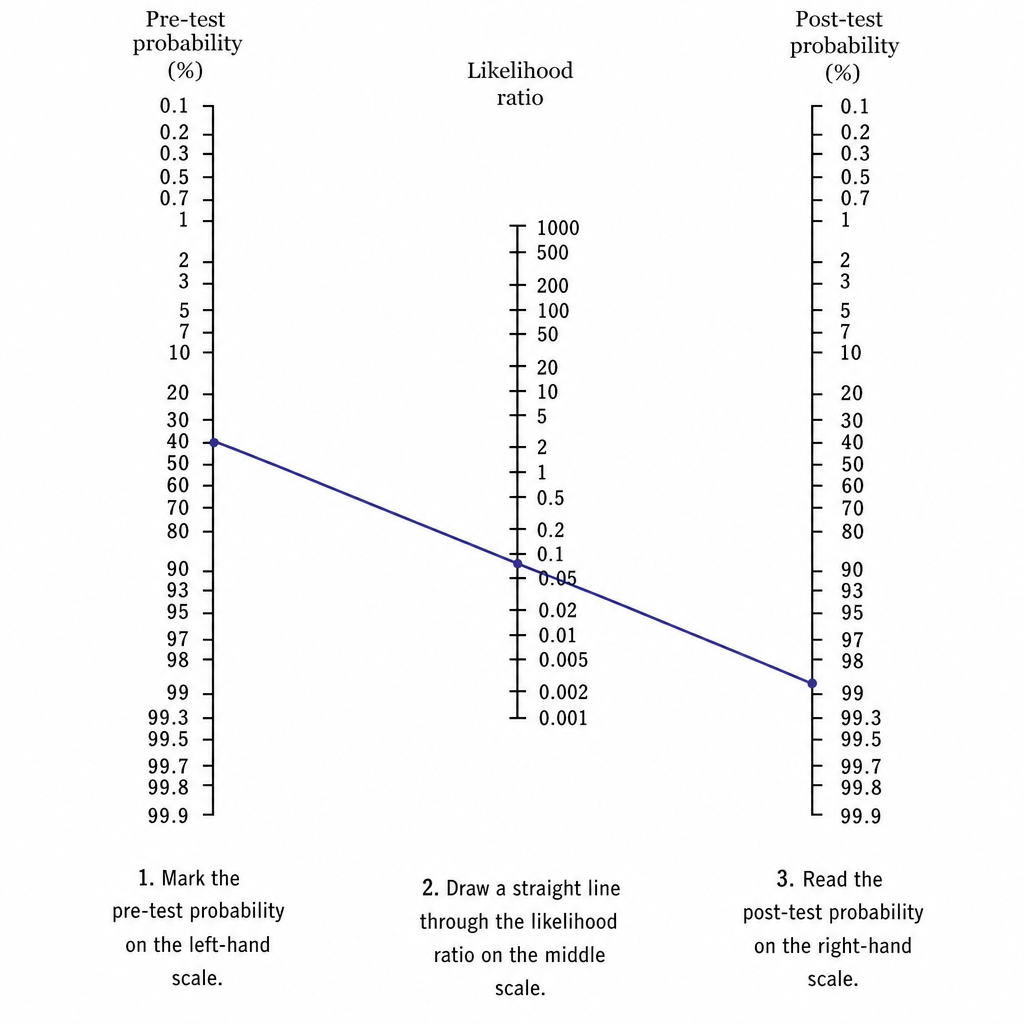
A 14-month-old Caucasian boy is admitted to the pediatric clinic with an 8-month history of diarrhea, abdominal tenderness and concomitant failure to thrive. One of the possibilities that may cause these symptoms is Crohn’s disease, and on the basis of the attending pediatrician’s experience, the pre-test probability of this diagnosis was estimated at 40%. According to Fagan’s diagram (picture), if the likelihood ratio of a negative test result (LR-) is 0.04, what is the chance that this is the right diagnosis?
During an evaluation of a new diagnostic imaging modality for detecting salivary gland tumors, 90 patients tested positive out of the 100 patients who tested positive with the gold standard test. A total of 80 individuals tested negative with the new test out of the 100 individuals who tested negative with the gold standard test. What is the positive likelihood ratio for this test?
A 21-year-old U.S. born first year medical student with no prior hospital or healthcare work presents to the physician for a routine physical exam. The patient is HIV negative, denies drug use, and denies sick contacts. The physician places a purified protein tuberculin test in the patient's right forearm intradermally. What is the proper time to read the test and induration diameter that would indicate a positive test result?
You are reviewing raw data from a research study performed at your medical center examining the effectiveness of a novel AIDS screening examination. The study enrolled 250 patients with confirmed AIDS, and 240 of these patients demonstrated a positive screening examination. The control arm of the study enrolled 250 patients who do not have AIDS, and only 5 of these patients tested positive on the novel screening examination. What is the NPV of this novel test?
A 23-year-old female college basketball player presents in Sports Clinic after she felt a "pop" in her knee after coming down with a rebound. To examine the patient, you have her lie down on the table with her knees flexed 90 degrees. With your hand around her knee you are able to draw the tibia toward you from underneath the femur. The torn structure implicated by this physical exam maneuver has which of the following attachments?
A 60-year-old-man presents to his physician with worsening myalgias and new symptoms of early fatigue, muscle weakness, and drooping eyelids. His wife presents with him and states that he never used to have such symptoms. His medical history is significant for gout, hypertension, hypercholesterolemia, diabetes mellitus type II, and pilocytic astrocytoma as a teenager. He denies smoking, drinks a 6-pack of beer per day, and endorses a past history of cocaine use but currently denies any illicit drug use. His vital signs include temperature 36.7°C (98.0°F), blood pressure 126/74 mm Hg, heart rate 87/min, and respiratory rate 15/min. Physical examination shows minimal bibasilar rales, but otherwise clear lungs on auscultation, grade 2/6 holosystolic murmur, 3/5 strength in all extremities, and benign abdominal findings. The Tensilon test result is positive. Which of the following options explains why a chest CT should be ordered for this patient?
A 28-year-old woman comes to the emergency department for a rash that began 3 days ago. She has low-grade fever and muscle aches. She has no history of serious illness and takes no medications. She has had 5 male sexual partners over the past year and uses condoms inconsistently. Her temperature is 38.1°C (100.6° F), pulse is 85/min, and blood pressure is 126/89 mm Hg. Examination shows a diffuse maculopapular rash that includes the palms and soles. The remainder of the examination shows no abnormalities. A venereal disease research laboratory (VDRL) test is positive. Which of the following is the next appropriate step in management?
Want unlimited practice?
Get full access to all questions, explanations, and performance tracking.
Scan to download app