
Cost-effective test ordering — MCQs

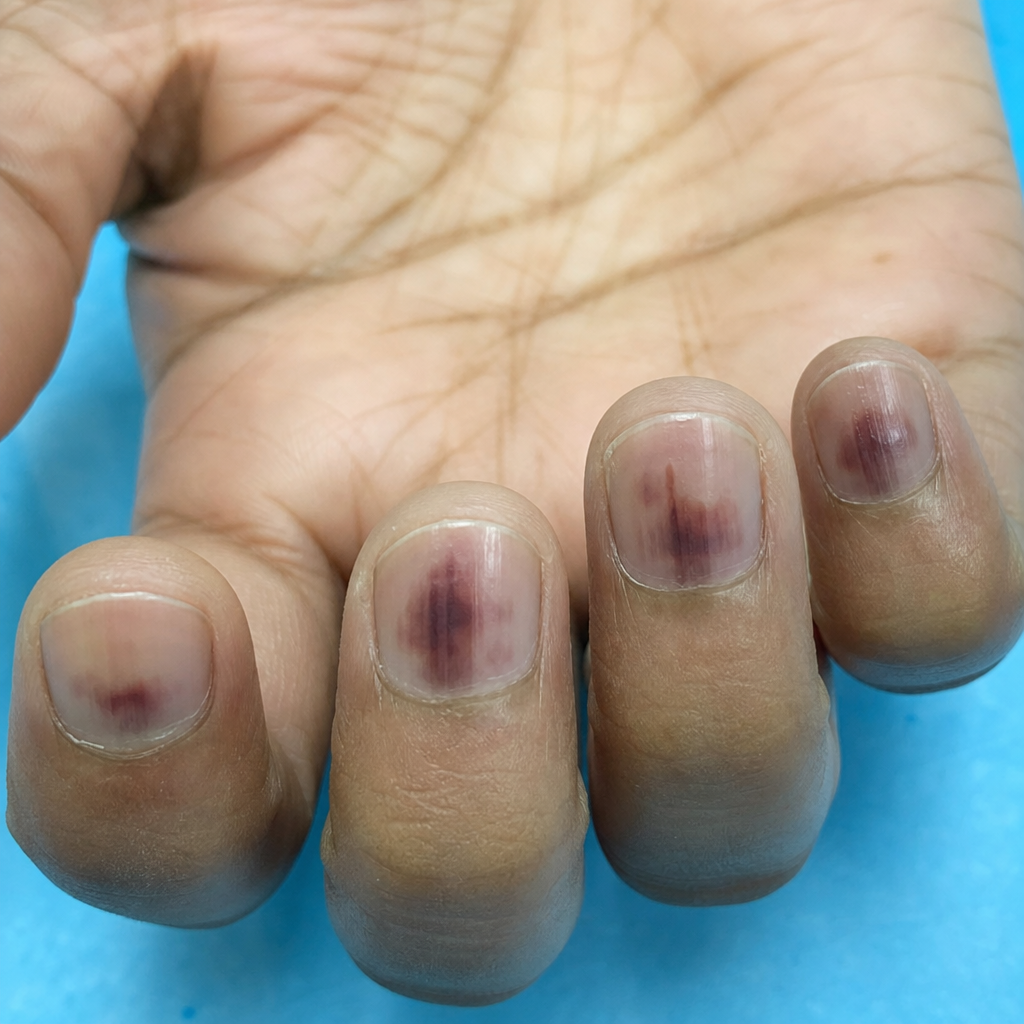
A 35-year-old woman with a medical history significant for asthma, hypertension, and occasional IV drug use comes to the emergency department with fever. On physical exam, there are findings depicted in figure A, for which the patient cannot account. What test will be most helpful to establish the diagnosis?
A mother presents to the family physician with her 16-year-old son. She explains, "There's something wrong with him doc. His grades are getting worse, he's cutting class, he's gaining weight, and his eyes are often bloodshot." Upon interviewing the patient apart from his mother, he seems withdrawn and angry at times when probed about his social history. The patient denies abuse and sexual history. What initial test should be sent to rule out the most likely culprit of this patient's behavior?
A 50-year-old woman presents with esophageal varices, alcoholic cirrhosis, hepatic encephalopathy, portal hypertension, and recent onset confusion. The patient’s husband does not recall her past medical history but knows her current medications and states that she is quite disciplined about taking them. Current medications are spironolactone, labetalol, lactulose, and furosemide. Her temperature is 38.3°C (100.9°F), heart rate is 115/min, blood pressure is 105/62 mm Hg, respiratory rate is 12/min, and oxygen saturation is 96% on room air. On physical examination, the patient is disoriented, lethargic, and poorly responsive to commands. A cardiac examination is unremarkable. Lungs are clear to auscultation. The abdomen is distended, tense, and mildly tender. Mild asterixis is present. Neurologic examination is normal. The digital rectal examination reveals guaiac negative stool. Laboratory findings are significant for the following: Basic metabolic panel Unremarkable Platelet count 95,500/µL Leukocyte count 14,790/µL Hematocrit 33% (baseline is 30%) Which of the following would most likely be of diagnostic value in this patient?
You are developing a new diagnostic test to identify patients with disease X. Of 100 patients tested with the gold standard test, 10% tested positive. Of those that tested positive, the experimental test was positive for 90% of those patients. The specificity of the experimental test is 20%. What is the positive predictive value of this new test?
A family doctor in a rural area is treating a patient for dyspepsia. The patient had chronic heartburn and abdominal pain for the last 2 months and peptic ulcer disease due to a suspected H. pylori infection. For reasons relating to affordability and accessibility, the doctor decides to perform a diagnostic test in the office that is less invasive and more convenient. Which of the following is the most likely test used?
A 55-year-old woman presents with fatigue and flu-like symptoms. She says her symptoms started 5 days ago with a low-grade fever and myalgia, which have not improved. For the past 4 days, she has also had chills, sore throat, and rhinorrhea. She works as a kindergarten teacher and says several children in her class have had similar symptoms. Her past medical history is significant for depression managed with escitalopram, and dysmenorrhea. A review of systems is significant for general fatigue for the past 5 months. Her vital signs include: temperature 38.5°C (101.3°F), pulse 99/min, blood pressure 115/75 mm Hg, and respiratory rate 22/min. Physical examination reveals pallor of the mucous membranes. Initial laboratory findings are significant for the following: Hematocrit 24.5% Hemoglobin 11.0 g/dL Platelet Count 215,000/mm3 Mean corpuscular volume (MCV) 82 fL Red cell distribution width (RDW) 10.5% Which of the following is the best next diagnostic test in this patient?
A research study is comparing 2 novel tests for the diagnosis of Alzheimer’s disease (AD). The first is a serum blood test, and the second is a novel PET radiotracer that binds to beta-amyloid plaques. The researchers intend to have one group of patients with AD assessed via the novel blood test, and the other group assessed via the novel PET examination. In comparing these 2 trial subsets, the authors of the study may encounter which type of bias?
Two studies are reviewed for submission to an oncology journal. In Study A, a novel MRI technology is evaluated as a screening tool for ovarian cancer. The authors find that the mean survival time is 4 years in the control group and 10 years in the MRI-screened group. In Study B, cognitive behavioral therapy (CBT) and a novel antidepressant are used to treat patients with comorbid pancreatic cancer and major depression. Patients receiving the new drug are told that they are expected to have quick resolution of their depression, while those who do not receive the drug are not told anything about their prognosis. Which of the following describes the likely type of bias in Study A and Study B?
A pharmaceutical corporation is developing a research study to evaluate a novel blood test to screen for breast cancer. They enrolled 800 patients in the study, half of which have breast cancer. The remaining enrolled patients are age-matched controls who do not have the disease. Of those in the diseased arm, 330 are found positive for the test. Of the patients in the control arm, only 30 are found positive. What is this test’s sensitivity?
A 65-year-old man is admitted to the hospital because of a 1-month history of fatigue, intermittent fever, and weakness. Results from a peripheral blood smear taken during his evaluation are indicative of possible acute myeloid leukemia. Bone marrow aspiration and subsequent cytogenetic studies confirm the diagnosis. The physician sets aside an appointed time-slot and arranges a meeting in a quiet office to inform him about the diagnosis and discuss his options. He has been encouraged to bring someone along to the appointment if he wanted. He comes to your office at the appointed time with his daughter. He appears relaxed, with a full range of affect. Which of the following is the most appropriate opening statement in this situation?
Want unlimited practice?
Get full access to all questions, explanations, and performance tracking.
Scan to download app