A 36-year-old female presents to clinic inquiring about the meaning of a previous negative test result from a new HIV screening test. The efficacy of this new screening test for HIV has been assessed by comparison against existing gold standard detection of HIV RNA via PCR. The study includes 1000 patients, with 850 HIV-negative patients (by PCR) receiving a negative test result, 30 HIV-negative patients receiving a positive test result, 100 HIV positive patients receiving a positive test result, and 20 HIV positive patients receiving a negative test result. Which of the following is most likely to increase the negative predictive value for this test?
Q32
A novel PET radiotracer is being evaluated for its ability to aid in the diagnosis of Alzheimer’s disease (AD). The study decides to use a sample size of 1,000 patients, and half of the patients enrolled have AD. In the group of patients with AD, 400 are found positive on the novel type of PET imaging examination. In the control group, 50 are found positive. What is the PPV of this novel exam?
Q33
A new assay for Lyme disease has been developed. While the assay has been tested extensively in Maine, a group of inventors are planning to test it in Southern California. In comparison to the assay's performance in Maine, testing the assay in Southern California would affect the performance of the assay in which of the following ways?
Q34
A genetic population study is being conducted to find the penetrance of a certain disease. This disease is associated with impaired iron metabolism and primarily affects the liver. Patients often present with diabetes and bronze skin pigmentation. After a genetic screening of 120 inhabitants with a family history of this disease, 40 were found to have the disease-producing genotype, but only 10 presented with symptoms. What are the chances of the screened patients with said genotype developing the disease phenotype?
Q35
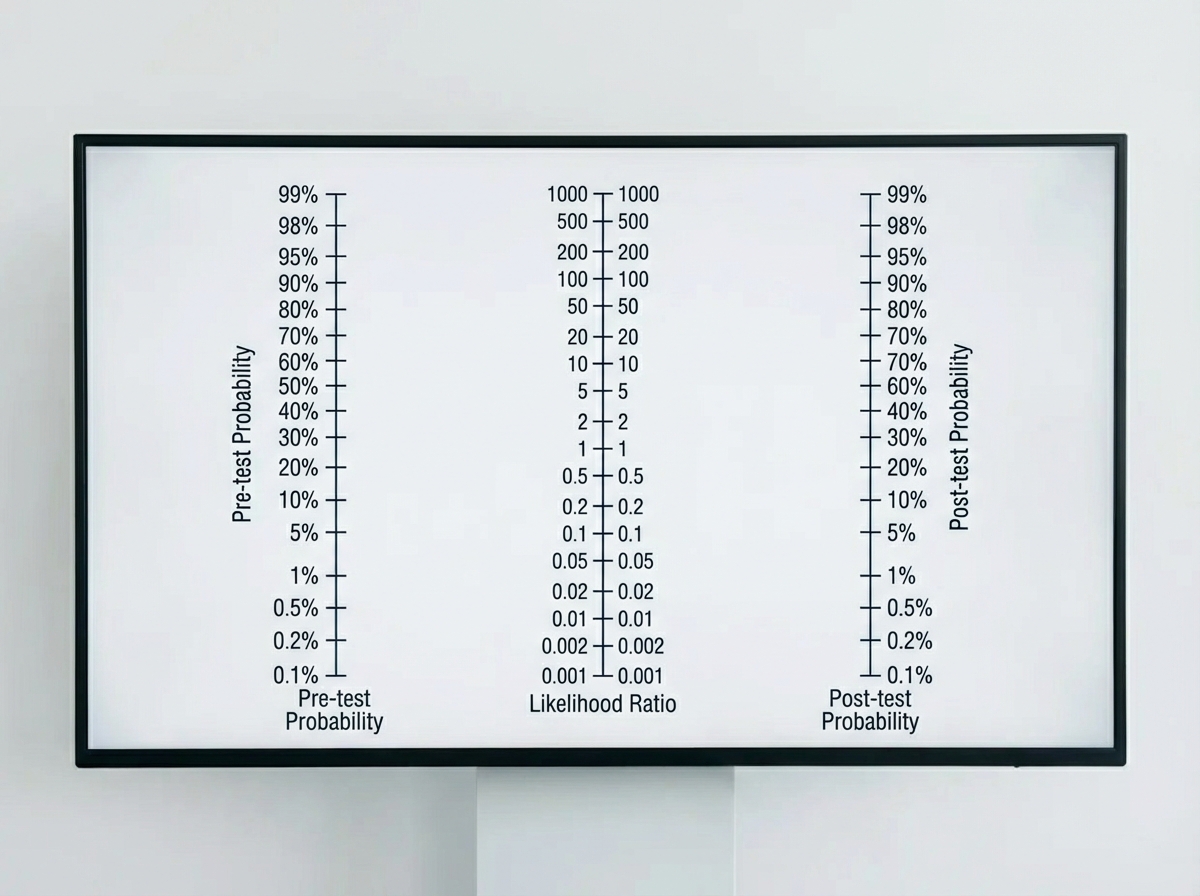
A 14-month-old boy is brought in by his parents with an 8-month history of diarrhea, abdominal tenderness and concomitant failure to thrive. The pediatric attending physician believes that Crohn’s disease is the best explanation of this patient’s symptoms. Based on the pediatric attending physician’s experience, the pretest probability of this diagnosis is estimated at 40%. According to Fagan nomogram (see image). If the likelihood ratio of a negative test result (LR-) for Crohn’s disease is 0.04, what is the chance that this is the correct diagnosis in this patient with a negative test result?
Q36
A geriatric investigator is evaluating the consistency of Alzheimer dementia diagnoses based on clinical symptoms. Patients with known chart diagnoses of Alzheimer dementia were evaluated by multiple physicians during a fixed time interval. Each evaluator was blinded to the others' assessments. The extent to which the diagnosis by one physician was replicated by another clinician examining the same patient is best described by which of the following terms?
Q37
An infectious disease investigator is evaluating the diagnostic accuracy of a new interferon-gamma-based assay for diagnosing tuberculosis in patients who have previously received a Bacillus Calmette-Guérin (BCG) vaccine. Consenting participants with a history of BCG vaccination received an interferon-gamma assay and were subsequently evaluated for tuberculosis by sputum culture. Results of the study are summarized in the table below.
Tuberculosis, confirmed by culture No tuberculosis Total
Positive interferon-gamma assay 90 6 96
Negative interferon-gamma assay 10 194 204
Total 100 200 300
Based on these results, what is the sensitivity of the interferon-gamma-based assay for the diagnosis of tuberculosis in this study?
Q38
You are reviewing raw data from a research study performed at your medical center examining the effectiveness of a novel AIDS screening examination. The study enrolled 250 patients with confirmed AIDS, and 240 of these patients demonstrated a positive screening examination. The control arm of the study enrolled 250 patients who do not have AIDS, and only 5 of these patients tested positive on the novel screening examination. What is the NPV of this novel test?
Q39
A new screening test utilizing a telemedicine approach to diagnosing diabetic retinopathy has been implemented in a diabetes clinic. An ophthalmologist’s exam was also performed on all patients as the gold standard for diagnosis. In a pilot study of 500 patients, the screening test detected the presence of diabetic retinopathy in 250 patients. Ophthalmologist exam confirmed a diagnosis of diabetic retinopathy in 200 patients who tested positive in the screening test, as well as 10 patients who tested negative in the screening test. What is the sensitivity, specificity, positive predictive value, and negative predictive value of the screening test?
Sensitivity/Specificity US Medical PG Practice Questions and MCQs
Question 31: A 36-year-old female presents to clinic inquiring about the meaning of a previous negative test result from a new HIV screening test. The efficacy of this new screening test for HIV has been assessed by comparison against existing gold standard detection of HIV RNA via PCR. The study includes 1000 patients, with 850 HIV-negative patients (by PCR) receiving a negative test result, 30 HIV-negative patients receiving a positive test result, 100 HIV positive patients receiving a positive test result, and 20 HIV positive patients receiving a negative test result. Which of the following is most likely to increase the negative predictive value for this test?
A. Decreased prevalence of HIV in the tested population (Correct Answer)
B. Increased prevalence of HIV in the tested population
C. Increased number of false positive test results
D. Increased number of false negative test results
E. Decreased number of false positive test results
Explanation: ***Decreased prevalence of HIV in the tested population***
- A **lower prevalence** of a disease in the population means there are fewer actual cases, making a **negative test result** more reliable in ruling out the disease.
- This increases the probability that a person with a negative test truly does not have the disease, thus elevating the **negative predictive value (NPV)**.
*Increased prevalence of HIV in the tested population*
- A **higher prevalence** means there are more actual cases of HIV in the population.
- In this scenario, a negative test result is less reassuring, as there's a greater chance of missing a true positive case, leading to a **decreased NPV**.
*Increased number of false positive test results*
- **False positives** are instances where a test indicates disease when it's not present; they do not directly impact the ability of a negative test to predict absence of disease.
- While they affect the **positive predictive value (PPV)**, they do not directly alter the reliability of a negative result to exclude disease, so the NPV is not increased.
*Increased number of false negative test results*
- **False negatives** occur when a test indicates no disease, but the disease is actually present.
- An increase in false negatives directly implies that a negative test result is less trustworthy, leading to a **decrease in the NPV**.
*Decreased number of false positive test results*
- A decrease in false positive results primarily improves the **positive predictive value (PPV)**.
- While it indicates a more accurate test overall, it does not directly affect NPV, which measures the reliability of a negative test result in ruling out disease.
Question 32: A novel PET radiotracer is being evaluated for its ability to aid in the diagnosis of Alzheimer’s disease (AD). The study decides to use a sample size of 1,000 patients, and half of the patients enrolled have AD. In the group of patients with AD, 400 are found positive on the novel type of PET imaging examination. In the control group, 50 are found positive. What is the PPV of this novel exam?
A. 400 / (400+50) (Correct Answer)
B. 450 / (450 + 100)
C. 400 / (400+100)
D. 450 / (450 + 50)
E. 400 / (400 + 150)
Explanation: ***400 / (400+50)***
- The **Positive Predictive Value (PPV)** is the probability that subjects with a positive test result actually have the disease. It's calculated as **True Positives / (True Positives + False Positives)**.
- In this scenario, **True Positives** are 400 (patients with AD who tested positive), and **False Positives** are 50 (control patients without AD who tested positive).
*450 / (450 + 100)*
- This calculation incorrectly includes **False Negatives** (450, total AD patients - true positives) in the numerator or denominator for PPV, and misidentifies other components.
- The formula for PPV specifically focuses on positive test results and the proportion of those that are truly disease-positive.
*400 / (400+100)*
- This option correctly identifies **True Positives** as 400 but incorrectly assumes **False Positives** are 100.
- The problem states that 50 control patients (without AD) tested positive, which are the false positives.
*450 / (450 + 50)*
- This formula incorrectly uses **450** as the number of **True Positives**, which represents the total number of patients with AD testing positive and negative (400 TP + 100 FN).
- PPV only considers those who tested positive in its numerator.
*400 / (400 + 150)*
- While 400 is correctly identified as **True Positives**, the **False Positives** are incorrectly stated as 150.
- The problem explicitly states that 50 control patients were found positive, making 50 the correct number for false positives.
Question 33: A new assay for Lyme disease has been developed. While the assay has been tested extensively in Maine, a group of inventors are planning to test it in Southern California. In comparison to the assay's performance in Maine, testing the assay in Southern California would affect the performance of the assay in which of the following ways?
A. Greater likelihood that an individual with a positive test will truly have Lyme disease
B. Decreased positive likelihood ratio of the Lyme disease assay
C. Decrease negative likelihood ratio of the Lyme disease assay
D. Lower likelihood that a patient without Lyme disease truly has a negative test
E. Greater likelihood that an individual with a negative test will truly not have Lyme disease (Correct Answer)
Explanation: ***Greater likelihood that an individual with a negative test will truly not have Lyme disease***
- This scenario describes an increase in the **negative predictive value (NPV)** of the assay. In an area with lower disease prevalence (Southern California compared to Maine for Lyme disease), the NPV increases because there are fewer true cases to miss, making a negative result more reliable in ruling out the disease.
- The intrinsic properties of the test (sensitivity and specificity) remain the same, but the interpretation of its results is influenced by the **pre-test probability** (prevalence).
*Greater likelihood that an individual with a positive test will truly have Lyme disease*
- This describes an increase in the **positive predictive value (PPV)**. This would occur if the test were moved to an area with higher **prevalence**, not lower prevalence like Southern California for Lyme disease.
- In an area with lower prevalence, the PPV would actually **decrease**, meaning a positive test is less likely to represent a true positive.
*Decreased positive likelihood ratio of the Lyme disease assay*
- The **likelihood ratio (LR)** of a diagnostic test is an intrinsic property that depends on its **sensitivity** and **specificity**, and it is generally independent of disease prevalence.
- Therefore, moving the test to an area with different prevalence should not change its positive likelihood ratio.
*Decrease negative likelihood ratio of the Lyme disease assay*
- Similar to the positive LR, the **negative likelihood ratio** is an intrinsic characteristic of the test (calculated from sensitivity and specificity).
- It remains constant regardless of the **disease prevalence** in the population being tested.
*Lower likelihood that a patient without Lyme disease truly has a negative test*
- This statement describes a decrease in **specificity** (a decrease in the true negative rate) or an increase in the **false negative rate**.
- The intrinsic **specificity** of the assay does not change with population prevalence, only the interpretation of the results through metrics like predictive values.
Question 34: A genetic population study is being conducted to find the penetrance of a certain disease. This disease is associated with impaired iron metabolism and primarily affects the liver. Patients often present with diabetes and bronze skin pigmentation. After a genetic screening of 120 inhabitants with a family history of this disease, 40 were found to have the disease-producing genotype, but only 10 presented with symptoms. What are the chances of the screened patients with said genotype developing the disease phenotype?
A. 0.4%
B. 40%
C. 3%
D. 4%
E. 25% (Correct Answer)
Explanation: ***25%***
- **Penetrance** is calculated as the proportion of individuals with a specific genotype who express the associated phenotype.
- In this case, 10 individuals out of 40 with the disease-producing genotype developed symptoms, so (10 / 40) * 100% = **25%**.
*0.4%*
- This value is significantly lower than the actual penetrance and likely results from an incorrect calculation or misinterpretation of the given data.
- It does not accurately reflect the proportion of genotypically affected individuals who express the phenotype.
*40%*
- This percentage represents the proportion of screened individuals with the disease-producing genotype (40 out of 120 are ~33%), not the penetrance itself.
- It incorrectly equates the presence of the genotype in the population with the expression of the phenotype.
*3%*
- This value is likely obtained by an erroneous calculation, possibly by dividing the symptomatic individuals by the total screened population (10/120 ≈ 8.3%), which does not represent penetrance.
- It does not account for the specific individuals who possess the genotype.
*4%*
- This percentage might arise from an incorrect division or a misunderstanding of what constitutes penetrance.
- It is an inaccurate representation of the ratio between phenotype expression and genotype presence.
Question 35: A 14-month-old boy is brought in by his parents with an 8-month history of diarrhea, abdominal tenderness and concomitant failure to thrive. The pediatric attending physician believes that Crohn’s disease is the best explanation of this patient’s symptoms. Based on the pediatric attending physician’s experience, the pretest probability of this diagnosis is estimated at 40%. According to Fagan nomogram (see image). If the likelihood ratio of a negative test result (LR-) for Crohn’s disease is 0.04, what is the chance that this is the correct diagnosis in this patient with a negative test result?
A. 40%
B. 75%
C. 97.5%
D. 25%
E. 2.5% (Correct Answer)
Explanation: ***2.5%***
- Begin by locating the **pretest probability of 40%** on the left-hand scale of the **Fagan nomogram**
- Draw a line from this point through the **likelihood ratio negative (LR-) of 0.04** on the middle scale, extending it to the right-hand scale to find the **posttest probability of approximately 2.5%**
- This can be verified mathematically: pretest odds = 0.40/0.60 = 0.667; posttest odds = 0.667 × 0.04 = 0.027; posttest probability = 0.027/1.027 ≈ 2.6% (rounds to 2.5%)
*40%*
- This represents the **initial pretest probability** before incorporating the test result
- It does not account for the impact of the **negative test result** with an LR- of 0.04
- The Fagan nomogram is used to **update this probability** based on the test outcome
*75%*
- This value does not align with a **negative test result** and an **LR- of 0.04**
- A posttest probability higher than the pretest probability would require a positive test with an LR+ greater than 1
- With a negative test and LR- = 0.04, the probability must decrease significantly
*97.5%*
- This extremely high posttest probability would require a **positive test** with a very high **likelihood ratio positive (LR+)**
- It is completely inconsistent with a **negative test result** and a low LR- of 0.04
- An LR- of 0.04 indicates strong evidence against the disease, not for it
*25%*
- While this represents a decrease from the pretest probability of 40%, it underestimates the impact of the test result
- An **LR- of 0.04** means the odds of having the disease are reduced by a factor of 25 (multiplied by 0.04)
- This should yield a much lower posttest probability than 25%
Question 36: A geriatric investigator is evaluating the consistency of Alzheimer dementia diagnoses based on clinical symptoms. Patients with known chart diagnoses of Alzheimer dementia were evaluated by multiple physicians during a fixed time interval. Each evaluator was blinded to the others' assessments. The extent to which the diagnosis by one physician was replicated by another clinician examining the same patient is best described by which of the following terms?
A. Validity
B. Specificity
C. Predictive value
D. Sensitivity
E. Precision (Correct Answer)
Explanation: ***Precision***
- **Precision** refers to the consistency or reproducibility of a measurement or diagnosis. When multiple physicians reach the same diagnosis for the same patient, it indicates high precision.
- In this context, it specifically assesses **inter-rater reliability**, which is the extent to which different observers agree on the same assessment.
*Validity*
- **Validity** refers to the extent to which a test or measure accurately assesses what it is intended to measure. It is about the "truthfulness" of the diagnosis.
- While important for diagnosis, validity is about accuracy against a gold standard, not consistency among different observers.
*Specificity*
- **Specificity** is the ability of a test to correctly identify individuals who do *not* have the disease (true negatives).
- It measures the proportion of healthy individuals who are correctly identified as healthy by the test, which is not what is being evaluated here.
*Predictive value*
- **Predictive value** assesses the probability that a person *actually has* (positive predictive value) or *does not have* (negative predictive value) a disease given their test result.
- This concept relates to the diagnostic utility of a test in a population, not the consistency of different clinician diagnoses.
*Sensitivity*
- **Sensitivity** is the ability of a test to correctly identify individuals who *do* have the disease (true positives).
- It measures the proportion of diseased individuals who are correctly identified as diseased by the test, which is distinct from inter-rater agreement.
Question 37: An infectious disease investigator is evaluating the diagnostic accuracy of a new interferon-gamma-based assay for diagnosing tuberculosis in patients who have previously received a Bacillus Calmette-Guérin (BCG) vaccine. Consenting participants with a history of BCG vaccination received an interferon-gamma assay and were subsequently evaluated for tuberculosis by sputum culture. Results of the study are summarized in the table below.
Tuberculosis, confirmed by culture No tuberculosis Total
Positive interferon-gamma assay 90 6 96
Negative interferon-gamma assay 10 194 204
Total 100 200 300
Based on these results, what is the sensitivity of the interferon-gamma-based assay for the diagnosis of tuberculosis in this study?
A. 90/96
B. 100/300
C. 194/200
D. 90/100 (Correct Answer)
E. 194/204
Explanation: ***90/100***
- **Sensitivity** measures the proportion of **true positive** cases that are correctly identified by the test.
- In this study, there are 90 true positive results (positive interferon-gamma assay in patients with confirmed tuberculosis) out of a total of 100 individuals with confirmed tuberculosis (90 + 10).
*90/96*
- This calculation represents the **positive predictive value** (90 true positives / 96 total positive tests).
- It answers the question: "If the test is positive, what is the likelihood that the patient actually has the disease?"
*100/300*
- This value represents the prevalence of tuberculosis in the study population (100 confirmed cases / 300 total participants).
- It does not reflect a measure of the test's diagnostic accuracy.
*194/200*
- This value represents the **specificity** of the test (194 true negatives / 200 total individuals without tuberculosis).
- Specificity measures the proportion of true negative cases that are correctly identified by the test.
*194/204*
- This calculation represents the **negative predictive value** (194 true negatives / 204 total negative tests).
- It answers the question: "If the test is negative, what is the likelihood that the patient does not have the disease?"
Question 38: You are reviewing raw data from a research study performed at your medical center examining the effectiveness of a novel AIDS screening examination. The study enrolled 250 patients with confirmed AIDS, and 240 of these patients demonstrated a positive screening examination. The control arm of the study enrolled 250 patients who do not have AIDS, and only 5 of these patients tested positive on the novel screening examination. What is the NPV of this novel test?
A. 240 / (240 + 15)
B. 240 / (240 + 5)
C. 240 / (240 + 10)
D. 245 / (245 + 10) (Correct Answer)
E. 245 / (245 + 5)
Explanation: ***245 / (245 + 10)***
- The **negative predictive value (NPV)** is calculated as **true negatives (TN)** divided by the sum of **true negatives (TN)** and **false negatives (FN)**.
- In this study, there are 250 patients with AIDS; 240 tested positive (true positives, TP), meaning 10 tested negative (false negatives, FN = 250 - 240). There are 250 patients without AIDS; 5 tested positive (false positives, FP), meaning 245 tested negative (true negatives, TN = 250 - 5). Therefore, NPV = 245 / (245 + 10).
*240 / (240 + 15)*
- This calculation incorrectly uses the number of **true positives** (240) in the numerator and denominator, which is relevant for **positive predictive value (PPV)**, not NPV.
- The denominator `(240 + 15)` does not correspond to a valid sum for calculating NPV from the given data.
*240 / (240 + 5)*
- This calculation incorrectly uses **true positives** (240) in the numerator, which is not part of the NPV formula.
- The denominator `(240 + 5)` mixes true positives and false positives, which is incorrect for NPV.
*240 / (240 + 10)*
- This incorrectly places **true positives** (240) in the numerator instead of **true negatives**.
- The denominator `(240+10)` represents **true positives + false negatives**, which is related to sensitivity, not NPV.
*245 / (245 + 5)*
- This calculation correctly identifies **true negatives** (245) in the numerator but incorrectly uses **false positives** (5) in the denominator instead of **false negatives**.
- The denominator for NPV should be **true negatives + false negatives**, which is 245 + 10.
Question 39: A new screening test utilizing a telemedicine approach to diagnosing diabetic retinopathy has been implemented in a diabetes clinic. An ophthalmologist’s exam was also performed on all patients as the gold standard for diagnosis. In a pilot study of 500 patients, the screening test detected the presence of diabetic retinopathy in 250 patients. Ophthalmologist exam confirmed a diagnosis of diabetic retinopathy in 200 patients who tested positive in the screening test, as well as 10 patients who tested negative in the screening test. What is the sensitivity, specificity, positive predictive value, and negative predictive value of the screening test?