
Reporting in medical literature — MCQs

A researcher is investigating whether there is an association between the use of social media in teenagers and bipolar disorder. In order to study this potential relationship, she collects data from people who have bipolar disorder and matched controls without the disorder. She then asks how much on average these individuals used social media in the 3 years prior to their diagnosis. This continuous data is divided into 2 groups: those who used more than 2 hours per day and those who used less than 2 hours per day. She finds that out of 1000 subjects, 500 had bipolar disorder of which 300 used social media more than 2 hours per day. She also finds that 400 subjects who did not have the disorder also did not use social media more than 2 hours per day. Which of the following is the odds ratio for development of bipolar disorder after being exposed to more social media?
Group of 100 medical students took an end of the year exam. The mean score on the exam was 70%, with a standard deviation of 25%. The professor states that a student's score must be within the 95% confidence interval of the mean to pass the exam. Which of the following is the minimum score a student can have to pass the exam?
A 25-year-old man with a genetic disorder presents for genetic counseling because he is concerned about the risk that any children he has will have the same disease as himself. Specifically, since childhood he has had difficulty breathing requiring bronchodilators, inhaled corticosteroids, and chest physiotherapy. He has also had diarrhea and malabsorption requiring enzyme replacement therapy. If his wife comes from a population where 1 in 10,000 people are affected by this same disorder, which of the following best represents the likelihood a child would be affected as well?
A randomized control double-blind study is conducted on the efficacy of 2 sulfonylureas. The study concluded that medication 1 was more efficacious in lowering fasting blood glucose than medication 2 (p ≤ 0.05; 95% CI: 14 [10-21]). Which of the following is true regarding a 95% confidence interval (CI)?
A researcher is conducting a study to compare fracture risk in male patients above the age of 65 who received annual DEXA screening to peers who did not receive screening. He conducts a randomized controlled trial in 900 patients, with half of participants assigned to each experimental group. The researcher ultimately finds similar rates of fractures in the two groups. He then notices that he had forgotten to include 400 patients in his analysis. Including the additional participants in his analysis would most likely affect the study's results in which of the following ways?
A healthy 29-year-old nulligravid woman comes to the physician for genetic counseling prior to conception. Her brother has a disease that has resulted in infertility, a right-sided heart, and frequent sinus and ear infections. No other family members are affected. The intended father has no history of this disease. The population prevalence of this disease is 1 in 40,000. Which of the following best represents the chance that this patient’s offspring will develop her brother's disease?
In a randomized controlled trial studying a new treatment, the primary endpoint (mortality) occurred in 14.4% of the treatment group and 16.7% of the control group. Which of the following represents the number of patients needed to treat to save one life, based on the primary endpoint?
In 2013 the national mean score on the USMLE Step 1 exam was 227 with a standard deviation of 22. Assuming that the scores for 15,000 people follow a normal distribution, approximately how many students scored above the mean but below 250?
A researcher has identified a chemical compound that she expects may contribute to the development of colorectal cancer. She designs an experiment where she exposes 70 mice to a diet containing this compound with another 50 mice in a control group that was fed a regular diet. After 9 months, the mice were evaluated for tumor development at necropsy. In total, 14 mice in the experimental group developed colorectal tumor burden, and 1 mouse in the control group developed tumors. Based on this experiment, what risk of colorectal cancer can be attributable to this chemical compound?
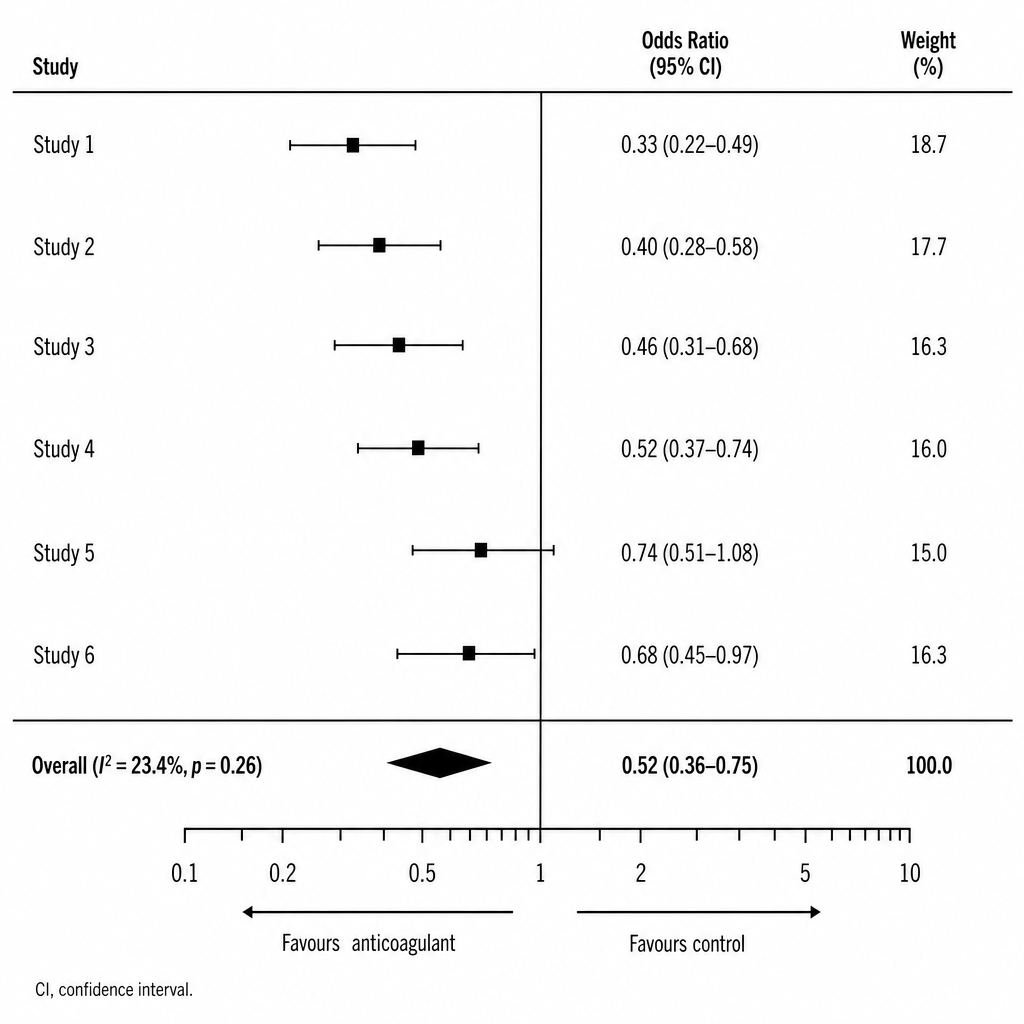
An investigator presents a forest plot from a meta-analysis of six RCTs examining whether a new anticoagulant reduces stroke in patients with non-valvular atrial fibrillation. The image shows individual study odds ratios with 95% confidence intervals and an overall pooled estimate. Studies 1–4 show confidence intervals entirely to the left of the line of no effect. Study 5 shows a confidence interval of 0.74 (95% CI: 0.51–1.08). Study 6 shows a confidence interval of 0.68 (95% CI: 0.45–0.97). Which of the following conclusions is best supported by these results?
Want unlimited practice?
Get full access to all questions, explanations, and performance tracking.
Scan to download app