
Survival curves — MCQs

Group of 100 medical students took an end of the year exam. The mean score on the exam was 70%, with a standard deviation of 25%. The professor states that a student's score must be within the 95% confidence interval of the mean to pass the exam. Which of the following is the minimum score a student can have to pass the exam?
A researcher is trying to determine whether a newly discovered substance X can be useful in promoting wound healing after surgery. She conducts this study by enrolling the next 100 patients that will be undergoing this surgery and separating them into 2 groups. She decides which patient will be in which group by using a random number generator. Subsequently, she prepares 1 set of syringes with the novel substance X and 1 set of syringes with a saline control. Both of these sets of syringes are unlabeled and the substances inside cannot be distinguished. She gives the surgeon performing the surgery 1 of the syringes and does not inform him nor the patient which syringe was used. After the study is complete, she analyzes all the data that was collected and performs statistical analysis. This study most likely provides which level of evidence for use of substance X?
A pharmaceutical company conducts a randomized clinical trial to demonstrate that their new anticoagulant drug, Aclotsaban, prevents more thrombotic events following total knee arthroplasty than the current standard of care. A significant number of patients are lost to follow-up, and many fail to complete treatment according to the study arm to which they were assigned. Despite these protocol deviations, the results for the patients who completed the course of Aclotsaban are encouraging. Which of the following analytical approaches is most appropriate for the primary analysis to establish the efficacy of Aclotsaban?
A neuro-oncology investigator has recently conducted a randomized controlled trial in which the addition of a novel alkylating agent to radiotherapy was found to prolong survival in comparison to radiotherapy alone (HR = 0.7, p < 0.01). A number of surviving participants who took the alkylating agent reported that they had experienced significant nausea from the medication. The investigator surveyed all participants in both the treatment and the control group on their nausea symptoms by self-report rated mild, moderate, or severe. The investigator subsequently compared the two treatment groups with regards to nausea level. | | Mild nausea | Moderate nausea | Severe nausea | |---|---|---|---| | Treatment group (%) | 20 | 30 | 50 | | Control group (%) | 35 | 35 | 30 | Which of the following statistical methods would be most appropriate to assess the statistical significance of these results?
A biostatistician is processing data for a large clinical trial she is working on. The study is analyzing the use of a novel pharmaceutical compound for the treatment of anorexia after chemotherapy with the outcome of interest being the change in weight while taking the drug. While most participants remained about the same weight or continued to lose weight while on chemotherapy, there were smaller groups of individuals who responded very positively to the orexic agent. As a result, the data had a strong positive skew. The biostatistician wishes to report the measures of central tendency for this project. Just by understanding the skew in the data, which of the following can be expected for this data set?
A resident in the department of obstetrics and gynecology is reading about a randomized clinical trial from the late 1990s that was conducted to compare breast cancer mortality risk, disease localization, and tumor size in women who were randomized to groups receiving either annual mammograms starting at age 40 or annual mammograms starting at age 50. One of the tables in the study compares the two experimental groups with regard to socioeconomic demographics (e.g., age, income), medical conditions at the time of recruitment, and family history of breast cancer. The purpose of this table is most likely to evaluate which of the following?
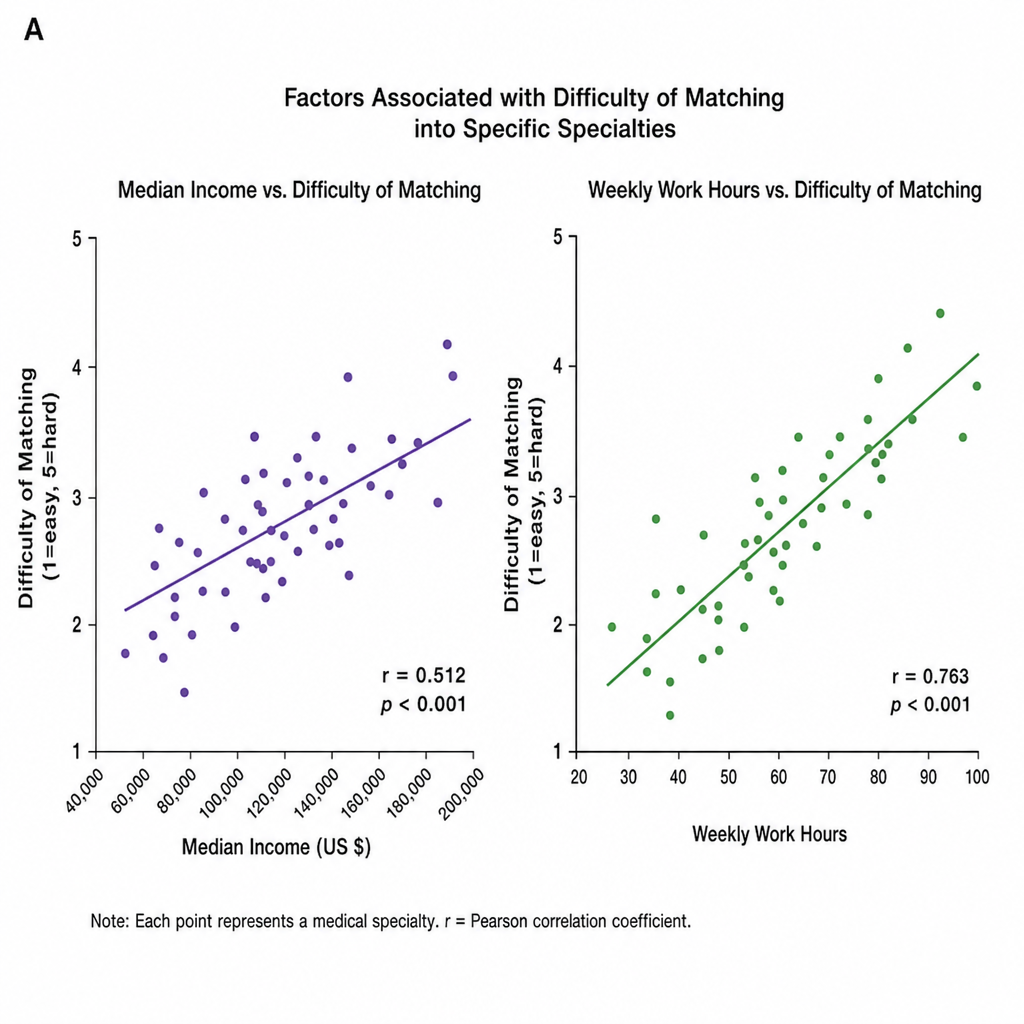
Confident of your performance on Step 1 given your extensive utilization of Medbullets, you preemptively start to ponder your future specialty choice. You come across an analysis of lifestyle factors and how they affect medical student specialty choices. Image A depicts two scatter plots comparing the relationship between median income and weekly work hours on the difficulty of matching into specific specialties. Both associations are statistically significant. Which statement best describes the results?
In 2013 the national mean score on the USMLE Step 1 exam was 227 with a standard deviation of 22. Assuming that the scores for 15,000 people follow a normal distribution, approximately how many students scored above the mean but below 250?
A 28-year-old male presents to his primary care physician with complaints of intermittent abdominal pain and alternating bouts of constipation and diarrhea. His medical chart is not significant for any past medical problems or prior surgeries. He is not prescribed any current medications. Which of the following questions would be the most useful next question in eliciting further history from this patient?
Many large clinics have noticed that the prevalence of primary biliary cholangitis (PBC) has increased significantly over the past 20 years. An epidemiologist is working to identify possible reasons for this. After analyzing a series of nationwide health surveillance databases, the epidemiologist finds that the incidence of PBC has remained stable over the past 20 years. Which of the following is the most plausible explanation for the increased prevalence of PBC?
Want unlimited practice?
Get full access to all questions, explanations, and performance tracking.
Scan to download app