
Vitamin toxicity syndromes — MCQs

A 57-year-old man calls his primary care physician to discuss the results of his annual laboratory exams. The results show that he has dramatically decreased levels of high-density lipoprotein (HDL) and mildly increased levels of low-density lipoprotein (LDL). The physician says that the HDL levels are of primary concern so he is started on the lipid level modifying drug that most effectively increases serum HDL levels. Which of the following is the most likely a side effect of this medication that the patient should be informed about?
A 48-year-old man with a history of diabetes mellitus presents to his primary care physician with lethargy, joint pain, and impotence. Lab evaluation is notable for a ferritin of 1400 ug/L (nl <300 ug/L), increased total iron, increased transferrin saturation, and decreased total iron binding capacity. All of the following are true regarding this patient's condition EXCEPT:
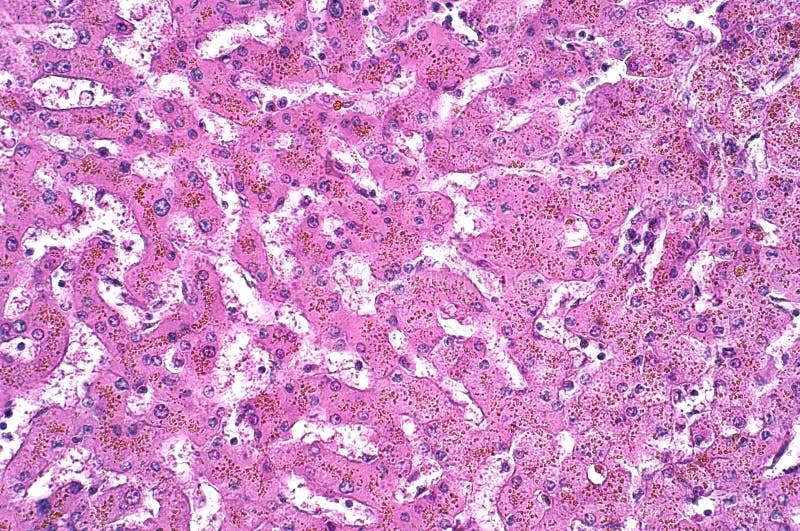
A previously healthy 44-year-old man comes to his physician because of frequent urination and increased thirst for several weeks. Physical examination shows darkened skin and a firm mass in the right upper quadrant. His blood glucose is 220 mg/dL. A photomicrograph of a specimen obtained on liver biopsy is shown. Which of the following best describes the pathogenesis of the disease process in this patient?
A 5-year-old girl is brought to the physician for evaluation of a pruritic rash on her face and extremities for the last year that increases with sun exposure. Her parents report that she often seems clumsy and has had several falls in the last two weeks. Physical examination shows an erythematous, scaly rash with hyperpigmentation over the nasal bridge and cheeks as well as on the dorsal forearms and hands. Urinalysis shows high levels of neutral amino acids. The most appropriate treatment for this patient's condition includes administration of an agent that is associated with which of the following adverse effects?
A 55-year-old male presents to his primary care physician with right upper quadrant pain that has progressed over the last three months with unexplained weakness and joint pains that have been "out of the ordinary" over the last year. On history, you note the patient lives a sedentary lifestyle, rarely leaves the house, has controlled diabetes diagnosed 15 years ago, and has documented cardiomyopathy. On physical exam the man appears non-toxic, sclera are icteric, cornea appear normal, generalized pain is elicited on palpation of the right upper quadrant, and skin appears quite bronzed on his extremities. What is this patient most at risk for ten to fifteen years later due to his underlying condition?
A homeless woman presents with shortness of breath on exertion and pedal edema. Cardiac workup performed shows evidence of dilated cardiomyopathy and increased cardiac output. She also has decreased sensation over both extremities bilaterally. Which vitamin deficiency most likely caused these symptoms?
A 17-year-old male is diagnosed with acne vulgaris during a visit to a dermatologist. He is prescribed a therapy that is a derivative of vitamin A. He has no other significant past medical history. Which of the following is a major side-effect of this therapy that requires regular monitoring during treatment?
A 28-year-old male presents to his primary care physician with complaints of intermittent abdominal pain and alternating bouts of constipation and diarrhea. His medical chart is not significant for any past medical problems or prior surgeries. He is not prescribed any current medications. Which of the following questions would be the most useful next question in eliciting further history from this patient?
A 55-year-old woman presents to her primary care physician with diarrhea. She states that it has persisted for the past several weeks and has not been improving. She also endorses episodes of feeling particularly flushed in the face. Her temperature is 99°F (37.2°C), blood pressure is 125/63 mmHg, pulse is 100/min, respirations are 15/min, and oxygen saturation is 97% on room air. Physical exam is notable for wheezing on pulmonary exam. The patient is discharged with medications for her symptoms. She returns 2 weeks later with symptoms of diarrhea, dry skin, a non-specific rash, and a notable decline in her memory. Which of the following is the most likely cause of this patient’s most recent presentation?
A 62-year-old woman presents to the emergency department for evaluation of a spreading skin infection that began from an ulcer on her foot. The patient has type 2 diabetes mellitus that is poorly controlled. On examination, there is redness and erythema to the lower limb with skin breakdown along an extensive portion of the leg. The patient’s tissues separate readily from the fascial plane, prompting a diagnosis of necrotizing fasciitis. What is the exotoxin most likely associated with this patient’s presentation?
Want unlimited practice?
Get full access to all questions, explanations, and performance tracking.
Scan to download app