
Dietary sources and requirements — MCQs

A 26-year-old man from India visits the clinic with complaints of feeling tired all the time and experiencing lack of energy for the past couple of weeks. He also complains of weakness and numbness of his lower limbs. He has been strictly vegan since the age of 18, including not consuming eggs and milk. He does not take any vitamin or dietary supplements. Physical examination reveals a smooth, red beefy tongue along with lower extremity sensory and motor deficits. What other finding is most likely to accompany this patient’s condition?
A 29-year-old woman came to the emergency department due to severe symptoms of intoxication and unexplained convulsions. She is accompanied by her husband who reports that she takes disulfiram. There is no prior personal and family history of epilepsy. She shows signs of confusion, hyperirritability, and disorientation. On further evaluation, the patient is noted to have stomatitis, glossitis, and cheilosis. A chest X-ray is unremarkable. The deficiency of which of the vitamins below is likely to be the major cause of this patient’s symptoms?
A 37-year-old man with Crohn disease is admitted to the hospital because of acute small bowel obstruction. Endoscopy shows a stricture in the terminal ileum. The ileum is surgically resected after endoscopic balloon dilatation fails to relieve the obstruction. Three years later, he returns for a follow-up examination. He takes no medications. This patient is most likely to have which of the following physical exam findings?
A 51-year-old gentleman presents with new onset bilateral paresthesias of his feet. He also admits that he has not been able to exercise as much as previously and his friends have commented that he looks pale. Upon physical exam you find that he has conjunctival pallor and mildly decreased sensation and proprioception on his feet bilaterally. Based on your suspicions you decide to obtain a blood smear where you see megaloblasts as well as hypersegmented neutrophils. Given these findings you decide to investigate the cause of his disorder by injecting an intramuscular vitamin, then feeding him a radiolabeled version of the same vitamin orally. After waiting 24 hours you see that no radiolabeled vitamin appears in the urine so you repeat the test with intrinsic factor added to the oral mixture, at which point 20% of the radiolabeled vitamin appears in the urine. Which of the following is the most likely etiology of this gentleman's symptoms?
A 19-year-old woman with a known history of malabsorption presents with a painful red tongue, red eyes, and cracked lips. She says her symptoms gradually began 4 months ago after moving away from home for college. She also complains of photophobia, spontaneous lacrimation, and itchy dermatitis. Past medical history is significant for a long-standing malabsorption syndrome, which she says that she hasn't been able to maintain her normal diet or take her vitamins regularly due to her busy schedule. The patient is afebrile and vital signs are within normal limits. On physical examination, she has a malnourished appearance with significant pallor. Conjunctival injection is present bilaterally. Which of the following diagnostic tests will be most helpful to support the diagnosis of the most likely vitamin deficiency in this patient?
A homeless woman presents with shortness of breath on exertion and pedal edema. Cardiac workup performed shows evidence of dilated cardiomyopathy and increased cardiac output. She also has decreased sensation over both extremities bilaterally. Which vitamin deficiency most likely caused these symptoms?
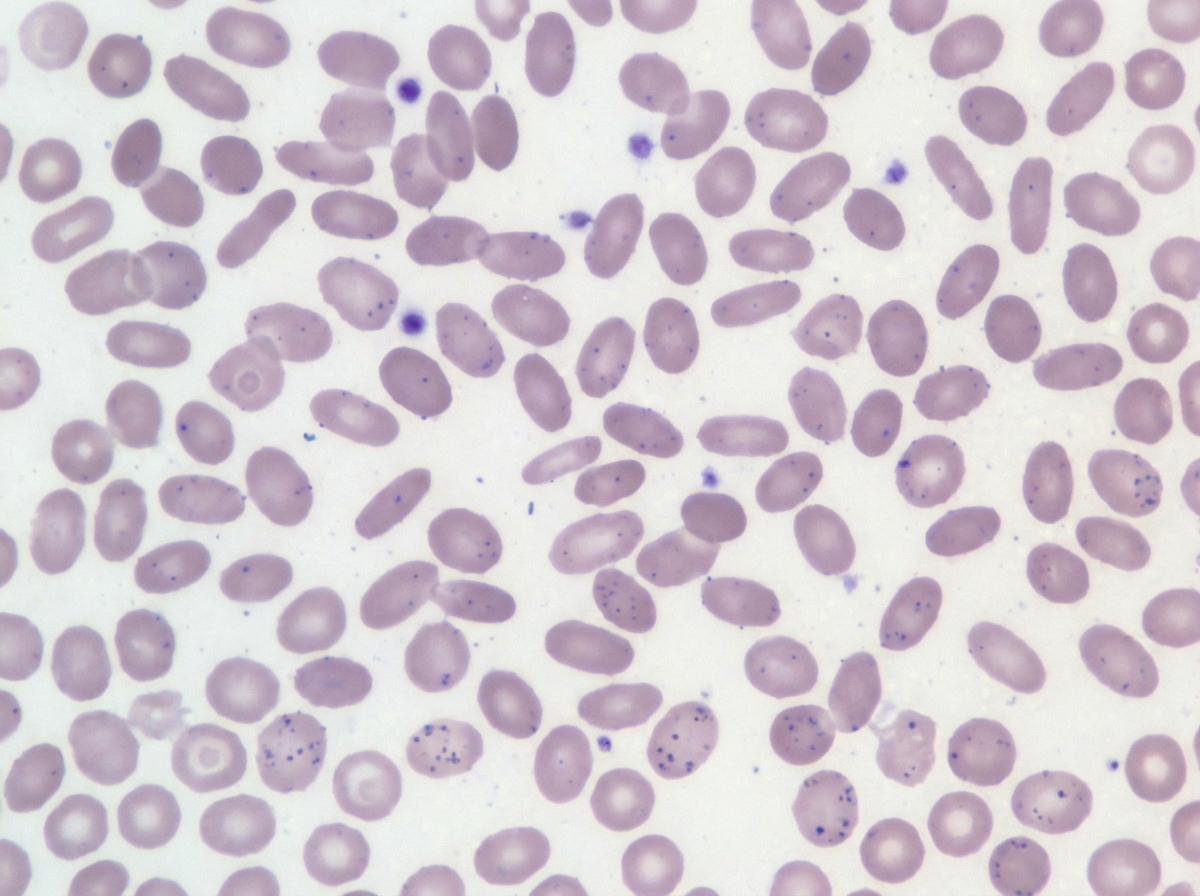
A 7-year-old boy is brought to the pediatrician by his parents for concern of general fatigue and recurrent abdominal pain. You learn that his medical history is otherwise unremarkable and that these symptoms started about 3 months ago after they moved to a different house. Based on clinical suspicion labs are obtained that reveal a microcytic anemia with high-normal levels of ferritin. Examination of a peripheral blood smear shows findings that are demonstrated in the figure provided. Which of the following is the most likely mechanism responsible for the anemia in this patient?
A 4-year-old girl is brought to the physician for a routine checkup. She was recently adopted and has never seen a doctor before. The patient's parents state she was very emaciated when they adopted her and noticed she has trouble seeing in the evening. They also noted that she was experiencing profuse foul-smelling diarrhea as well, which is currently being worked up by a gastroenterologist. Her temperature is 97.8°F (36.6°C), blood pressure is 104/54 mmHg, pulse is 100/min, respirations are 19/min, and oxygen saturation is 98% on room air. The girl appears very thin. She has dry skin noted on physical exam. Laboratory studies are ordered as seen below. Hemoglobin: 12 g/dL Hematocrit: 36% Leukocyte count: 4,500/mm^3 with normal differential Platelet count: 191,000/mm^3 Serum: Na+: 139 mEq/L Cl-: 100 mEq/L K+: 3.8 mEq/L HCO3-: 28 mEq/L BUN: 20 mg/dL Glucose: 88 mg/dL Creatinine: 0.7 mg/dL Ca2+: 9.0 mg/dL Which of the following findings is also likely to be seen in this patient?
A 3-year-old boy is brought to the physician for a follow-up examination. He has lactose intolerance. His family emigrated from Somalia 6 months ago. He is at the 30th percentile for height and 15th percentile for weight. Vital signs are within normal limits. Examination shows pale conjunctivae, an erythematous throat, and swollen tongue. There is inflammation of the perioral and labial mucosa, and peeling and cracking of the skin at the corners of the mouth. Cardiopulmonary examination shows no abnormalities. His hemoglobin concentration is 9.8 g/dL and mean corpuscular volume is 87 μm3. If left untreated, this child is also most likely to develop which of the following?
An investigator is studying nutritional deficiencies in humans. A group of healthy volunteers are started on a diet deficient in pantothenic acid. After 4 weeks, several of the volunteers develop irritability, abdominal cramps, and burning paresthesias of their feet. These symptoms are fully reversed after reintroduction of pantothenic acid to their diet. The function of which of the following enzymes was most likely impaired in the volunteers during the study?
Want unlimited practice?
Get full access to all questions, explanations, and performance tracking.
Scan to download app