
RNA interference and microRNAs — MCQs

A 25-year-old female comes to the clinic complaining of fatigue and palpitations. She has been undergoing immense stress from her thesis defense and has been extremely tired. The patient denies any weight loss, diarrhea, cold/heat intolerance. TSH was within normal limits. She reports a family history of "blood disease" and was later confirmed positive for β-thalassemia minor. It is believed that abnormal splicing of the beta globin gene results in β-thalassemia. What is removed during this process that allows RNA to be significantly shorter than DNA?
In translation, the wobble phenomenon is best illustrated by the fact that:
A pharmaceutical company has modified one of its existing antibiotics to have an improved toxicity profile. The new antibiotic blocks protein synthesis by first entering the cell and then binding to active ribosomes. The antibiotic mimics the structure of aminoacyl-tRNA. The drug is covalently bonded to the existing growing peptide chain via peptidyl transferase, thereby impairing the rest of protein synthesis and leading to early polypeptide truncation. Where is the most likely site that this process occurs?
An investigator is studying the genetic profile of an isolated pathogen that proliferates within macrophages. The pathogen contains sulfatide on the surface of its cell wall to prevent fusion of the phagosome and lysosome. She finds that some of the organisms under investigation have mutations in a gene that encodes the enzyme required for synthesis of RNA from a DNA template. The mutations are most likely to reduce the therapeutic effect of which of the following drugs?
While performing a Western blot, a graduate student spilled a small amount of the radiolabeled antibody on her left forearm. Although very little harm was done to the skin, the radiation did cause minor damage to the DNA of the exposed skin by severing covalent bonds between the nitrogenous bases and the deoxyribose sugar, leaving several apurinic/apyrimidinic sites. Damaged cells would most likely repair these sites by which of the following mechanisms?
DNA replication is a highly complex process where replication occurs on both strands of DNA. On the leading strand of DNA, replication occurs uninterrupted, but on the lagging strand, replication is interrupted and occurs in fragments called Okazaki fragments. These fragments need to be joined, which of the following enzymes is involved in the penultimate step before ligation can occur?
An investigator is studying the effects of zinc deprivation on cancer cell proliferation. It is hypothesized that because zinc is known to be a component of transcription factor motifs, zinc deprivation will result in slower tumor growth. To test this hypothesis, tumor cells are cultured on media containing low and high concentrations of zinc. During the experiment, a labeled oligonucleotide probe is used to identify the presence of a known transcription factor. The investigator most likely used which of the following laboratory techniques?
An investigator is studying human genetics and cell division. A molecule is used to inhibit the exchange of genetic material between homologous chromosomes. Which of the following phases of the cell cycle does the molecule target?
A scientist wants to determine if a specific fragment is contained within genome X. She uses a restriction enzyme to digest the genome into smaller fragments to run on an agarose gel, with the goal of separating the resulting fragments. A nitrocellulose blotting paper is then used to transfer the fragments from the agarose gel. A radiolabeled probe containing a complementary sequence to the fragment she is searching for is incubated with the blotting paper. Which of the following is the RNA equivalent of this technique?
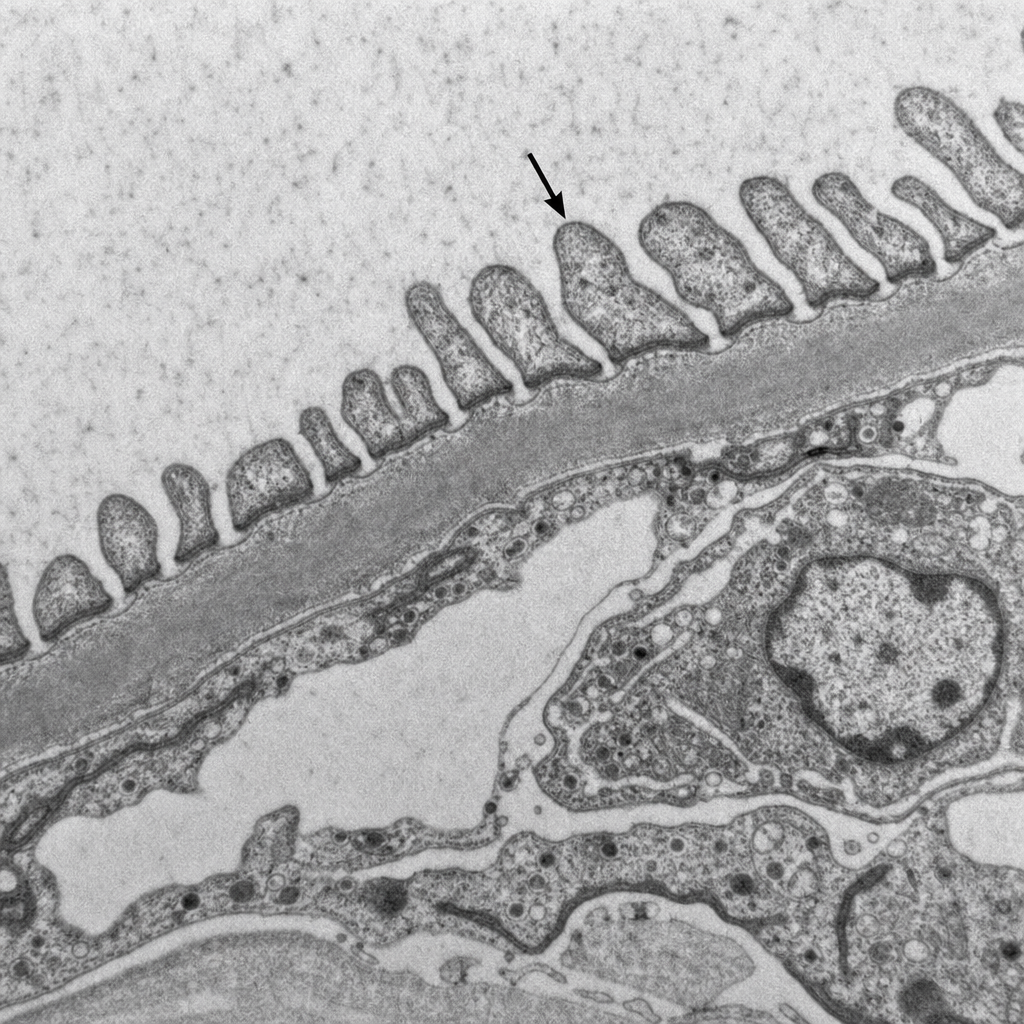
A 12-year-old male presents to the emergency department following several days of facial edema. A urinalysis confirms proteinuria and hematuria. Once admitted, a kidney biopsy is viewed under an electron microscope to confirm the diagnosis of minimal change disease. In the following electron micrograph, what process occurs in the structure marked with an arrow?
Want unlimited practice?
Get full access to all questions, explanations, and performance tracking.
Scan to download app