
Epigenetic mechanisms — MCQs

A researcher is investigating compounds that modulate the cell cycle as possible chemotherapeutic agents against peripheral T-cell lymphoma. The researcher discovers a group of natural compounds with inhibitory activity against histone deacetylases, a class of enzymes that remove acetyl groups from the lysine residues of histones. A histone deacetylase inhibitor most likely causes which of the following?
Researchers are investigating oncogenes, specifically the KRAS gene that is associated with colon, lung, and pancreatic cancer. They have established that the gain-of-function mutation in this gene increases the chance of cancer development. They are also working to advance the research further to study tumor suppressor genes. Which of the genes below is considered a tumor suppressor gene?
A mother from rural Louisiana brings her 4-year-old son to a pediatrician. Her son is intellectually disabled, and she hopes that genetic testing will help determine the cause of her son's condition. She had previously been opposed to allowing physicians to treat her son, but his impulsive behavior and learning disabilities are making it difficult to manage his care on her own. On exam, the child has a long, thin face with a large jaw, protruding ears, and macroorchidism. The physician also hears a high-pitched holosystolic murmur at the apex of the heart that radiates to the axilla. Which of the following trinucleotide repeats is most likely affected in this individual?
A 4-year-old child presents with developmental delay, ataxia, and inappropriate laughter. The parents undergo genetic testing to determine the cause of their child's symptoms. Results show no mutations in all three family members that would cause this constellation of symptoms. Karyotyping reveals no deletions, insertions, or gene translocations. However, methylation studies demonstrate abnormal imprinting patterns at the 15q11-q13 region. Based on these findings, the child is diagnosed with Angelman syndrome. Which of the following genetic mechanisms best describes the cause of this disorder?
A group of researchers is studying molecules and DNA segments that are critical for important cellular processes in eukaryotic cells. They have identified a region that is located about 28 bases upstream of the 5’ coding region. This region promotes the initiation of transcription by binding with transcription factors. Which of the following regions have these researchers most likely identified?
A 2-year-old male is referred to a geneticist for developmental delay and intellectual disability. He was hypotonic at birth and his parents are concerned that he tries to eat everything, including erasers and chalk. Physical exam is remarkable for severe obesity and hypogonadism. Genetic analysis reveals that he has one mutated allele and one normal allele at the gene of interest. Which of the following is the most likely explanation for why this patient is affected despite having a normal allele?
A 40-year-old male with Down syndrome is brought to your clinic by his mother. She reports that over the past few months he has started having difficulty managing his daily routine at his assisted-living facility and no longer seems like himself. She says that last week he wandered away from the facility and was brought back by police. Additionally, he has stopped taking his regular antiepileptic medication, and she is concerned that he might have a seizure. TSH is checked and is normal. Which of the following is most likely to be responsible for this man's current presentation?
Expression of an mRNA encoding for a soluble form of the Fas protein prevents a cell from undergoing programmed cell death. However, after inclusion of a certain exon, this same Fas pre-mRNA eventually leads to the translation of a protein that is membrane bound, subsequently promoting the cell to undergo apoptosis. Which of the following best explains this finding?
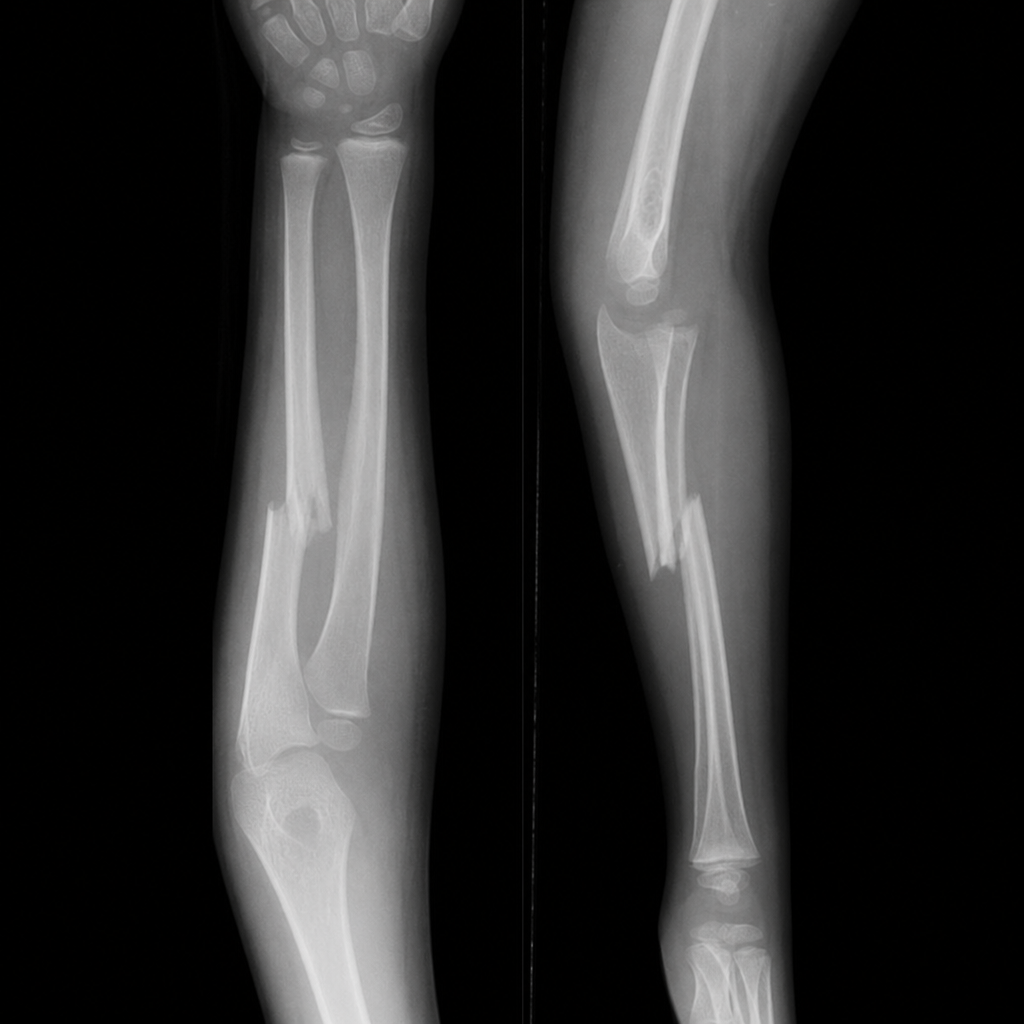
A 3-year-old boy is brought to the physician because of arm pain following a fall that took place 5 hours ago. According to his mother, the boy was running in the yard when he fell and injured his right arm. The boy is crying and clutching his arm. During the past year, he has been brought in 4 other times for extremity pain following falls, all of which have been diagnosed as long bone fractures. He is at the 10th percentile for height and 25th percentile for weight. His temperature is 37.3°C (99.1°F), pulse is 95/min, respirations are 21/min, and blood pressure is 97/68 mm Hg. His right forearm is diffusely erythematous. The patient withdraws and yells when his forearm is touched. His left arm has two small ecchymotic regions overlying the elbow and wrist. A photograph of his face is shown. An x-ray of the right forearm shows a transverse mid-ulnar fracture with diffusely decreased bone density. Which of the following is the most likely cause of this patient's symptoms?
An investigator is studying the rate of wound healing by secondary intention. He performs a biopsy of a surgically debrided wound 1 day and 5 days after the initial surgical procedure. The second biopsy shows wound contraction, endothelial cell proliferation, and accumulation of macrophages. The cells responsible for wound contraction also secrete a protein that assembles in supercoiled triple helices. In which of the following structures does this protein type play an important structural role?
Want unlimited practice?
Get full access to all questions, explanations, and performance tracking.
Scan to download app