
Non-Mendelian inheritance — MCQs

A 4-year-old boy presents to his pediatrician for severe developmental delay. On exam he is noted to have macroorchidism, hypertelorism, large protruding ears, a large jaw, and a long thin face. Suspicious of what the diagnosis may be, the pediatrician orders a PCR and DNA sequencing. The results reveal an expansion of 250 repeats of CGG. What is the diagnosis of the boy?
An 8-year-old boy is brought to the pediatrician because his mother is concerned about recent behavioral changes. His mother states that she has started to notice that he is slurring his speech and seems to be falling more than normal. On exam, the pediatrician observes the boy has pes cavus, hammer toes, and kyphoscoliosis. Based on these findings, the pediatrician is concerned the child has a trinucleotide repeat disease. Which of the following trinucleotide repeats is this child most likely to possess?
A healthy 30-year-old woman comes to the physician with her husband for preconception counseling. Her husband is healthy but she is concerned because her brother was recently diagnosed with a genetic liver condition for which he takes penicillamine. Her father-in-law has liver cirrhosis and a tremor. The results of genetic testing show that both the patient and her husband are carriers of a mutation in the ATP7B gene. Which of the following is the chance that this patient’s offspring will eventually develop the hereditary condition?
A 5-year-old boy is brought to the physician because of behavioral problems. His mother says that he has frequent angry outbursts and gets into fights with his classmates. He constantly complains of feeling hungry, even after eating a full meal. He has no siblings, and both of his parents are healthy. He is at the 25th percentile for height and is above the 95th percentile for weight. Physical examination shows central obesity, undescended testes, almond-shaped eyes, and a thin upper lip. Which of the following genetic changes is most likely associated with this patient's condition?
A deficiency in which of the following lysosomal enzymes is inherited in a pattern similar to a deficiency of iduronate sulfatase (Hunter syndrome)?
A 13-year-old girl is brought to the physician by her mother because of a 1-month history of abnormal movements of her muscles that she cannot control. She has a younger brother with cognitive disabilities and epilepsy. Examination shows frequent, brief, involuntary contractions of the muscle groups of the upper arms, legs, and face that can be triggered by touch. An EEG shows generalized epileptiform activity. A trichrome stain of a skeletal muscle biopsy specimen shows muscle fibers with peripheral red inclusions that disrupt the normal fiber contour. Which of the following is the most likely underlying mechanism of the patient's symptoms?
A 6-year-old male presents to the pediatrician with seizures. His mother reports that the patient has had two seizures lasting about 30 seconds each over the last three days. She reports that the patient has previously had seizures a few times per year since he was 12 months of age. The patient’s past medical history is otherwise notable for intellectual disability. He rolled over at 14 months of age and walked at 24 months of age. The patient’s mother denies any family history of epilepsy or other neurologic diseases. The patient is in the 3rd percentile for height and the 15th percentile for weight. On physical exam, he has a happy demeanor with frequent smiling. The patient has strabismus and an ataxic gait accompanied by flapping of the hands. He responds intermittently to questions with one-word answers. This patient is most likely to have which of the following genetic abnormalities?
A Caucasian 32-year-old woman has an uncomplicated vaginal delivery, giving birth to male and female fraternal twins at term. At 2 days of life, the twin sister develops abdominal distension without emesis, and the mother states that she has not noticed the passage of stool for this infant. Genetic testing identifies deletion of an amino acid in a membrane channel for the girl. Both parents are healthy. Assuming that twin brother's disease status/symptomatology is unclear, which of the following best approximates the probability that the twin brother is a carrier of the disease allele?
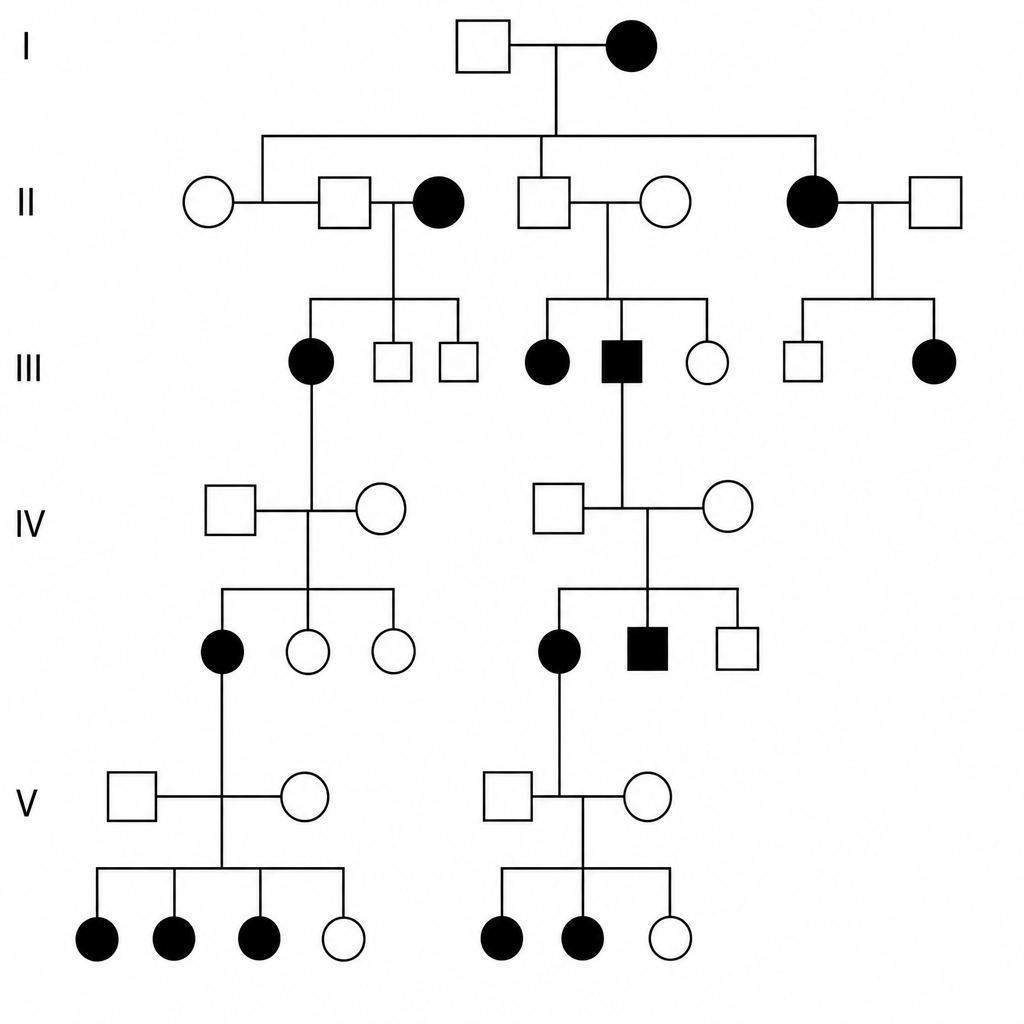
Given the pattern of inheritance shown in the pedigree, where might you find the disease gene in question?
A 13-year-old girl is brought to the outpatient clinic by her parents with a complaint of episodic spasm in her fingers for the past few months. Upon further questioning, her mother notes that the girl has not been doing well at school. She also believes that the girl is shorter than the other children in her class. On examination, her pulse is 72/min, temperature 37.6°C (99.7°F), respiratory rate 16/min, and blood pressure 120/88 mm Hg. The girl has short 4th and 5th fingers on both hands, a round face, and discolored teeth. Her height is 135 cm (4 ft 5 in) and she weighs 60 kg (132 lb). Investigation reports show the following values: Hemoglobin (Hb%) 12.5 g/dL White blood cell total count 10,000/mm3 Platelets 260,000/mm3 Calcium, serum (Ca2+) 4.0 mg/dL Serum albumin 4.0 g/dL Alanine aminotransferase (ALT), serum 15 U/L Aspartate aminotransferase (AST), serum 8 U/L Serum creatinine 0.5 mg/dL Urea 27 mg/dL Sodium 137 mEq/L Potassium 4.5 mEq/L Magnesium 2.5 mEq/L Parathyroid hormone, serum, N-terminal 930 pg/mL (normal: 230-630 pg/mL) Serum vitamin D 45 ng/dL Which of the following is the mode of inheritance of the disease this patient has?
Want unlimited practice?
Get full access to all questions, explanations, and performance tracking.
Scan to download app