A 3-month-old infant is brought to her pediatrician for a well-child visit. The infant was born to a 22-year-old mother via a spontaneous vaginal delivery at 38 weeks of gestation in her home. She moved to the United States approximately 3 weeks ago from a small village. She reports that her infant had 2 episodes of non-bloody and non-bilious vomiting. The infant's medical history includes eczema and 2 seizure episodes that resolved with benzodiazepines in the emergency department. Physical examination is notable for a musty body odor, eczema, and a fair skin complexion. Which of the following is the best next step in management?
Q142
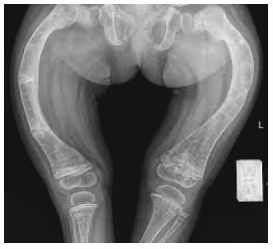
A 6-year-old boy is brought to the physician for a well-child examination. His mother has noticed he frequently falls while running. He was born at term and pregnancy was uncomplicated. He has a seizure disorder treated with phenytoin. He is at the 20th percentile for height and at 30th percentile for weight. Vital signs are within normal limits. Examination shows decreased muscle strength in the lower extremities. There is a deep groove below the costal margins bilaterally. An x-ray of the lower extremities is shown. Which of the following is the most likely cause of these findings?
Q143
A 59-year-old man is brought to the physician by his wife for a psychiatric evaluation. Over the past 12 months, his behavior has become increasingly disruptive. His wife no longer brings him along shopping because he has attempted to grope a female cashier on 2 occasions. He has begun to address the mail carrier using a racial epithet. Three years later, the patient dies. Light microscopy of sections of the frontal and temporal lobes shows intracellular inclusions of transactive response DNA binding protein (TDP-43). These proteins are bound to a regulatory molecule that usually marks them for degradation. The regulatory molecule in question is most likely which of the following?
Q144
A 45-year-old man is brought to the emergency department by ambulance after vomiting blood. The patient reports that he only ate a small snack the morning before and had not eaten anything for over 24 hours. At the hospital, the patient is stabilized. He is admitted to a surgical floor and placed on NPO with a nasogastric tube set to intermittent suction. He has been previously diagnosed with liver cirrhosis. An esophagogastroduodenoscopy (EGD) has been planned for the next afternoon. At the time of endoscopy, some pathways were generating glucose to maintain serum glucose levels. Which of the following enzymes catalyzes the irreversible biochemical reaction of this process?
Q145
In cells with impaired production of reducing factors for respiratory burst, decreased production of which substance is most likely observed?
Q146
A 31-year-old male comes to the physician because of a 2-day history of blisters and brownish discoloration of urine. His symptoms appeared after he returned from a 4-day trip with his friends in Florida. He has had similar episodes of blistering twice in the past three years. Each episode resolved spontaneously after a few weeks. Examination shows vesicles and bullae on the face and the dorsal surfaces of his hands and forearms. His condition is most likely caused by a defect in which of the following enzymes?
Q147
A 9-year-old boy is brought to his primary care physician after his mom noticed that he was limping. He says that he has been experiencing significant hip and knee pain over the last 2 months but thought he may have just strained a muscle. Radiographs show a collapse of the femoral head, and he is diagnosed with Legg-Calve-Perthes disease. He undergoes surgery and is placed in a Petrie cast from his hips to his toes bilaterally so that he is unable to move his knees or ankles. Eight weeks later, the cast is removed, and he is found to have significantly smaller calves than before the cast was placed. Which process in myocytes is most likely responsible for this finding?
Q148
A 12-year-old girl is brought to the physician because of a 2-hour history of severe epigastric pain, nausea, and vomiting. Her father has a history of similar episodes of abdominal pain and developed diabetes mellitus at the age of 30 years. Abdominal examination shows guarding and rigidity. Ultrasonography of the abdomen shows diffuse enlargement of the pancreas; no gallstones are visualized. Which of the following is the most likely underlying cause of this patient's condition?
Q149
A 1-year-old male with a history of recurrent pseudomonal respiratory infections and steatorrhea presents to the pediatrician for a sweat test. The results demonstrate a chloride concentration of 70 mEq/L (nl < 40 mEq/L). Which of the following defects has a similar AUTOSOMAL RECESSIVE mode of inheritance as the disorder experienced by this patient?
Q150
A 6-month-old boy is brought to a pediatrician by his parents for his first visit after they adopt him from a European country. His parents are concerned about the boy’s short episodes of shaking of his arms and legs; they believe it might be epilepsy. They also note that the child is less responsive than other children of his age. The family is unable to provide any vaccination, birth, or family history. His pulse is 130/min, respiratory rate is 28/min, and blood pressure is 90/50 mm Hg. The boy has a light skin tone and emits a noticeable musty body odor. Which of the following should be supplemented in this patient’s diet?
Metabolism US Medical PG Practice Questions and MCQs
Question 141: A 3-month-old infant is brought to her pediatrician for a well-child visit. The infant was born to a 22-year-old mother via a spontaneous vaginal delivery at 38 weeks of gestation in her home. She moved to the United States approximately 3 weeks ago from a small village. She reports that her infant had 2 episodes of non-bloody and non-bilious vomiting. The infant's medical history includes eczema and 2 seizure episodes that resolved with benzodiazepines in the emergency department. Physical examination is notable for a musty body odor, eczema, and a fair skin complexion. Which of the following is the best next step in management?
A. Dietary restriction (Correct Answer)
B. Abdominal radiography
C. Dermatology consult
D. MRI of the brain
E. Antiepileptic drug
Explanation: ***Dietary restriction***
- The infant's symptoms, including **eczema**, **seizures**, **fair skin**, and a distinctive "musty" odor, strongly suggest **phenylketonuria (PKU)**. PKU is an **autosomal recessive metabolic disorder** where the body cannot properly break down **phenylalanine**.
- The primary treatment for PKU is a **lifelong diet low in phenylalanine**. This involves restricting high-protein foods and using special medical formulas to provide adequate nutrition. Early and strict dietary management is crucial to prevent intellectual disability and other neurological complications.
*Abdominal radiography*
- While the infant experienced vomiting, the description of it being **non-bloody** and **non-bilious**, along with the absence of other gastrointestinal symptoms like distension, makes a significant abdominal pathology less likely than **metabolic derangement**.
- Abdominal radiography would be more appropriate for suspected **bowel obstruction** or perforation, for which there are no strong indications in this case.
*Dermatology consult*
- The presence of eczema is noted, but it is one of several symptoms pointing towards a **systemic metabolic disorder** rather than an isolated skin condition.
- Addressing the underlying metabolic cause (PKU) through dietary restriction will likely improve or resolve the eczema, making a consult for symptomatic treatment a secondary concern.
*MRI of the brain*
- The infant has experienced seizures, which often prompt neurological imaging. However, in the context of the other clinical findings (musty odor, fair skin, eczema), the seizures are highly suggestive of **metabolic encephalopathy** due to PKU.
- While an MRI might show changes related to chronic phenylalanine toxicity, the most urgent and effective intervention is to address the metabolic cause through **dietary restriction**.
*Antiepileptic drug*
- Starting an antiepileptic drug might control the seizures symptomatically, but it would **not address the underlying cause** of the seizures, which is the metabolic disturbance in PKU.
- **Untreated PKU** will lead to progressive neurological damage and intellectual disability even if seizures are controlled, highlighting the importance of root cause treatment.
Question 142: A 6-year-old boy is brought to the physician for a well-child examination. His mother has noticed he frequently falls while running. He was born at term and pregnancy was uncomplicated. He has a seizure disorder treated with phenytoin. He is at the 20th percentile for height and at 30th percentile for weight. Vital signs are within normal limits. Examination shows decreased muscle strength in the lower extremities. There is a deep groove below the costal margins bilaterally. An x-ray of the lower extremities is shown. Which of the following is the most likely cause of these findings?
A. Proximal tibial growth plate disruption
B. Metabolic abnormality (Correct Answer)
C. Normal development
D. Heavy metal toxicity
E. Neoplastic growth
Explanation: **Metabolic abnormality**
- The combination of **frequent falls**, **decreased lower extremity strength**, **rachitic rosary** (deep groove below costal margins indicating enlarged costochondral junctions), and **skeletal abnormalities on X-ray** (likely showing widened growth plates and metaphyseal cupping/fraying) strongly suggests a metabolic bone disorder like rickets.
- **Phenytoin use** can interfere with **vitamin D metabolism**, further predisposing to rickets by increasing its catabolism and decreasing calcium absorption.
*Proximal tibial growth plate disruption*
- While falls could potentially cause growth plate injuries, the systemic signs like **rachitic rosary** and general weakness point away from an isolated traumatic injury.
- Growth plate disruption would typically present with acute pain, swelling, and localized tenderness, rather than widespread skeletal and muscle weakness.
*Normal development*
- **Frequent falling** at 6 years old, combined with **decreased muscle strength** and an anatomical finding like a **rachitic rosary**, are not consistent with normal development.
- Normal growth and development in this age group would include improved coordination and muscle strength, not regression or signs of skeletal abnormalities.
*Heavy metal toxicity*
- Heavy metal toxicity (e.g., lead) can cause developmental problems and neurological symptoms, but it typically does not manifest with a **rachitic rosary** or the specific skeletal changes seen in rickets on X-ray.
- Lead poisoning, for example, is associated with **lead lines** in the metaphyses, which are distinct from the changes seen in rickets.
*Neoplastic growth*
- Neoplastic growth, especially bone tumors, could cause localized pain and weakness, but it would not typically present with the diffuse muscle weakness, **rachitic rosary**, and characteristic X-ray findings of rickets.
- Malignancies would generally show lytic or blastic lesions on X-ray and often systemic symptoms like weight loss or night sweats, which are not described here.
Question 143: A 59-year-old man is brought to the physician by his wife for a psychiatric evaluation. Over the past 12 months, his behavior has become increasingly disruptive. His wife no longer brings him along shopping because he has attempted to grope a female cashier on 2 occasions. He has begun to address the mail carrier using a racial epithet. Three years later, the patient dies. Light microscopy of sections of the frontal and temporal lobes shows intracellular inclusions of transactive response DNA binding protein (TDP-43). These proteins are bound to a regulatory molecule that usually marks them for degradation. The regulatory molecule in question is most likely which of the following?
A. Kinesin
B. Chaperone
C. Cyclin
D. Ubiquitin (Correct Answer)
E. Clathrin
Explanation: ***Ubiquitin***
- **Ubiquitin** is a small regulatory protein that marks other proteins for degradation, typically by the **proteasome**. In neurodegenerative diseases like **frontotemporal dementia (FTD)**, aggregates of misfolded proteins, such as **TDP-43**, can accumulate when the ubiquitin-proteasome system is overwhelmed or dysfunctional.
- The patient's clinical presentation of **behavioral changes** (disruptive, inappropriate, racial epithets) and the pathological finding of **TDP-43 inclusions** in the frontal and temporal lobes are highly characteristic of **FTD**. The accumulation of TDP-43, despite being marked for degradation, points to a failure of the normal ubiquitin-mediated protein disposal pathway.
*Kinesin*
- **Kinesin** is a motor protein that facilitates **anterograde axonal transport**, moving cargo away from the cell body along microtubules.
- While important for neuronal function, kinesin is not directly involved in marking proteins for degradation.
*Chaperone*
- **Chaperones** are proteins that assist in the proper **folding of other proteins** and can help refold misfolded proteins, preventing aggregation.
- While chaperones play a role in protein quality control, they do not directly mark proteins for degradation in the same way as ubiquitin.
*Cyclin*
- **Cyclins** are a family of proteins that regulate the progression of cells through the **cell cycle** by activating cyclin-dependent kinases (CDKs).
- They are primarily involved in cell division and growth, not protein degradation pathways.
*Clathrin*
- **Clathrin** is a protein that plays a key role in the formation of **coated vesicles** involved in endocytosis and intracellular trafficking.
- It is crucial for forming vesicles that transport cargo, but it is not directly involved in marking proteins for degradation.
Question 144: A 45-year-old man is brought to the emergency department by ambulance after vomiting blood. The patient reports that he only ate a small snack the morning before and had not eaten anything for over 24 hours. At the hospital, the patient is stabilized. He is admitted to a surgical floor and placed on NPO with a nasogastric tube set to intermittent suction. He has been previously diagnosed with liver cirrhosis. An esophagogastroduodenoscopy (EGD) has been planned for the next afternoon. At the time of endoscopy, some pathways were generating glucose to maintain serum glucose levels. Which of the following enzymes catalyzes the irreversible biochemical reaction of this process?
A. Glucose-6-phosphate dehydrogenase
B. Glycogen phosphorylase
C. Enolase
D. Glyceraldehyde-3-phosphate dehydrogenase
E. Fructose-1,6-bisphosphatase (Correct Answer)
Explanation: ***Fructose-1,6-bisphosphatase***
- The scenario describes a patient in a fasting state for over 24 hours, during which **gluconeogenesis** is crucial for maintaining blood glucose levels.
- **Fructose-1,6-bisphosphatase** is one of the key regulatory enzymes in gluconeogenesis, catalyzing an **irreversible reaction** that bypasses the phosphofructokinase-1 step of glycolysis.
*Glucose-6-phosphate dehydrogenase*
- This enzyme is involved in the **pentose phosphate pathway**, which generates NADPH and precursors for nucleotide synthesis.
- It does not directly participate in gluconeogenesis to produce glucose from non-carbohydrate sources.
*Glycogen phosphorylase*
- This enzyme is involved in **glycogenolysis**, the breakdown of glycogen into glucose-1-phosphate.
- While it releases glucose, the body's glycogen stores would likely be depleted after over 24 hours of fasting, making gluconeogenesis the primary pathway for glucose production.
*Enolase*
- Enolase is an enzyme in the glycolytic pathway, catalyzing the reversible conversion of 2-phosphoglycerate to phosphoenolpyruvate.
- It is not an enzyme of gluconeogenesis, nor does it catalyze an irreversible step in the glucose production process during fasting.
*Glyceraldehyde-3-phosphate dehydrogenase*
- This enzyme is also part of glycolysis, catalyzing the reversible oxidation and phosphorylation of glyceraldehyde-3-phosphate to 1,3-bisphosphoglycerate.
- Like enolase, it is not an irreversible enzyme in gluconeogenesis that would be generating glucose under fasting conditions.
Question 145: In cells with impaired production of reducing factors for respiratory burst, decreased production of which substance is most likely observed?
A. Mevalonate from β-hydroxy-β-methylglutaryl-CoA
B. 6-phosphogluconolactone from glucose-6-phosphate (Correct Answer)
C. Ribose-5-phosphate from fructose-6-phosphate
D. Ribulose-5-phosphate from glucose-6-phosphate
E. Glucose-6-phosphate from glucose
Explanation: ***6-phosphogluconolactone from glucose-6-phosphate***
- The production of **reducing factors for respiratory burst** (e.g., NADPH) primarily occurs via the **pentose phosphate pathway**.
- The first committed step in this pathway, catalyzed by **glucose-6-phosphate dehydrogenase**, converts **glucose-6-phosphate** to **6-phosphogluconolactone**, generating **NADPH**. Impaired NADPH production would directly reduce this step.
*Mevalonate from β-hydroxy-β-methylglutaryl-CoA*
- **Mevalonate** is an intermediate in cholesterol and isoprenoid synthesis, derived from **HMG-CoA**.
- This pathway is unrelated to the generation of reducing factors for the **respiratory burst**.
*Glucose-6-phosphate*
- **Glucose-6-phosphate** is a central metabolite in glycolysis and the pentose phosphate pathway, and its *production* would not be directly decreased due to impaired reducing factor generation for respiratory burst; rather, its *conversion* into other products will be affected.
- Decreased respiratory burst reducing factors would primarily impact the utilization of glucose-6-phosphate in the oxidative branch of the **pentose phosphate pathway**.
*Ribose-5-phosphate from fructose-6-phosphate*
- **Ribose-5-phosphate** can be produced from **fructose-6-phosphate** in the *non-oxidative* branch of the **pentose phosphate pathway**.
- This pathway does not generate **NADPH**, which is the crucial reducing factor for the respiratory burst; therefore, its production would not be directly affected by impaired reducing factor synthesis.
*Ribulose-5-phosphate from glucose-6-phosphate*
- **Ribulose-5-phosphate** is primarily formed from **6-phosphogluconate** (which is derived from 6-phosphogluconolactone) in the oxidative branch of the pentose phosphate pathway.
- While it's downstream of the initial NADPH-producing step, the direct production *from glucose-6-phosphate* is not how ribulose-5-phosphate is formed. The **initial step of NADPH synthesis** involves glucose-6-phosphate to 6-phosphogluconolactone.
Question 146: A 31-year-old male comes to the physician because of a 2-day history of blisters and brownish discoloration of urine. His symptoms appeared after he returned from a 4-day trip with his friends in Florida. He has had similar episodes of blistering twice in the past three years. Each episode resolved spontaneously after a few weeks. Examination shows vesicles and bullae on the face and the dorsal surfaces of his hands and forearms. His condition is most likely caused by a defect in which of the following enzymes?
A. Aminolevulinic acid dehydratase
B. Aminolevulinic acid synthase
C. Uroporphyrinogen III synthase
D. Porphobilinogen deaminase
E. Uroporphyrinogen decarboxylase (Correct Answer)
Explanation: ***Uroporphyrinogen decarboxylase***
- The patient's symptoms (blisters, brownish urine, photosensitivity due to sun exposure in Florida, and recurrent episodes) are classic for **Porphyria Cutanea Tarda (PCT)**.
- PCT is caused by a deficiency in **uroporphyrinogen decarboxylase (UROD)**, leading to an accumulation of uroporphyrinogens, which are photoreactive.
*Aminolevulinic acid dehydratase*
- A deficiency in **aminolevulinic acid dehydratase** leads to **ALA dehydratase deficiency porphyria**, characterized by **neuropsychiatric symptoms** and an increase in **aminolevulinic acid** (ALA), but not typically blistering skin lesions.
- This condition is very rare and generally presents with acute attacks that do not involve photosensitivity or skin fragility.
*Aminolevulinic acid synthase*
- **Aminolevulinic acid synthase (ALAS)** is the **rate-limiting enzyme** in heme synthesis; its deficiency (or mutations) can lead to **sideroblastic anemia**, but not porphyric skin manifestations.
- Overactivity of ALAS1 can contribute to acute intermittent porphyria, but primary deficiency is not associated with PCT.
*Uroporphyrinogen III synthase*
- A deficiency in **uroporphyrinogen III synthase** causes **Congenital Erythropoietic Porphyria (CEP)**, also known as **Günther's disease**.
- CEP is characterized by severe photosensitivity, hemolytic anemia, and **red urine**, but typically presents in infancy or early childhood with more severe symptoms.
*Porphobilinogen deaminase*
- A deficiency in **porphobilinogen deaminase (hydroxymethylbilane synthase)** causes **Acute Intermittent Porphyria (AIP)**.
- AIP typically presents with **acute neurovisceral attacks** (abdominal pain, neurological symptoms) and psychiatric manifestations, without cutaneous photosensitivity.
Question 147: A 9-year-old boy is brought to his primary care physician after his mom noticed that he was limping. He says that he has been experiencing significant hip and knee pain over the last 2 months but thought he may have just strained a muscle. Radiographs show a collapse of the femoral head, and he is diagnosed with Legg-Calve-Perthes disease. He undergoes surgery and is placed in a Petrie cast from his hips to his toes bilaterally so that he is unable to move his knees or ankles. Eight weeks later, the cast is removed, and he is found to have significantly smaller calves than before the cast was placed. Which process in myocytes is most likely responsible for this finding?
A. Decreased formation of double membrane bound vesicles
B. Increased formation of double membrane bound vesicles
C. Monoubiquitination of proteins
D. Inhibition of gene transcription
E. Polyubiquitination of proteins (Correct Answer)
Explanation: ***Polyubiquitination of proteins***
- **Polyubiquitination** targets proteins for degradation by the **proteasome**, a key mechanism in skeletal muscle atrophy due to disuse.
- The cast-induced disuse leads to muscle fiber shrinkage, as the cellular machinery for protein breakdown becomes more active than protein synthesis.
*Decreased formation of double membrane bound vesicles*
- This option refers to a decrease in **autophagy**, a process where cells degrade and recycle cellular components. While autophagy is involved in muscle atrophy, a *decrease* in this process would generally lead to accumulation of cellular components rather than a reduction in muscle mass.
- Autophagy would typically be *increased* during disuse atrophy to break down unnecessary components, not decreased.
*Increased formation of double membrane bound vesicles*
- This describes **increased autophagy**, a process that contributes to muscle atrophy by degrading cell components, including organelles and proteins. However, the primary and most direct mechanism for the rapid degradation of muscle proteins in disuse atrophy is the ubiquitin-proteasome pathway, rather than autophagy in this specific context.
- While autophagy does play a role in muscle wasting, **ubiquitin-proteasome system** is considered the dominant pathway for targeted protein degradation in disuse atrophy.
*Monoubiquitination of proteins*
- **Monoubiquitination** is typically involved in regulatory processes like **endomembrane trafficking**, **DNA repair**, and changing protein activity or localization, not directly in targeting proteins for proteasomal degradation.
- Unlike polyubiquitination, which marks proteins for destruction, monoubiquitination typically serves as a regulatory signal for various cellular functions without leading to rapid protein breakdown.
*Inhibition of gene transcription*
- While prolonged disuse can lead to changes in gene expression, including the downregulation of genes involved in muscle growth, the immediate and direct cause of muscle mass reduction in the context of acute disuse is the **accelerated degradation of existing proteins**.
- **Reduced gene transcription** would reduce the *synthesis* of new proteins, but the significant and rapid atrophy observed also requires the active breakdown of existing muscle proteins.
Question 148: A 12-year-old girl is brought to the physician because of a 2-hour history of severe epigastric pain, nausea, and vomiting. Her father has a history of similar episodes of abdominal pain and developed diabetes mellitus at the age of 30 years. Abdominal examination shows guarding and rigidity. Ultrasonography of the abdomen shows diffuse enlargement of the pancreas; no gallstones are visualized. Which of the following is the most likely underlying cause of this patient's condition?
A. Defective elastase inhibitor
B. Premature activation of trypsinogen (Correct Answer)
C. Elevated serum amylase levels
D. Increased β-glucuronidase activity
E. Impaired cellular copper transport
Explanation: ***Premature activation of trypsinogen***
- The familial history of **abdominal pain** and early-onset **diabetes mellitus**, combined with signs of **acute pancreatitis** (epigastric pain, nausea, vomiting, guarding, rigidity, pancreatic enlargement), strongly suggests **hereditary pancreatitis**.
- This condition is often caused by mutations in the **PRSS1 gene**, leading to a gain-of-function mutation in cationic **trypsinogen**, causing its premature activation within the pancreas.
*Defective elastase inhibitor*
- While elastase is a pancreatic enzyme, a defect in its inhibitor is not the primary known genetic cause of **hereditary pancreatitis**.
- **Alpha-1 antitrypsin deficiency** affects elastase activity, but primarily targets lung tissue and liver, not typically causing recurrent pancreatitis in this manner.
*Elevated serum amylase levels*
- **Elevated serum amylase** is a diagnostic marker for pancreatitis but is a **consequence** of the inflammation, not the underlying cause.
- It indicates pancreatic injury but does not explain the etiology in this patient with suggestive family history and recurrent episodes.
*Increased β-glucuronidase activity*
- **Increased β-glucuronidase activity** is primarily associated with the formation of **pigment gallstones** (unconjugated bilirubin stones), often found in patients with chronic hemolysis or biliary infections.
- The patient has no evidence of gallstones, and this mechanism does not explain hereditary pancreatitis.
*Impaired cellular copper transport*
- **Impaired cellular copper transport** is the hallmark of **Wilson's disease**, which leads to copper accumulation in the liver, brain, and other organs.
- While Wilson's disease can rarely cause pancreatitis, it is not associated with the familial pattern of recurrent abdominal pain and early-onset diabetes described here.
Question 149: A 1-year-old male with a history of recurrent pseudomonal respiratory infections and steatorrhea presents to the pediatrician for a sweat test. The results demonstrate a chloride concentration of 70 mEq/L (nl < 40 mEq/L). Which of the following defects has a similar AUTOSOMAL RECESSIVE mode of inheritance as the disorder experienced by this patient?
A. Abnormal production of type IV collagen
B. Trinucleotide repeat expansion of CAG on chromosome 4
C. Mutated gene for mitochondrial-tRNA-Lys
D. Accumulation of glycogen in the lysosome (Correct Answer)
E. Inability to convert carbamoyl phosphate and ornithine into citrulline
Explanation: ***Accumulation of glycogen in the lysosome***
- The patient's symptoms (recurrent **pseudomonal respiratory infections**, **steatorrhea**, and elevated sweat chloride) are classic for **cystic fibrosis (CF)**, an **autosomal recessive** disorder.
- Accumulation of glycogen in the lysosome describes **Pompe disease (Type II Glycogen Storage Disease)**, which is also an **autosomal recessive** disorder, making this the correct answer.
*Abnormal production of type IV collagen*
- This defect is characteristic of **Alport syndrome**, which is predominantly **X-linked dominant** (~80-85% of cases), though autosomal recessive forms exist.
- The question context and typical board exam framing classify this as X-linked, not autosomal recessive.
- Alport syndrome primarily affects the kidneys, ears, and eyes, and does not present with recurrent pseudomonal infections or steatorrhea.
*Trinucleotide repeat expansion of CAG on chromosome 4*
- This genetic defect is responsible for **Huntington's disease**, which is an **autosomal dominant** neurodegenerative disorder.
- Huntington's disease presents with chorea, cognitive decline, and psychiatric symptoms, which are distinct from CF.
*Mutated gene for mitochondrial-tRNA-Lys*
- A mutated gene for mitochondrial-tRNA-Lys is associated with **MELAS syndrome (Mitochondrial Encephalomyopathy, Lactic Acidosis, and Stroke-like episodes)**, which is inherited through **maternal (mitochondrial)** inheritance.
- This mode of inheritance is distinct from the autosomal recessive pattern seen in cystic fibrosis.
*Inability to convert carbamoyl phosphate and ornithine into citrulline*
- This describes a defect in **ornithine transcarbamylase (OTC) deficiency**, an **X-linked recessive** disorder, not autosomal recessive.
- OTC deficiency leads to hyperammonemia and metabolic disturbances, without the pulmonary and gastrointestinal symptoms typical of cystic fibrosis.
Question 150: A 6-month-old boy is brought to a pediatrician by his parents for his first visit after they adopt him from a European country. His parents are concerned about the boy’s short episodes of shaking of his arms and legs; they believe it might be epilepsy. They also note that the child is less responsive than other children of his age. The family is unable to provide any vaccination, birth, or family history. His pulse is 130/min, respiratory rate is 28/min, and blood pressure is 90/50 mm Hg. The boy has a light skin tone and emits a noticeable musty body odor. Which of the following should be supplemented in this patient’s diet?
A. Isoleucine
B. Leucine
C. Tyrosine (Correct Answer)
D. Phenylalanine
E. Histidine
Explanation: ***Tyrosine***
- The patient's presentation with **seizures**, **developmental delay** (less responsive), **light skin tone**, and a **musty body odor** is highly suggestive of **phenylketonuria (PKU)**.
- In PKU, there is a deficiency in the enzyme **phenylalanine hydroxylase**, which converts **phenylalanine** to **tyrosine**. Therefore, **tyrosine** becomes an **essential amino acid** and must be supplemented in the diet.
*Isoleucine*
- **Isoleucine** is a **branched-chain amino acid** that is typically restricted, along with leucine and valine, in conditions like **maple syrup urine disease (MSUD)**, not PKU.
- Supplementation of isoleucine would be detrimental in MSUD and is not indicated for PKU.
*Leucine*
- Similar to isoleucine, **leucine** is a **branched-chain amino acid** whose metabolism is impaired in **MSUD**, not PKU.
- Supplementing leucine is not beneficial for PKU and would be harmful in MSUD.
*Phenylalanine*
- **Phenylalanine** is the amino acid that accumulates to toxic levels in **PKU** due to the enzyme deficiency.
- Therefore, phenylalanine must be **strictly restricted** in the patient's diet, not supplemented.
*Histidine*
- **Histidine** is an essential amino acid but is not directly involved in the metabolic pathway affected by PKU.
- There is no indication for histidine supplementation in the management of PKU.