An 8-day-old boy is brought to the physician by his mother because of vomiting and poor feeding. The pregnancy was uncomplicated, and he was born at full term. He appears pale and lethargic. Physical examination shows diffusely increased muscle tone. His urine is noted to have a sweet odor. This patient's symptoms are most likely caused by the accumulation of which of the following?
Q122
A 6-year-old boy is brought to the office by his mother. She reports that her son is well but has some concerns about his overall health: he is shorter and, physically, seems less developed compared to his siblings when they were the same age. He recently started school and the mother reports that the boy’s teachers are concerned with his learning capability. His height and weight are in the 10th and 15th percentiles, respectively. Lab results reveal:
Hemoglobin 10 gm/dL
Mean corpuscular volume 110 fL
Multi-segmented neutrophils are seen on peripheral blood smear. Urinary orotic acid levels are found to be high. What is the most likely cause of this patient’s condition?
Q123
Parkinson’s disease is a progressive neurodegenerative disease. It is characterized by a loss of dopaminergic neurons in the substantia nigra pars compacta and the formation of cellular inclusions called Lewy bodies. These are composed of α-synuclein that has been bound to ubiquitin. In healthy individuals, α-synuclein bound to ubiquitin would be degraded by which of the following?
Q124
A 5-month-old boy presents with increasing weakness for the past 3 months. The patient’s mother says that the weakness is accompanied by dizziness, sweating, and vertigo early in the morning. Physical examination shows hepatomegaly. Laboratory findings show an increased amount of lactate, uric acid, and elevated triglyceride levels. Which of the following enzymes is most likely deficient in this patient?
Q125
A 12-year-old girl comes to the clinic with a grossly enlarged abdomen. She has a history of frequent episodes of weakness, sweating, and pallor that are eliminated by eating. Her development has been slow. She started to walk unassisted at 2 years and was not performing well at school. Physical examination reveals a blood pressure of 100/60 mm Hg, heart rate of 80/min, and temperature of 36.9°C (98.4℉). On physical examination, the liver is enlarged, firm, and palpable up to the pelvis. The spleen and kidney are not palpable. Laboratory investigation reveals low blood glucose and pH with high lactate, triglycerides, ketones, and free fatty acids. The liver biopsy revealed high glycogen content. Hepatic glycogen structure was normal. The enzyme assay performed on the biopsy tissue revealed very low glucose-6-phosphatase levels. What is the most likely diagnosis?
Q126
A 3-year-old African-American female presents to the emergency department with fatigue. Her parents endorse malaise and weakness on behalf of the patient for two weeks. Her temperature is 98.9°F (37.2°C), blood pressure is 94/70 mmHg, pulse is 102/min, and respirations are 22/min. On physical exam, she is tired-appearing with conjunctival pallor. Her parents report that they immigrated from Liberia before the patient was born. They deny any family history of medical disorders, and the patient has no sick contacts at home.
Laboratory tests are performed and reveal the following:
Leukocyte count: 10,700/mm^3
Hemoglobin: 8.6 g/dL
Hematocrit: 24%
Mean corpuscular volume: 84 µm^3
Platelet count: 488,000/mm^3
Reticulocyte index: 3.8%
The patient should receive which of the following nutritional supplements?
Q127
A 43-year-old man comes to the physician because of left flank pain and nausea for 2 hours. The pain comes in waves and radiates to his groin. Over the past year, he has had intermittent pain in the bilateral flanks and recurrent joint pain in the toes, ankles, and fingers. He has not seen a physician in over 10 years. He takes no medications. He drinks 3–5 beers daily. His sister has rheumatoid arthritis. Vital signs are within normal limits. Physical examination shows marked tenderness bilaterally in the costovertebral areas. A photograph of the patient's left ear is shown. A CT scan of the abdomen shows multiple small kidney stones and a 7-mm left distal ureteral stone. A biopsy of the patient's external ear findings is most likely to show which of the following?
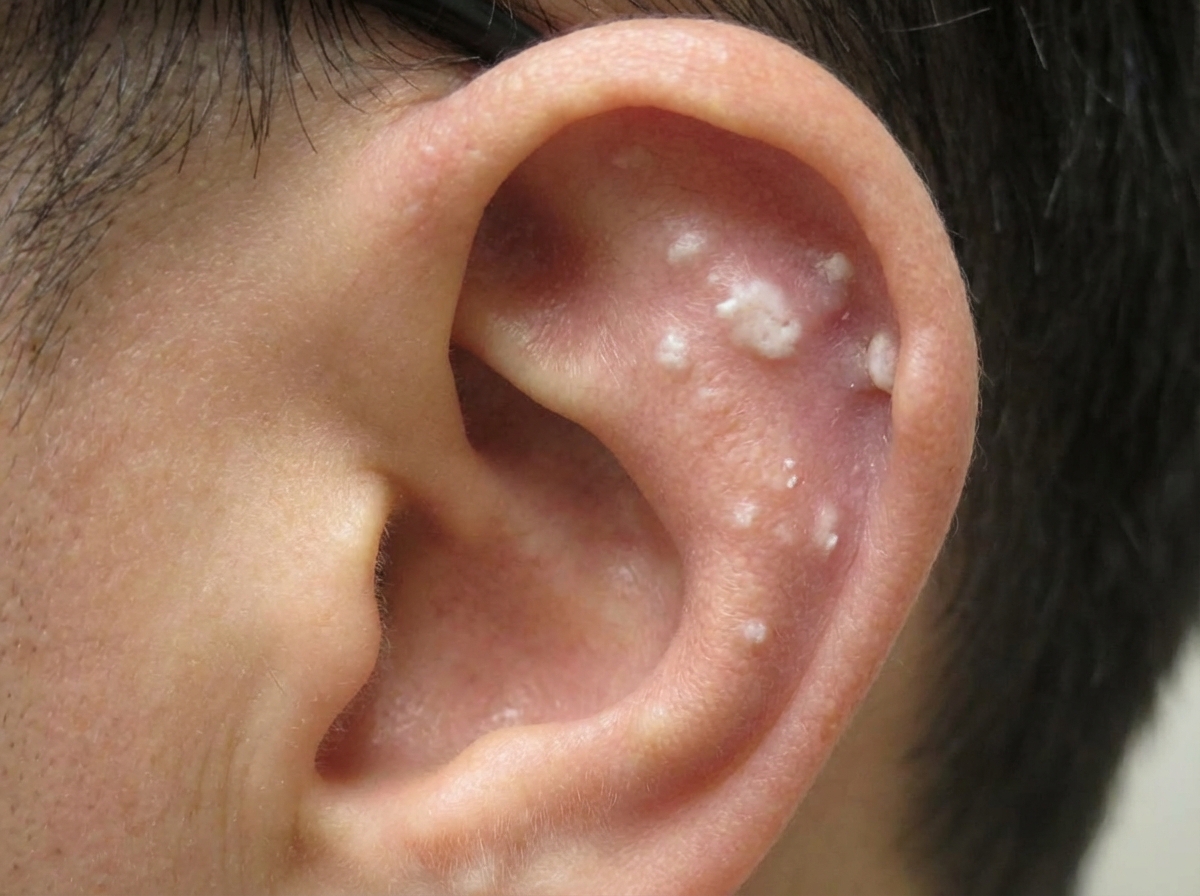
Q128
A 17-year-old girl presents to her primary care physician for a wellness checkup. The patient is currently doing well in school and plays soccer. She has a past medical history of childhood obesity that was treated with diet and exercise. The patient states that her menses have not changed, and they occur every 1 to 3 months. Her temperature is 99.5°F (37.5°C), blood pressure is 127/70 mmHg, pulse is 90/min, respirations are 13/min, and oxygen saturation is 98% on room air. The patient's BMI at this visit is 22.1 kg/m^2. On physical exam, the patient is in no distress. You note acne present on her face, shoulders, and chest. You also note thick, black hair on her upper lip and chest. The patient's laboratory values are seen as below.
Hemoglobin: 14 g/dL
Hematocrit: 42%
Leukocyte count: 7,500/mm^3 with normal differential
Platelet count: 177,000/mm^3
Serum:
Na+: 137 mEq/L
Cl-: 101 mEq/L
K+: 4.4 mEq/L
HCO3-: 24 mEq/L
BUN: 27 mg/dL
Glucose: 90 mg/dL
Creatinine: 1.0 mg/dL
Ca2+: 10.1 mg/dL
Testosterone: 82 ng/dL
17-hydroxyprogesterone: elevated
AST: 12 U/L
ALT: 10 U/L
Which of the following is associated with this patient's most likely diagnosis?
Q129
During normal respiration in the lungs, oxygen is absorbed into the bloodstream and carbon dioxide is released. The oxygen is used in cells as the final electron acceptor during oxidative phosphorylation, and carbon dioxide is generated during each turn of the tricarboxylic citric acid cycle (TCA). Which of the following steps in the TCA cycle represents the first decarboxylation reaction that generates carbon dioxide?
Q130
A 46-year-old man presents to the emergency room after an industrial accident at a plastic manufacturer with altered consciousness, headache, shortness of breath, and abdominal pain. The vital signs include: blood pressure 145/80 mm Hg, heart rate 111/min, respiratory rate 27/min, and temperature 37.0℃ (98.6℉). The blood oxygen saturation on room air is 97%. On physical examination, the patient has a GCS score of 13. The skin is cherry-red and covered with perspiration. Breath and heart sounds are decreased. There is widespread tenderness on abdominal palpation. Blood testing shows the following findings:
pH 7.29
Po2 66 mm Hg
Pco2 30 mm Hg
Na+ 144 mEq/L
K+ 5.1 mEq/L
Cl- 107 mEq/L
HCO3- 11 mEq/L
Base Excess -5 mEq/L
Lactate 22 mmol/L (198.2 mg/dL)
Inhibition of which enzyme caused this patient’s condition?
Metabolism US Medical PG Practice Questions and MCQs
Question 121: An 8-day-old boy is brought to the physician by his mother because of vomiting and poor feeding. The pregnancy was uncomplicated, and he was born at full term. He appears pale and lethargic. Physical examination shows diffusely increased muscle tone. His urine is noted to have a sweet odor. This patient's symptoms are most likely caused by the accumulation of which of the following?
A. Phenylalanine
B. Homogentisic acid
C. Isoleucine (Correct Answer)
D. Homocysteine
E. Phytanic acid
Explanation: ***Isoleucine***
- The combination of **vomiting**, poor feeding, lethargy, **increased muscle tone**, and a **sweet-smelling urine** (often described as maple syrup odor) in a neonate strongly points to **Maple Syrup Urine Disease (MSUD)**.
- MSUD is caused by a defect in the **branched-chain alpha-keto acid dehydrogenase complex**, leading to the accumulation of branched-chain amino acids (leucine, isoleucine, and valine) and their corresponding alpha-keto acids.
*Phenylalanine*
- Accumulation of **phenylalanine** is characteristic of **Phenylketonuria (PKU)**, which typically presents with intellectual disability, seizures, and an eczematous rash if untreated, but not a maple syrup odor in urine or acute neonatal crisis.
- The urine odor in PKU is often described as **mousy** or musty, distinctly different from a sweet or maple syrup odor.
*Homogentisic acid*
- Accumulation of **homogentisic acid** is seen in **Alkaptonuria**, an inborn error of metabolism that primarily causes dark urine upon standing (due to oxidation of homogentisic acid), ochronosis (blue-black pigmentation of cartilage and connective tissue later in life), and arthritis.
- It does not present with acute neonatal symptoms such as vomiting, lethargy, or a sweet urine odor.
*Homocysteine*
- Elevated levels of **homocysteine** are found in **Homocystinuria**, which can lead to intellectual disability, developmental delay, dislocation of the ocular lens (ectopia lentis), Marfanoid habitus, and thromboembolic events.
- It does not typically present in the neonatal period with a sweet urine odor or acute neurological symptoms like increased muscle tone.
*Phytanic acid*
- Accumulation of **phytanic acid** is characteristic of **Refsum disease**, a rare peroxisomal disorder that causes progressive neurological symptoms such as retinitis pigmentosa, peripheral neuropathy, ataxia, and deafness in childhood or adulthood.
- It does not present in the neonatal period with the described acute symptoms or unique urine odor.
Question 122: A 6-year-old boy is brought to the office by his mother. She reports that her son is well but has some concerns about his overall health: he is shorter and, physically, seems less developed compared to his siblings when they were the same age. He recently started school and the mother reports that the boy’s teachers are concerned with his learning capability. His height and weight are in the 10th and 15th percentiles, respectively. Lab results reveal:
Hemoglobin 10 gm/dL
Mean corpuscular volume 110 fL
Multi-segmented neutrophils are seen on peripheral blood smear. Urinary orotic acid levels are found to be high. What is the most likely cause of this patient’s condition?
A. Deficiency of cobalamin
B. Inhibition of carbamoyl phosphate synthetase II
C. Deficiency of uridine monophosphate synthase (Correct Answer)
D. Activation of inosine monophosphate dehydrogenase
E. Overactivity of uridine monophosphate synthase
Explanation: ***Deficiency of uridine monophosphate synthase***
- The patient presents with **macrocytic anemia** (low hemoglobin, high MCV) and features of **orotic aciduria** (developmental delay, growth retardation, high urinary orotic acid).
- **Uridine monophosphate synthase** is a bifunctional enzyme containing both **orotate phosphoribosyltransferase** and **OMP decarboxylase** activities, whose deficiency leads to the buildup of orotic acid and impaired **pyrimidine synthesis**.
*Deficiency of cobalamin*
- **Cobalamin deficiency** causes **macrocytic anemia** and elevated **mean corpuscular volume** (MCV), but it does not lead to elevated urinary orotic acid levels.
- This deficiency is also associated with **neurological symptoms** (paresthesias, subacute combined degeneration) which are not the primary concern here.
*Inhibition of carbamoyl phosphate synthetase II*
- **Carbamoyl phosphate synthetase II** catalyzes the first committed step of **pyrimidine synthesis**, forming carbamoyl phosphate from glutamine and CO2.
- Deficiency of CPS II would block pyrimidine synthesis at an early step, preventing orotic acid formation rather than causing its accumulation, and would not present with **elevated urinary orotic acid**.
- This is distinct from **ornithine transcarbamylase deficiency** (a urea cycle disorder) which does cause orotic aciduria through a different mechanism.
*Activation of inosine monophosphate dehydrogenase*
- **Inosine monophosphate dehydrogenase** is involved in **purine synthesis**, not pyrimidine synthesis, and its activation would not lead to **elevated orotic acid** or the described symptoms of orotic aciduria.
- The use of **mycophenolate mofetil**, an IMPDH inhibitor, is known to cause myelosuppression, but this is an exogenous effect, not a primary metabolic disorder.
*Overactivity of uridine monophosphate synthase*
- **Overactivity of uridine monophosphate synthase** would enhance **pyrimidine synthesis**, leading to *lower* rather than *higher* levels of **orotic acid**.
- This would not cause the symptoms of **orotic aciduria** or **macrocytic anemia** seen in the patient.
Question 123: Parkinson’s disease is a progressive neurodegenerative disease. It is characterized by a loss of dopaminergic neurons in the substantia nigra pars compacta and the formation of cellular inclusions called Lewy bodies. These are composed of α-synuclein that has been bound to ubiquitin. In healthy individuals, α-synuclein bound to ubiquitin would be degraded by which of the following?
A. Peroxisome
B. Lysosome
C. Proteasome (Correct Answer)
D. Ribosome
E. Vesicle
Explanation: ***Proteasome***
- The **ubiquitin-proteasome system** is the primary pathway for degrading misfolded or damaged proteins, such as **α-synuclein** bound to **ubiquitin**, within the cell.
- The proteasome specifically recognizes and breaks down proteins that have been tagged with multiple copies of the small protein **ubiquitin**.
*Peroxisome*
- Peroxisomes are involved in **fatty acid metabolism**, detoxification of reactive oxygen species, and other metabolic processes.
- They do not play a primary role in the degradation of ubiquitinated proteins.
*Lysosome*
- Lysosomes contain hydrolytic enzymes and are primarily responsible for the degradation of **extracellular material**, organelles, and certain intracellular proteins through **autophagy**.
- While they can degrade some ubiquitinated proteins, the proteasome is the dominant pathway for the specific degradation of misfolded cytoplasmic proteins.
*Ribosome*
- Ribosomes are responsible for **protein synthesis** (translation) based on mRNA templates.
- They are not involved in the degradation of proteins.
*Vesicle*
- Vesicles are small, membrane-bound sacs involved in transporting substances within the cell or releasing them outside the cell.
- They are primarily involved in storage and transport, not the enzymatic degradation of ubiquitinated proteins.
Question 124: A 5-month-old boy presents with increasing weakness for the past 3 months. The patient’s mother says that the weakness is accompanied by dizziness, sweating, and vertigo early in the morning. Physical examination shows hepatomegaly. Laboratory findings show an increased amount of lactate, uric acid, and elevated triglyceride levels. Which of the following enzymes is most likely deficient in this patient?
A. Hepatic glycogen phosphorylase
B. Debranching enzyme
C. Glucose-6-phosphatase (Correct Answer)
D. Muscle glycogen phosphorylase
E. Lysosomal α-1,4-glucosidase
Explanation: ***Glucose-6-phosphatase***
- The constellation of **hypoglycemia** (weakness, dizziness, sweating, vertigo, especially early morning), **hepatomegaly**, **lactic acidosis**, **hyperuricemia**, and **hypertriglyceridemia** are classic features of **Type I glycogen storage disease (von Gierke disease)**, which is caused by a deficiency of **glucose-6-phosphatase**.
- This enzyme is crucial for the final step of both **glycogenolysis** and **gluconeogenesis**, releasing free glucose into the bloodstream; its deficiency leads to an inability to maintain normal blood glucose levels during fasting and accumulation of glucose-6-phosphate, which shunts into other metabolic pathways.
*Hepatic glycogen phosphorylase*
- Deficiency in **hepatic glycogen phosphorylase** (Type VI glycogen storage disease, Hers disease) would cause **hepatomegaly** and **hypoglycemia**, but typically does not present with severe **lactic acidosis**, **hyperuricemia**, or **hypertriglyceridemia** to the same degree as von Gierke disease.
- The primary defect is in breaking down glycogen, leading to its accumulation in the liver, but the products of glycolysis can still exit the liver via gluconeogenesis.
*Debranching enzyme*
- Deficiency in **debranching enzyme** (Type III glycogen storage disease, Cori or Forbes disease) causes **hepatomegaly** and **hypoglycemia**, but usually presents with milder symptoms and less severe **lactic acidosis**, **hyperuricemia**, and **hypertriglyceridemia**.
- Patients often present with symptoms similar to Type I, but muscle involvement is also common, and **glycogen structures with short outer branches** are characteristic.
*Muscle glycogen phosphorylase*
- Deficiency in **muscle glycogen phosphorylase** (Type V glycogen storage disease, McArdle disease) primarily affects **skeletal muscle**, leading to exercise intolerance, muscle pain, and myoglobinuria.
- It does not typically cause **hypoglycemia** or **hepatomegaly**, as the liver enzyme is functional, and the symptoms described are systemic rather than muscle-specific.
*Lysosomal α-1,4-glucosidase*
- Deficiency in **lysosomal α-1,4-glucosidase** (Type II glycogen storage disease, Pompe disease) primarily affects the **heart, muscle, and liver**, causing severe **cardiomyopathy**, hypotonia, and **hepatomegaly**.
- While it involves glycogen accumulation, it typically does not present with **hypoglycemia** (as cytoplasmic glycogen metabolism is intact), **lactic acidosis**, or the specific metabolic derangements seen in this patient.
Question 125: A 12-year-old girl comes to the clinic with a grossly enlarged abdomen. She has a history of frequent episodes of weakness, sweating, and pallor that are eliminated by eating. Her development has been slow. She started to walk unassisted at 2 years and was not performing well at school. Physical examination reveals a blood pressure of 100/60 mm Hg, heart rate of 80/min, and temperature of 36.9°C (98.4℉). On physical examination, the liver is enlarged, firm, and palpable up to the pelvis. The spleen and kidney are not palpable. Laboratory investigation reveals low blood glucose and pH with high lactate, triglycerides, ketones, and free fatty acids. The liver biopsy revealed high glycogen content. Hepatic glycogen structure was normal. The enzyme assay performed on the biopsy tissue revealed very low glucose-6-phosphatase levels. What is the most likely diagnosis?
A. Pompe's disease
B. Cori's disease
C. Hereditary hemochromatosis
D. Von-Gierke's disease (Correct Answer)
E. McArdle disease
Explanation: ***Von-Gierke's disease***
- The combination of **hepatomegaly**, **hypoglycemia** (causing weakness, sweating, pallor), **lactic acidosis**, **hyperlipidemia**, and elevated ketones points to a severe defect in glucose metabolism.
- **Very low glucose-6-phosphatase levels** on liver biopsy and normal hepatic glycogen structure are pathognomonic for Von-Gierke's disease (Glycogen Storage Disease Type I).
*Pompe's disease*
- This is a **lysosomal storage disease** affecting **alpha-1,4-glucosidase**, leading to glycogen accumulation in lysosomes.
- It primarily affects the **heart** and skeletal muscles and would not present with severe lactic acidosis and hyperlipidemia.
*Cori's disease*
- This is **Glycogen Storage Disease Type III**, caused by a deficiency in the **debranching enzyme** (amylo-alpha-1,6-glucosidase).
- While it can cause hepatomegaly and hypoglycemia, the hepatic glycogen structure would be abnormal due to incompletely debranched glycogen, and glucose-6-phosphatase levels would be normal.
*Hereditary hemochromatosis*
- This is an **iron overload disorder** leading to iron deposition in organs like the liver, heart, and pancreas.
- It would present with symptoms related to organ damage from iron accumulation, such as liver cirrhosis and diabetes, not the metabolic derangements seen here.
*McArdle disease*
- This is **Glycogen Storage Disease Type V**, due to a deficiency in **muscle glycogen phosphorylase**.
- It primarily causes exercise-induced muscle pain, cramping, and fatigue due to an inability to break down muscle glycogen for energy, not systemic metabolic disturbances or hepatomegaly.
Question 126: A 3-year-old African-American female presents to the emergency department with fatigue. Her parents endorse malaise and weakness on behalf of the patient for two weeks. Her temperature is 98.9°F (37.2°C), blood pressure is 94/70 mmHg, pulse is 102/min, and respirations are 22/min. On physical exam, she is tired-appearing with conjunctival pallor. Her parents report that they immigrated from Liberia before the patient was born. They deny any family history of medical disorders, and the patient has no sick contacts at home.
Laboratory tests are performed and reveal the following:
Leukocyte count: 10,700/mm^3
Hemoglobin: 8.6 g/dL
Hematocrit: 24%
Mean corpuscular volume: 84 µm^3
Platelet count: 488,000/mm^3
Reticulocyte index: 3.8%
The patient should receive which of the following nutritional supplements?
A. Vitamin D
B. Vitamin B9 (Correct Answer)
C. Iron
D. Vitamin B6
E. Vitamin B12
Explanation: ***Vitamin B9 (Folate)***
- The **elevated reticulocyte index of 3.8%** (normal <2%) indicates active bone marrow compensation for red blood cell destruction, suggesting **hemolytic anemia** rather than nutritional deficiency causing impaired production.
- The patient's **normocytic anemia** (MCV 84 µm³ is normal for a 3-year-old) with elevated reticulocyte count and **reactive thrombocytosis** (platelets 488,000) are classic features of chronic hemolysis.
- The **African-American ethnicity and Liberian ancestry** raise suspicion for inherited hemolytic conditions such as **G6PD deficiency or sickle cell disease**, both common in this population.
- In **chronic hemolytic states**, there is increased folate demand due to accelerated RBC turnover and erythropoiesis. **Folic acid supplementation** is routinely recommended to prevent megaloblastic crisis.
*Iron*
- Iron deficiency would present with **low reticulocyte count** (inadequate bone marrow response) and eventual **microcytic anemia** (MCV <80 in children), not the normocytic anemia with elevated reticulocytes seen here.
- The elevated reticulocyte index indicates the bone marrow is functioning well with adequate iron stores to produce new RBCs in response to hemolysis.
- Reactive thrombocytosis can occur in iron deficiency, but the elevated reticulocyte index makes this diagnosis unlikely.
*Vitamin B12*
- Vitamin B12 deficiency causes **macrocytic anemia** (MCV >100 µm³) with **low reticulocyte count** due to ineffective erythropoiesis.
- The patient's normocytic indices and elevated reticulocyte count are inconsistent with B12 deficiency.
- B12 deficiency is rare in young children without specific risk factors (strict vegan diet, malabsorption, pernicious anemia).
*Vitamin B6*
- Vitamin B6 deficiency can cause **sideroblastic anemia** (microcytic with ringed sideroblasts), typically with **low reticulocyte count**.
- This is extremely rare in children and usually associated with specific medications (isoniazid) or genetic disorders.
- The elevated reticulocyte response rules out a nutritional deficiency causing impaired RBC production.
*Vitamin D*
- Vitamin D deficiency affects **bone metabolism** (causing rickets in children) but does not directly cause anemia or affect erythropoiesis.
- While vitamin D may have indirect effects on hematopoiesis, it is not the primary treatment for anemia of any type.
Question 127: A 43-year-old man comes to the physician because of left flank pain and nausea for 2 hours. The pain comes in waves and radiates to his groin. Over the past year, he has had intermittent pain in the bilateral flanks and recurrent joint pain in the toes, ankles, and fingers. He has not seen a physician in over 10 years. He takes no medications. He drinks 3–5 beers daily. His sister has rheumatoid arthritis. Vital signs are within normal limits. Physical examination shows marked tenderness bilaterally in the costovertebral areas. A photograph of the patient's left ear is shown. A CT scan of the abdomen shows multiple small kidney stones and a 7-mm left distal ureteral stone. A biopsy of the patient's external ear findings is most likely to show which of the following?
A. Palisading granulomas
B. Cholesterol
C. Calcium oxalate
D. Monosodium urate (Correct Answer)
E. Ammonium magnesium phosphate
Explanation: ***Monosodium urate***
- The patient's history of **recurrent joint pain** in the toes, ankles, and fingers, combined with flank pain and **kidney stones**, strongly suggests **gout**. The image of the ear likely shows **tophi**, which are subcutaneous deposits of **monosodium urate crystals**.
- **Alcohol consumption** (3-5 beers daily) is a risk factor for hyperuricemia and gout, and the biopsy of tophi would confirm the presence of these characteristic crystals.
*Palisading granulomas*
- **Palisading granulomas** are typical of conditions like **rheumatoid nodules** or **granuloma annulare**.
- While the patient's sister has rheumatoid arthritis, his clinical presentation of acute, migratory arthritis and kidney stones is not consistent with rheumatoid disease.
*Cholesterol*
- **Cholesterol crystals** can be found in some granulomatous diseases or in **atherosclerotic plaques** but are not typically associated with tophi in gout.
- The symptoms described point towards a crystal-induced arthropathy rather than a cholesterol-related pathology.
*Calcium oxalate*
- **Calcium oxalate crystals** are the most common type of **kidney stone**, accounting for about 80% of cases.
- However, they do not cause the characteristic **tophaceous deposits** in joints and soft tissues or the type of acute inflammatory arthritis seen in gout.
*Ammonium magnesium phosphate*
- **Ammonium magnesium phosphate (struvite) stones** are associated with **urinary tract infections** by urea-splitting bacteria, forming **staghorn calculi**.
- They do not cause characteristic joint pain or tophi, and the patient's symptoms are more consistent with pure crystal deposition disease.
Question 128: A 17-year-old girl presents to her primary care physician for a wellness checkup. The patient is currently doing well in school and plays soccer. She has a past medical history of childhood obesity that was treated with diet and exercise. The patient states that her menses have not changed, and they occur every 1 to 3 months. Her temperature is 99.5°F (37.5°C), blood pressure is 127/70 mmHg, pulse is 90/min, respirations are 13/min, and oxygen saturation is 98% on room air. The patient's BMI at this visit is 22.1 kg/m^2. On physical exam, the patient is in no distress. You note acne present on her face, shoulders, and chest. You also note thick, black hair on her upper lip and chest. The patient's laboratory values are seen as below.
Hemoglobin: 14 g/dL
Hematocrit: 42%
Leukocyte count: 7,500/mm^3 with normal differential
Platelet count: 177,000/mm^3
Serum:
Na+: 137 mEq/L
Cl-: 101 mEq/L
K+: 4.4 mEq/L
HCO3-: 24 mEq/L
BUN: 27 mg/dL
Glucose: 90 mg/dL
Creatinine: 1.0 mg/dL
Ca2+: 10.1 mg/dL
Testosterone: 82 ng/dL
17-hydroxyprogesterone: elevated
AST: 12 U/L
ALT: 10 U/L
Which of the following is associated with this patient's most likely diagnosis?
A. Deficiency of 17-hydroxylase
B. Malignancy
C. Deficiency of 11-hydroxylase
D. Insulin resistance
E. Deficiency of 21-hydroxylase (Correct Answer)
Explanation: ***Deficiency of 21-hydroxylase***
- The patient's symptoms of **hirsutism**, **acne**, and **oligomenorrhea** (menses every 1-3 months) in the presence of **elevated 17-hydroxyprogesterone** are classic for **non-classical congenital adrenal hyperplasia (NCCAH)** due to 21-hydroxylase deficiency.
- While the testosterone level of 82 ng/dL is elevated for a female, it is not as high as seen in most ovarian or adrenal tumors, and the elevated 17-hydroxyprogesterone is the key diagnostic marker for this specific variant of CAH.
*Deficiency of 17-hydroxylase*
- This deficiency typically presents with **female-like external genitalia** in genetic males, **hypertension**, and **hypokalemia** due to excess mineralocorticoids, which are not seen in this patient.
- Patients will have **low androgens** and **elevated ACTH** with **low cortisol** and **gonadal steroid hormones**.
*Malignancy*
- While adrenal or ovarian tumors can cause **hyperandrogenism**, they typically lead to a **more rapid onset** and **higher virilization** with significantly elevated testosterone levels that would not be accompanied by elevated 17-hydroxyprogesterone as the primary driver.
- The clinical picture and laboratory results (especially elevated 17-hydroxyprogesterone) strongly point away from malignancy.
*Deficiency of 11-hydroxylase*
- This condition presents with **hypertension**, **hypokalemia**, and **virilization** due to the accumulation of 11-deoxycorticosterone (a mineralocorticoid) and adrenal androgens.
- The patient's blood pressure is normal, and she does not have hypokalemia, making this diagnosis less likely.
*Insulin resistance*
- Although **insulin resistance** is commonly associated with **polycystic ovary syndrome (PCOS)**, which can present with hirsutism and oligomenorrhea, the hallmark biochemical finding in this patient is the **elevated 17-hydroxyprogesterone**.
- While some patients with NCCAH may also develop insulin resistance, it is not the primary underlying defect explained by the lab findings.
Question 129: During normal respiration in the lungs, oxygen is absorbed into the bloodstream and carbon dioxide is released. The oxygen is used in cells as the final electron acceptor during oxidative phosphorylation, and carbon dioxide is generated during each turn of the tricarboxylic citric acid cycle (TCA). Which of the following steps in the TCA cycle represents the first decarboxylation reaction that generates carbon dioxide?
A. Isocitrate to alpha ketoglutarate (Correct Answer)
B. Fumarate to Malate
C. Citrate to isocitrate
D. Malate to oxaloacetate
E. Alpha-ketoglutarate to Succinyl-CoA
Explanation: ***Isocitrate to alpha ketoglutarate***
- This is the **first decarboxylation reaction** in the TCA cycle, catalyzed by **isocitrate dehydrogenase**.
- During this reaction, **isocitrate** is oxidized and a molecule of **carbon dioxide** is released, along with the reduction of NAD+ to NADH.
- This is one of the three irreversible steps in the TCA cycle and a key regulatory point.
*Fumarate to Malate*
- This step involves the **hydration** of **fumarate** to **malate** by the enzyme **fumarase**.
- There is no release of carbon dioxide in this reaction; it's a simple addition of water.
*Citrate to isocitrate*
- This is an **isomerization** reaction, catalyzed by **aconitase**, where **citrate** is rearranged into its isomer, **isocitrate**.
- This step does not involve the removal of carbon atoms or the production of carbon dioxide.
*Malate to oxaloacetate*
- In this step, **malate** is oxidized to **oxaloacetate** by **malate dehydrogenase**, which produces NADH.
- This is an **oxidation** reaction, not a decarboxylation reaction, and no carbon dioxide is released.
*Alpha-ketoglutarate to Succinyl-CoA*
- This is the **second decarboxylation** step in the TCA cycle, catalyzed by the **alpha-ketoglutarate dehydrogenase complex**.
- While this step also produces carbon dioxide and reduces NAD+ to NADH, it occurs after the isocitrate to alpha-ketoglutarate step, making it the second rather than the first decarboxylation reaction.
Question 130: A 46-year-old man presents to the emergency room after an industrial accident at a plastic manufacturer with altered consciousness, headache, shortness of breath, and abdominal pain. The vital signs include: blood pressure 145/80 mm Hg, heart rate 111/min, respiratory rate 27/min, and temperature 37.0℃ (98.6℉). The blood oxygen saturation on room air is 97%. On physical examination, the patient has a GCS score of 13. The skin is cherry-red and covered with perspiration. Breath and heart sounds are decreased. There is widespread tenderness on abdominal palpation. Blood testing shows the following findings:
pH 7.29
Po2 66 mm Hg
Pco2 30 mm Hg
Na+ 144 mEq/L
K+ 5.1 mEq/L
Cl- 107 mEq/L
HCO3- 11 mEq/L
Base Excess -5 mEq/L
Lactate 22 mmol/L (198.2 mg/dL)
Inhibition of which enzyme caused this patient’s condition?
A. Succinyl coenzyme A synthetase
B. Lactate dehydrogenase
C. Glucokinase
D. Fumarase
E. Cytochrome C oxidase (Correct Answer)
Explanation: ***Cytochrome C oxidase***
- The patient's presentation with altered consciousness, **cherry-red skin**, and severe **lactic acidosis** (lactate 22 mmol/L, pH 7.29) following industrial exposure strongly suggests **cyanide poisoning**.
- **Cyanide** exerts its toxicity by binding to the ferric iron (Fe3+) in **cytochrome c oxidase** (Complex IV) of the mitochondrial electron transport chain, thereby inhibiting cellular respiration and ATP production.
*Succinyl coenzyme A synthetase*
- This enzyme is part of the **Krebs cycle** and is involved in the conversion of succinyl CoA to succinate, producing GTP.
- Its inhibition would impair the **Krebs cycle** and energy production but is not specifically targeted by cyanide and does not explain the characteristic cherry-red skin and rapid, severe lactic acidosis seen here.
*Lactate dehydrogenase*
- **Lactate dehydrogenase** (LDH) catalyzes the interconversion of pyruvate and lactate; it is crucial for anaerobic glycolysis.
- Inhibition of LDH would lead to an accumulation of **pyruvate** and **reduced lactate production**, which is inconsistent with the severe lactic acidosis observed in this patient.
*Glucokinase*
- **Glucokinase** is an enzyme found in the liver and pancreatic beta cells, responsible for phosphorylating glucose to glucose-6-phosphate, regulating glucose metabolism.
- Its inhibition would primarily affect **glucose uptake and metabolism** and would not cause the acute, life-threatening symptoms and severe lactic acidosis characteristic of cyanide poisoning.
*Fumarase*
- **Fumarase** (fumarate hydratase) is an enzyme in the Krebs cycle that catalyzes the reversible hydration/dehydration of fumarate to malate.
- While its inhibition would disrupt the **Krebs cycle** and energy production, it is not the primary target of cyanide poisoning, nor does its inhibition explain the specific clinical findings like cherry-red skin and extreme lactic acidosis.