
Treatment options (ERT, substrate reduction, chaperones) — MCQs

You are taking care of a patient with renal failure secondary to anti-fungal therapy. The patient is a 66-year-old male being treated for cryptococcal meningitis. This drug has a variety of known side effects including acute febrile reactions to infusions, anemia, hypokalemia and hypomagnesemia. What is the mechanism of action of this drug?
A drug discovery team is conducting research to observe the characteristics of a novel drug under different experimental conditions. The drug is converted into the inactive metabolites by an action of an enzyme E. After multiple experiments, the team concludes that as compared to physiologic pH, the affinity of the enzyme E for the drug decreases markedly in acidic pH. Co-administration of an antioxidant A increases the value of Michaelis-Menten constant (Km) for the enzyme reaction, while co-administration of a drug B decreases the value of Km. Assume the metabolism of the novel drug follows Michaelis-Menten kinetics at the therapeutic dose, and that the effects of different factors on the metabolism of the drug are first-order linear. For which of the following conditions will the metabolism of the drug be the slowest?
A steel welder presents to his family physician with a one-week history of intense abdominal cramping with nausea, vomiting, constipation, headaches, myalgias, and arthralgias. He claims that the symptoms started about two months after he began work on replacing the pipes in an early 20th century house. Blood was taken and he was found to have a microcytic, hypochromic anemia with basophilic stippling. Which of the following is the best treatment for his symptoms?
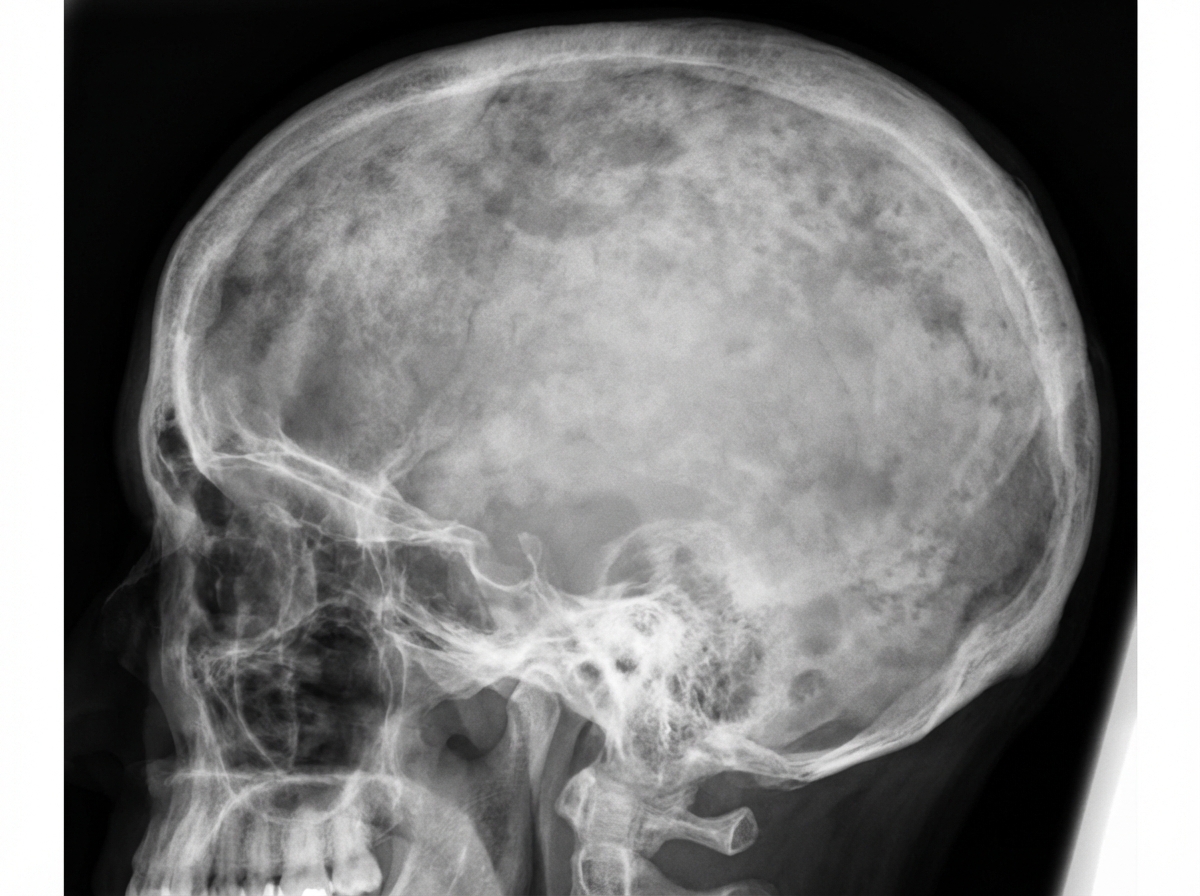
A 58-year-old man comes to the physician because of a 6-month history of headaches and back pain. Examination shows mild sensorineural hearing loss. Serum concentration of alkaline phosphatase is increased. An x-ray of the skull is shown. The most appropriate pharmacotherapy for this patient is a drug that has which of the following mechanisms of action?
What is the primary mechanism for glucose uptake in neurons?
A 5-year-old girl is brought in for a routine checkup. She was born at 39 weeks gestation via spontaneous vaginal delivery and is up to date on all vaccines and is meeting all developmental milestones. Upon examination, she is pale with a few petechiae on her chest neck and back. Examination of the abdomen reveals painless hepatosplenomegaly. Liver enzymes are mildly elevated and complete blood cell count shows slight anemia and thrombocytopenia. Iron, B12, and folate are normal. A bone marrow biopsy shows mildly hypocellular marrows with diffuse macrophages with eosinophilic cytoplasm. The cytoplasm looks like wrinkled tissue paper on further inspection. No blasts are observed. What is the most likely diagnosis in the present case?
A 26-year-old woman presents to a physician for genetic counseling, because she is worried about trying to have a child. Specifically, she had 2 siblings that died young from a lysosomal storage disorder and is afraid that her own children will have the same disorder. Her background is Ashkenazi Jewish, but she says that her husband's background is mixed European heritage. Her physician says that since her partner is not of Jewish background, their chance of having a child with Niemann-Pick disease is dramatically decreased. Which of the following genetic principles best explains why there is an increased prevalence of this disease in some populations?
A 1-year-old boy is brought to his pediatrician for a follow-up appointment. He was recently diagnosed with failure to thrive and developmental delay. His weight is 7 kg (15.4 lb), height is 61 cm (24 in), and head circumference is 42 cm (16.5 in). The patient’s father had a younger sister who suffered from mental and physical delay and died at a very young age. The patient was able to raise his head at the age of 7 months and began to sit alone only recently. He babbles, coos, and smiles to other people. On presentation, his blood pressure is 75/40 mm Hg, heart rate is 147/min, respiratory rate is 28/min, and temperature is 36.4°C (97.5°F). He has a coarse face with small deep orbits, proptotic eyes, big lips, and gingival hyperplasia. His skin is pale with decreased elasticity. His lung and heart sounds are normal. Abdominal examination reveals diminished anterior abdominal wall muscle tone and hepatomegaly. Muscle tone is increased in all groups of muscles on both upper and lower extremities. The physician becomes concerned and performs testing for the suspected hereditary disease. A blood test shows increased lysosomal enzyme concentration in the serum and decreased N-acetylglucosamine-1-phosphotransferase (GlcNAc phosphotransferase) activity within the leukocytes. Which of the statements listed below describes the mechanism of the patient’s condition?
A research study evaluates three siblings with Niemann-Pick disease type C: a 6-year-old with ataxia and vertical supranuclear gaze palsy, a 10-year-old with hepatosplenomegaly and mild cognitive impairment, and a 14-year-old who is asymptomatic. Genetic testing reveals all three carry the same compound heterozygous NPC1 mutations. Fibroblast studies show similar cholesterol esterification defects and filipin staining patterns. Miglustat therapy is available. Evaluate the biological basis for phenotypic variability and optimal treatment allocation.
A 15-year-old boy with Hunter syndrome (MPS II) on weekly enzyme replacement therapy develops IgG antibodies with high neutralizing capacity against idursulfase. His symptoms have worsened over the past 6 months with increasing hepatosplenomegaly and joint stiffness. His brother with the same mutation shows excellent response to ERT without antibody formation. Synthesize an appropriate management plan considering immunologic and genetic factors.
Want unlimited practice?
Get full access to all questions, explanations, and performance tracking.
Scan to download app