
Lysosome structure and function — MCQs

A 5-month-old boy is brought to his pediatrician because his parents have noticed that he has very restricted joint movement. He was born at home without prenatal care, but they say that he appeared healthy at birth. Since then, they say that he doesn't seem to move very much and is hard to arouse. Physical exam reveals coarse facial structures and hepatosplenomegaly. Radiography reveals skeletal malformations, and serum tests show high plasma levels of lysosomal enzymes. The production of which of the following substances will most likely be disrupted in this patient?
An investigator is studying the function of the endoplasmic reticulum in genetically modified lymphocytes. A gene is removed that facilitates the binding of ribosomes to the endoplasmic reticulum. Which of the following processes is most likely to be impaired as a result of this genetic modification?
A scientist is studying a protein that is present on the plasma membrane of cells. He therefore purifies the protein in a lipid bilayer and subjects it to a number of conditions. His investigations show that the protein has the following properties: 1) It is able to change ion concentrations across the membrane without addition of ATP to the solution. 2) Its activity increases linearly with substrate concentration without any saturation even at mildly supraphysiologic conditions. 3) In some states the protein leads to an ion concentration change; whereas, it has no effect in other states. 4) Changing the electrical charge across the membrane does not affect whether the protein has activity. 5) Adding a small amount of an additional substance to the solution reliably increases the protein's activity. These findings are consistent with a protein with which of the following functions?
An investigator is studying the clearance of respiratory particles in healthy non-smokers. An aerosol containing radio-labeled particles that are small enough to reach the alveoli is administered to the subjects via a non-rebreather mask. A gamma scanner is then used to evaluate the rate of particle clearance from the lungs. The primary mechanism of particle clearance most likely involves which of the following cell types?
Antigen presentation of extracellular pathogens by antigen presenting cells requires endocytosis of the antigen, followed by the degradation in the acidic environment of the formed phagolysosome. Should the phagolysosome become unable to lower its pH, what is the most likely consequence?
What is the primary mechanism for maintaining acid-base balance during prolonged vomiting?
In large neurons the nucleus can be found a large distance away from the terminal end of its axon. The body has a complex system of intracellular transporters that are able to carry essential proteins from the nucleus to the distal edge of the cell and back. Which of the following proteins are essential for this function?
A 5-month-old boy presents with increasing weakness for the past 3 months. The patient’s mother says that the weakness is accompanied by dizziness, sweating, and vertigo early in the morning. Physical examination shows hepatomegaly. Laboratory findings show an increased amount of lactate, uric acid, and elevated triglyceride levels. Which of the following enzymes is most likely deficient in this patient?
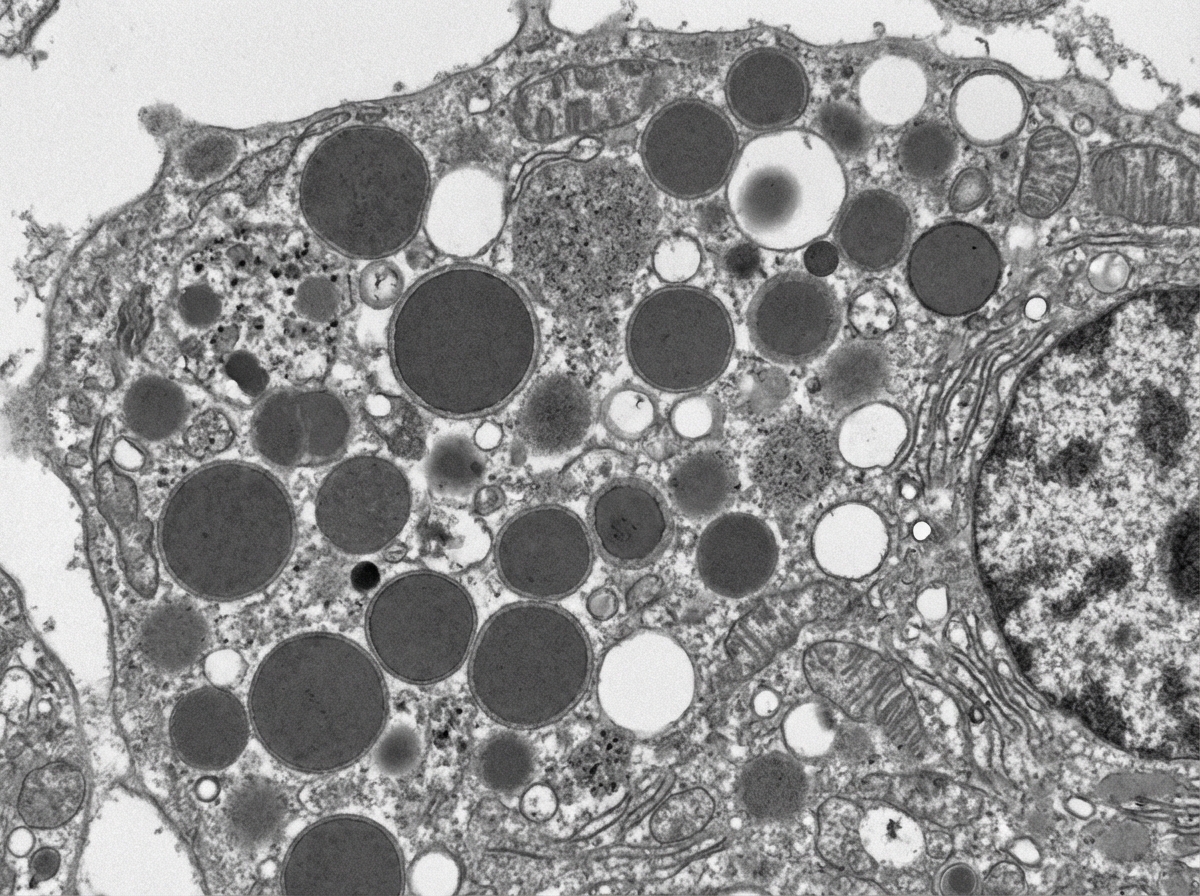
A 3-month-old boy presents for routine health maintenance. The patient has coarse facial features and stiff joint movements with restricted passive and active range of motion. He also has problems following objects with his eyes and seems not to focus on anything. On physical examination, the corneas are clouded, and the patient fails to meet any 3-month developmental milestones. Genetic testing and histopathology are performed and reveal failure of a cellular structure to phosphorylate mannose residues on glycoproteins. An electron microscopy image of one of this patient’s cells is shown. Which of the following is the most likely diagnosis in this patient?
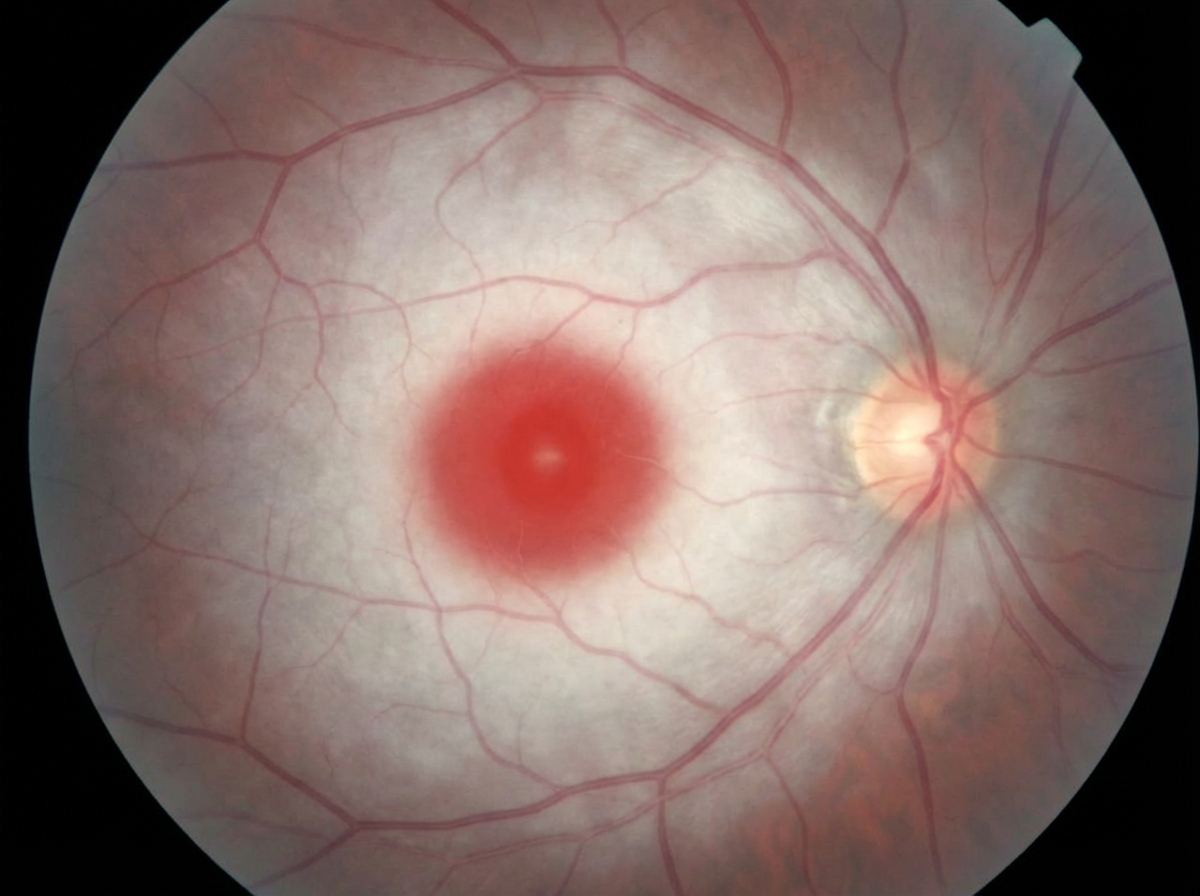
A 7-month-old boy is brought to the pediatrician by his parents due to progressively worsening weakness for the last three months. The parents also describe the boy as having an exaggerated response when startled as well as diminishing response to visual stimuli. At birth, the boy was healthy and remained as such for the first few months of life. The mother says pregnancy was unremarkable, and the boy was born at 39 weeks with no complications during delivery. He is up to date on his vaccinations. The boy's grandparents immigrated from an eastern European country. Physical examination reveals hyperreflexia. Abdominal examination reveals no abnormalities. On fundoscopy, the following is seen. Which of the following is most likely deficient in this patient?
Want unlimited practice?
Get full access to all questions, explanations, and performance tracking.
Scan to download app