
Clinical presentation patterns — MCQs

A deficiency in which of the following lysosomal enzymes is inherited in a pattern similar to a deficiency of iduronate sulfatase (Hunter syndrome)?
A 6-month-old boy is referred to a geneticist after he is found to have persistent hypotonia and failure to thrive. He has also had episodes of what appears to be respiratory distress and has an enlarged heart on physical exam. There is a family history of childhood onset hypertrophic cardiomyopathy, so a biopsy is performed showing electron dense granules within the lysosomes. Genetic testing is performed showing a defect in glycogen processing. A deficiency in which of the following enzymes is most likely to be responsible for this patient's symptoms?
A 32-year-old woman comes to the clinic for a routine evaluation. This is her first time visiting this office. Her medical history is significant for cystic medial necrosis of the aorta. Her vital signs include: heart rate 85/min, respiratory rate 15/min, temperature 36.0°C (96.8°F), and blood pressure 110/80 mm Hg. Physical examination shows she is thin and tall with abnormally long extremities and spider-like fingers. Which of the following disorders does the patient most likely have?
An 8-month-old female infant from a first-degree consanguineous couple was brought to the physician because the mother noticed abnormalities in the growth of her child as well as the different lengths of her child's legs. The infant had gingival hyperplasia, restricted movement in both shoulders, a prominent, pointed forehead, and enophthalmos with a slight opacity in both corneas. A blood test revealed 10 fold higher than normal levels of the following enzymes: N-acetyl-ß-glucosaminidase, ß-glucuronidase, ß-hexosaminidase A, and alkaline phosphatase. Which of the following is most likely deficient in this patient?
A 4-month-old male infant is brought in because he rejects food and is losing weight. He had several upper respiratory tract infections during the last 2 months. Upon examination, hepatosplenomegaly is noted, as well as mild hypotonia. During the next few weeks, hepatosplenomegaly progresses, the boy fails to thrive, and he continues to reject food. He has a blood pressure of 100/70 mm Hg and heart rate of 84/min. Blood tests show pancytopenia and elevated levels of transaminases. Slit lamp examination shows bilateral cherry-red spots on the macula. Chest X-ray shows a reticulonodular pattern and calcified nodules. Biopsy of the liver shows foamy histiocytes. What is the most likely diagnosis?
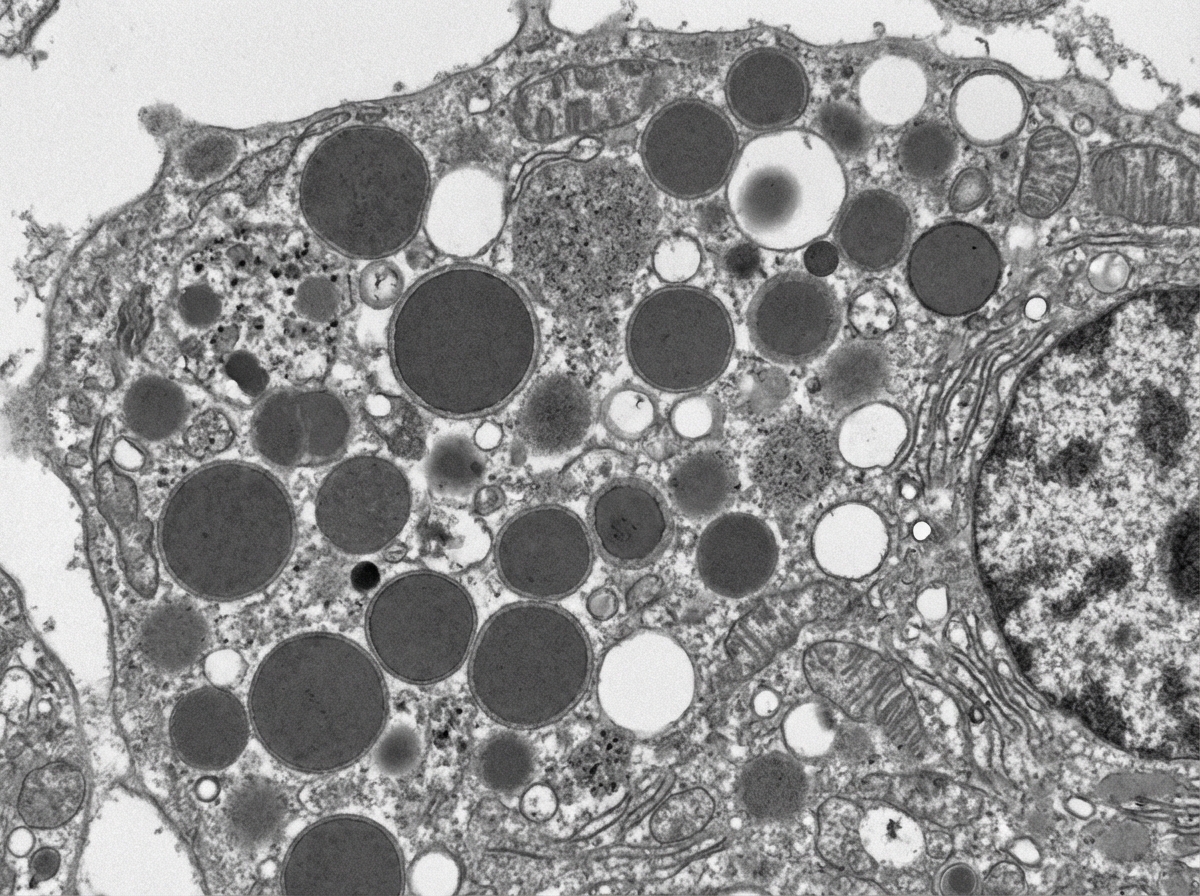
A 3-month-old boy presents for routine health maintenance. The patient has coarse facial features and stiff joint movements with restricted passive and active range of motion. He also has problems following objects with his eyes and seems not to focus on anything. On physical examination, the corneas are clouded, and the patient fails to meet any 3-month developmental milestones. Genetic testing and histopathology are performed and reveal failure of a cellular structure to phosphorylate mannose residues on glycoproteins. An electron microscopy image of one of this patient’s cells is shown. Which of the following is the most likely diagnosis in this patient?
A 55-year-old man with known coronary artery disease presents to the ED with epigastric pain, worsening fatigue, and melena. He takes aspirin and rosuvastatin, but took ibuprofen over the past two weeks for lower back pain. He denies nausea, vomiting, hematemesis, chest pain, fever, and weight loss. Sitting blood pressure is 100/70 mmHg and pulse is 90/min, but standing blood pressure is 85/60 mmHg and pulse is 110/min. Airway is patent. His hands feel cold and clammy. Abdominal exam confirms epigastric pain, but no rebound tenderness or guarding. Despite 2 liters of lactated Ringer's, the blood pressure and pulse have not changed. What hemoglobin (Hb) threshold should be considered if packed red blood cell (pRBC) transfusion is ordered in this patient?
A 5-year-old girl is brought in for a routine checkup. She was born at 39 weeks gestation via spontaneous vaginal delivery and is up to date on all vaccines and is meeting all developmental milestones. Upon examination, she is pale with a few petechiae on her chest neck and back. Examination of the abdomen reveals painless hepatosplenomegaly. Liver enzymes are mildly elevated and complete blood cell count shows slight anemia and thrombocytopenia. Iron, B12, and folate are normal. A bone marrow biopsy shows mildly hypocellular marrows with diffuse macrophages with eosinophilic cytoplasm. The cytoplasm looks like wrinkled tissue paper on further inspection. No blasts are observed. What is the most likely diagnosis in the present case?
A 26-year-old woman presents to a physician for genetic counseling, because she is worried about trying to have a child. Specifically, she had 2 siblings that died young from a lysosomal storage disorder and is afraid that her own children will have the same disorder. Her background is Ashkenazi Jewish, but she says that her husband's background is mixed European heritage. Her physician says that since her partner is not of Jewish background, their chance of having a child with Niemann-Pick disease is dramatically decreased. Which of the following genetic principles best explains why there is an increased prevalence of this disease in some populations?
A 6-month-old boy is brought to a pediatrician by his parents for his first visit after they adopt him from a European country. His parents are concerned about the boy’s short episodes of shaking of his arms and legs; they believe it might be epilepsy. They also note that the child is less responsive than other children of his age. The family is unable to provide any vaccination, birth, or family history. His pulse is 130/min, respiratory rate is 28/min, and blood pressure is 90/50 mm Hg. The boy has a light skin tone and emits a noticeable musty body odor. Which of the following should be supplemented in this patient’s diet?
Want unlimited practice?
Get full access to all questions, explanations, and performance tracking.
Scan to download app