
GSD type IV (Andersen disease) — MCQs

An otherwise healthy, exclusively breastfed 4-day-old neonate is brought to the physician because of yellowing of his skin and eyes. His urine has been clear and stools have been normal. He was born at term by vacuum-assisted delivery and weighed 4000 g (8 lb 8 oz). Pregnancy was complicated by gestational diabetes mellitus. His older sibling had jaundice in the neonatal period. Vital signs are within normal limits. He appears alert and comfortable. Physical examination shows jaundice of the skin and sclerae. The liver is palpated 1 cm below the right costal margin. Laboratory studies show: Hemoglobin 17 g/dl Reticulocyte count 0.5 % Total bilirubin 21.2 mg/dl Direct bilirubin 2 mg/dl Indirect bilirubin 19.1 mg/dl Coombs test Negative Which of the following is the most appropriate next step in management?
A 12-year-old girl comes to the clinic with a grossly enlarged abdomen. She has a history of frequent episodes of weakness, sweating, and pallor that are eliminated by eating. Her development has been slow. She started to walk unassisted at 2 years and was not performing well at school. Physical examination reveals a blood pressure of 100/60 mm Hg, heart rate of 80/min, and temperature of 36.9°C (98.4℉). On physical examination, the liver is enlarged, firm, and palpable up to the pelvis. The spleen and kidney are not palpable. Laboratory investigation reveals low blood glucose and pH with high lactate, triglycerides, ketones, and free fatty acids. The liver biopsy revealed high glycogen content. Hepatic glycogen structure was normal. The enzyme assay performed on the biopsy tissue revealed very low glucose-6-phosphatase levels. What is the most likely diagnosis?
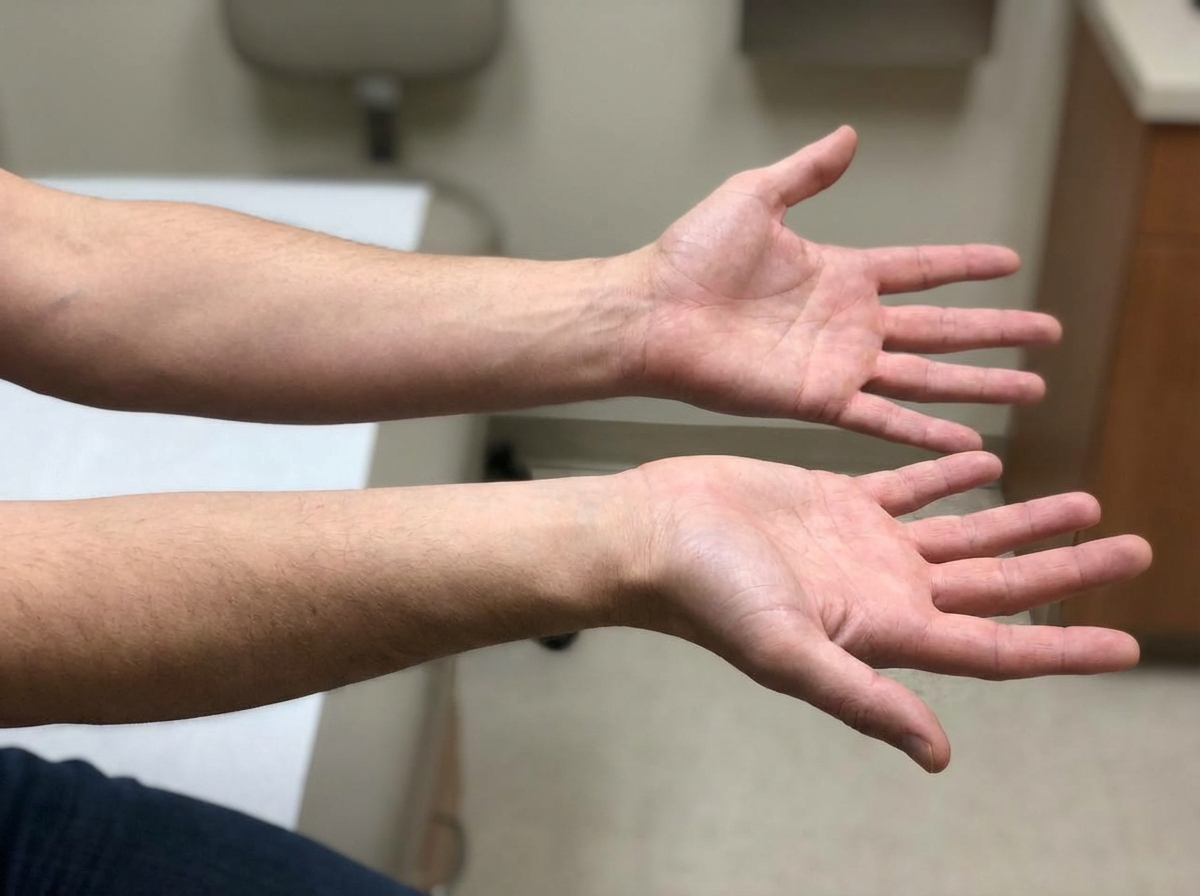
A 56-year-old male with a history of hepatitis C cirrhosis status post TIPS procedure is brought in by his wife to the emergency department because he has been acting disoriented, slurring his speech, and sleeping throughout the day. On arrival the patient is afebrile and his vital signs are pulse is 87/min, blood pressure is 137/93 mmHg, and respirations are 12/min with shallow breaths. Examination reveals a jaundiced male who appears older than stated age. Abdominal exam is positive for a fluid wave and shifting dullness to percussion. You note enlarged breasts, decreased facial hair, 3+ patellar reflexes bilaterally, and the following in the upper extremity (Image A). Paracentesis reveals ascitic fluid with neutrophil counts of < 100 cells/mcL. Serum creatinine is 1.0 and BUN is 15. Which of the following is the next best step in management?
A 5-month-old boy presents with increasing weakness for the past 3 months. The patient’s mother says that the weakness is accompanied by dizziness, sweating, and vertigo early in the morning. Physical examination shows hepatomegaly. Laboratory findings show an increased amount of lactate, uric acid, and elevated triglyceride levels. Which of the following enzymes is most likely deficient in this patient?
A 9-month-old girl is brought to the physician because of a 1-month history of poor feeding and irritability. She is at the 15th percentile for height and 5th percentile for weight. Examination shows hypotonia and wasting of skeletal muscles. Cardiopulmonary examination shows no abnormalities. There is hepatomegaly. Her serum glucose is 61 mg/dL, creatinine kinase is 100 U/L, and lactic acid is within the reference range. Urine ketone bodies are elevated. Which of the following enzymes is most likely deficient in this patient?
A 45-year-old woman presents to her primary care physician for knee pain. She states that she has been experiencing a discomfort and pain in her left knee that lasts for several hours but tends to improve with use. She takes ibuprofen occasionally which has been minimally helpful. She states that this pain is making it difficult for her to work as a cashier. Her temperature is 98.6°F (37.0°C), blood pressure is 117/58 mmHg, pulse is 90/min, respirations are 14/min, and oxygen saturation is 97% on room air. Physical exam reveals a stable gait that the patient claims causes her pain. The patient has a non-pulsatile, non-erythematous, palpable mass over the posterior aspect of her left knee that is roughly 3 to 4 cm in diameter and is hypoechoic on ultrasound. Which of the following is associated with this patient's condition?
A 61-year-old man presents to the emergency department because he has developed blisters at multiple locations on his body. He says that the blisters appeared several days ago after a day of hiking in the mountains with his colleagues. When asked about potential triggering events, he says that he recently had an infection and was treated with antibiotics but he cannot recall the name of the drug that he took. In addition, he accidentally confused his medication with one of his wife's blood thinner pills several days before the blisters appeared. On examination, the blisters are flesh-colored, raised, and widespread on his skin but do not involve his mucosal surfaces. The blisters are tense to palpation and do not separate with rubbing. Pathology of the vesicles show that they continue under the level of the epidermis. Which of the following is the most likely cause of this patient's blistering?
A 6-year-old boy is brought to the pediatrician by his mother after he reported having red urine. He has never experienced this before and did not eat anything unusual before the episode. His past medical history is notable for sensorineural deafness requiring hearing aids. He is otherwise healthy and enjoys being in the 1st grade. His birth history was unremarkable. His temperature is 98.8°F (37.1°C), blood pressure is 145/85 mmHg, pulse is 86/min, and respirations are 18/min. On examination, he is a well-appearing boy in no acute distress. Cardiac, respiratory, and abdominal exams are normal. A urinalysis is notable for microscopic hematuria and mild proteinuria. This patient’s condition is most commonly caused by which of the following inheritance patterns?
A 24-year-old man is brought to the emergency department by his brother because of a 3-hour history of lethargy and confusion. The brother says that 2 days ago, the patient ate several large-capped mushrooms he had foraged in the woods. After eating the mushrooms, he developed severe, bloody diarrhea that has since resolved. His pulse is 140/min, respirations are 26/min, and blood pressure is 98/62 mm Hg. Examination shows dry mucous membranes and tenderness to deep palpation in the right upper quadrant. Serum studies show a serum AST concentration of 2335 U/L and ALT concentration of 2294 U/L. Inhibition of which of the following processes is the most likely cause of this patient's condition?
A 4-year-old girl is brought to the physician by her mother because of fatigue and generalized weakness for 4 months. Examination shows decreased muscle tone. Her fasting serum glucose concentration is 41 mg/dL. The physician suspects a defect in one of the enzymes involved in the carnitine shuttle. Increased serum concentration of which of the following should most raise suspicion of a different diagnosis?
Want unlimited practice?
Get full access to all questions, explanations, and performance tracking.
Scan to download app