
Survey design — MCQs

A researcher is studying whether a new knee implant is better than existing alternatives in terms of pain after knee replacement. She designs the study so that it includes all the surgeries performed at a certain hospital. Interestingly, she notices that patients who underwent surgeries on Mondays and Thursdays reported much better pain outcomes on a survey compared with those who underwent the same surgeries from the same surgeons on Tuesdays and Fridays. Upon performing further analysis, she discovers that one of the staff members who works on Mondays and Thursdays is aware of the study and tells all the patients about how wonderful the new implant is. Which of the following forms of bias does this most likely represent?
A researcher is trying to determine whether a newly discovered substance X can be useful in promoting wound healing after surgery. She conducts this study by enrolling the next 100 patients that will be undergoing this surgery and separating them into 2 groups. She decides which patient will be in which group by using a random number generator. Subsequently, she prepares 1 set of syringes with the novel substance X and 1 set of syringes with a saline control. Both of these sets of syringes are unlabeled and the substances inside cannot be distinguished. She gives the surgeon performing the surgery 1 of the syringes and does not inform him nor the patient which syringe was used. After the study is complete, she analyzes all the data that was collected and performs statistical analysis. This study most likely provides which level of evidence for use of substance X?
You are reading through a recent article that reports significant decreases in all-cause mortality for patients with malignant melanoma following treatment with a novel biological infusion. Which of the following choices refers to the probability that a study will find a statistically significant difference when one truly does exist?
The APPLE study investigators are currently preparing for a 30-year follow-up evaluation. They are curious about the number of participants who will partake in follow-up interviews. The investigators noted that of the 83 participants who participated in the APPLE study's 20-year follow-up, 62 were in the treatment group and 21 were in the control group. Given the unequal distribution of participants between groups at follow-up, this finding raises concerns for which of the following?
Study X examined the relationship between coffee consumption and lung cancer. The authors of Study X retrospectively reviewed patients' reported coffee consumption and found that drinking greater than 6 cups of coffee per day was associated with an increased risk of developing lung cancer. However, Study X was criticized by the authors of Study Y. Study Y showed that increased coffee consumption was associated with smoking. What type of bias affected Study X, and what study design is geared to reduce the chance of that bias?
A study is conducted in a hospital to estimate the prevalence of handwashing among healthcare workers. All of the hospital staff members are informed that the study is being conducted for 1 month, and the study method will be a passive observation of their daily routine at the hospital. A total of 89 medical staff members give their consent for the study, and they are followed for a month. This study could most likely suffer from which of the following biases?
A 28-year-old male presents to his primary care physician with complaints of intermittent abdominal pain and alternating bouts of constipation and diarrhea. His medical chart is not significant for any past medical problems or prior surgeries. He is not prescribed any current medications. Which of the following questions would be the most useful next question in eliciting further history from this patient?
A researcher is reviewing data from a study evaluating a new urine dipstick test for detecting a urinary tract infection (UTI) in hospitalized patients. The following results were recorded: 90 patients with confirmed UTI tested positive, 10 with confirmed UTI tested negative, 30 patients without UTI tested positive, and 270 patients without UTI tested negative. A hospital administrator asks the researcher what proportion of patients who test negative truly do not have a UTI. Which value from the 2×2 table answers this question?
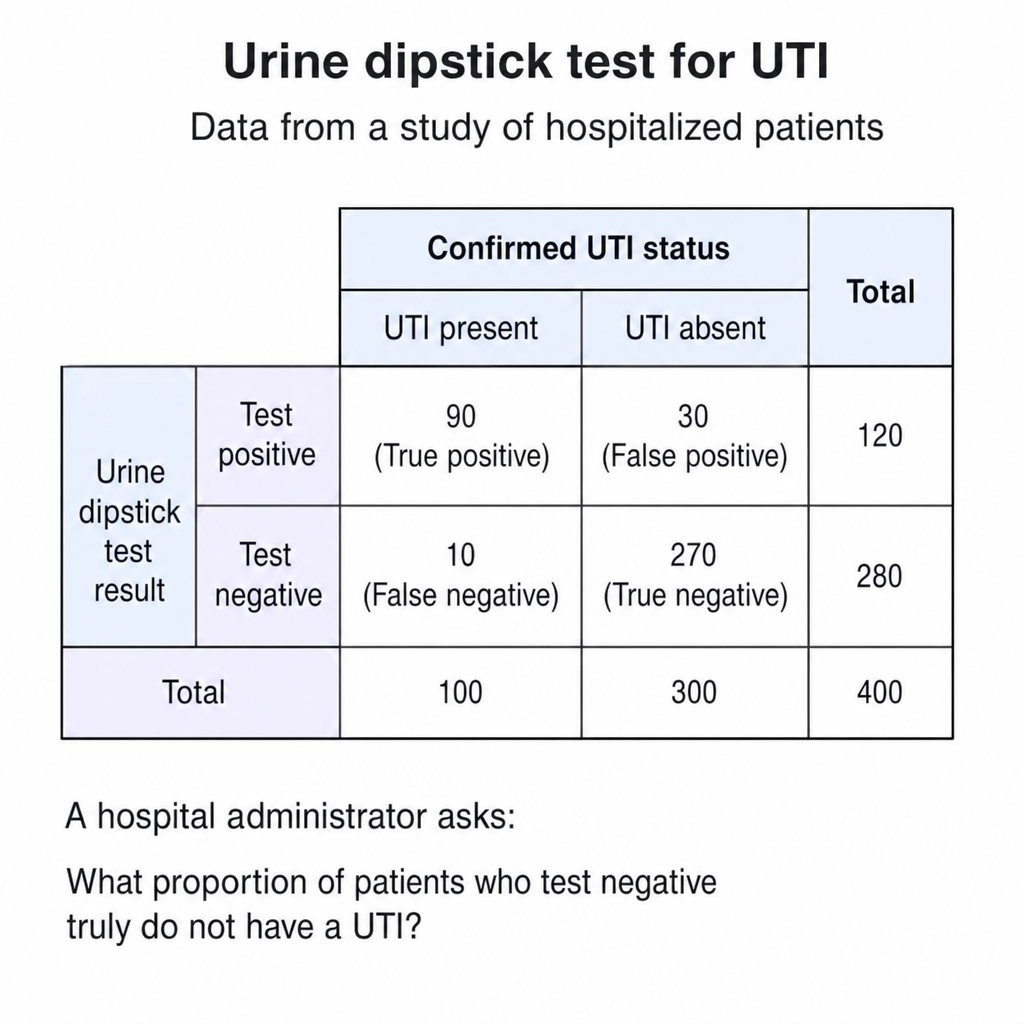
A research team has data from three completed studies on statin use and Alzheimer's disease: Study A (case-control, OR=0.6, n=500), Study B (retrospective cohort, RR=0.7, n=10,000), and Study C (RCT with cognitive decline as secondary endpoint, RR=0.9, n=2,000). The case-control study used prevalent cases, the cohort study had significant loss to follow-up in the unexposed group, and the RCT was underpowered for cognitive outcomes. Synthesize the evidence to determine the most reliable conclusion about the association.
A public health department needs to determine whether a cluster of birth defects in a county is associated with industrial pollution. They have limited resources, the suspected exposure occurred 3-5 years ago, and the outcome is rare (15 cases identified). Multiple potential confounders exist including maternal age, socioeconomic status, and prenatal care access. The community demands rapid answers. Evaluate the most appropriate initial study design considering feasibility, ethics, and scientific validity.
Want unlimited practice?
Get full access to all questions, explanations, and performance tracking.
Scan to download app