
Sampling methods — MCQs

A research team develops a new monoclonal antibody checkpoint inhibitor for advanced melanoma that has shown promise in animal studies as well as high efficacy and low toxicity in early phase human clinical trials. The research team would now like to compare this drug to existing standard of care immunotherapy for advanced melanoma. The research team decides to conduct a non-randomized study where the novel drug will be offered to patients who are deemed to be at risk for toxicity with the current standard of care immunotherapy, while patients without such risk factors will receive the standard treatment. Which of the following best describes the level of evidence that this study can offer?
A clinical trial investigating a new biomedical device used to correct congenital talipes equinovarus (club foot) in infants has recently been published. The study was a preliminary investigation of a new device and as such the sample size is only 20 participants. The results indicate that the new biomedical device is less efficacious than the current standard of care of serial casting (p < 0.001), but the authors mention in the conclusion that it may be due to a single outlier--a patient whose foot remained uncorrected by the conclusion of the study. Which of the following descriptive statistics is the least sensitive to outliers?
The success of a new treatment designed to deter people from smoking was evaluated by a team of researchers. However, the heaviest and most committed smokers in the study group were less interested in quitting and subsequently dropped out of the study. Nonetheless, the researchers continued with their research (disregarding those who dropped out), which resulted in a false conclusion that the treatment was more successful than the results would have shown under ideal study conditions. The smokers who were confirmed as quitters were actually the ones who were more interested in giving up smoking, which is why they remained in the study. Which of the following is the bias that invalidates the researchers’ conclusion in this example?
A research group wants to assess the safety and toxicity profile of a new drug. A clinical trial is conducted with 20 volunteers to estimate the maximum tolerated dose and monitor the apparent toxicity of the drug. The study design is best described as which of the following phases of a clinical trial?
Study X examined the relationship between coffee consumption and lung cancer. The authors of Study X retrospectively reviewed patients' reported coffee consumption and found that drinking greater than 6 cups of coffee per day was associated with an increased risk of developing lung cancer. However, Study X was criticized by the authors of Study Y. Study Y showed that increased coffee consumption was associated with smoking. What type of bias affected Study X, and what study design is geared to reduce the chance of that bias?
A resident in the department of obstetrics and gynecology is reading about a randomized clinical trial from the late 1990s that was conducted to compare breast cancer mortality risk, disease localization, and tumor size in women who were randomized to groups receiving either annual mammograms starting at age 40 or annual mammograms starting at age 50. One of the tables in the study compares the two experimental groups with regard to socioeconomic demographics (e.g., age, income), medical conditions at the time of recruitment, and family history of breast cancer. The purpose of this table is most likely to evaluate which of the following?
A study is conducted in a hospital to estimate the prevalence of handwashing among healthcare workers. All of the hospital staff members are informed that the study is being conducted for 1 month, and the study method will be a passive observation of their daily routine at the hospital. A total of 89 medical staff members give their consent for the study, and they are followed for a month. This study could most likely suffer from which of the following biases?
During identification of severely decomposed remains, which of the following methods provides the most reliable means of positive identification?
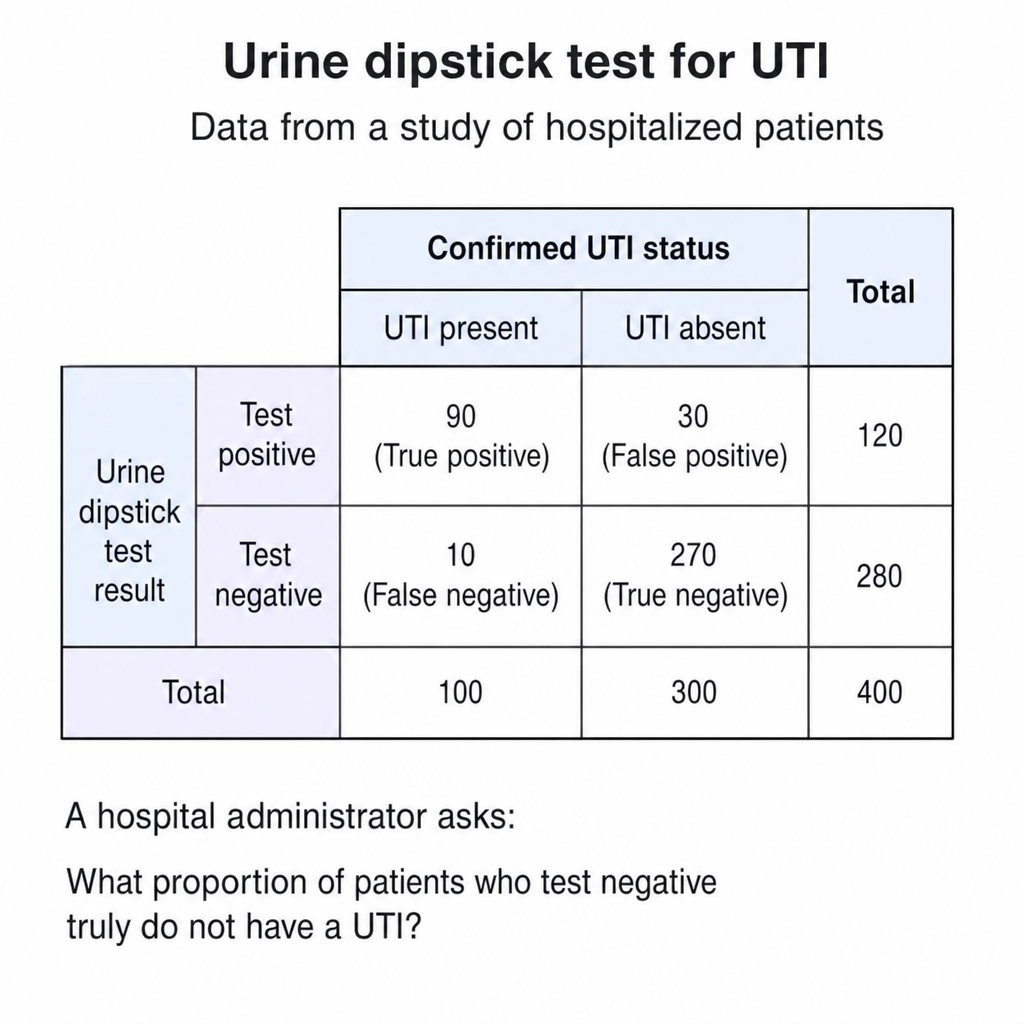
A researcher is reviewing data from a study evaluating a new urine dipstick test for detecting a urinary tract infection (UTI) in hospitalized patients. The following results were recorded: 90 patients with confirmed UTI tested positive, 10 with confirmed UTI tested negative, 30 patients without UTI tested positive, and 270 patients without UTI tested negative. A hospital administrator asks the researcher what proportion of patients who test negative truly do not have a UTI. Which value from the 2×2 table answers this question?
A research team has data from three completed studies on statin use and Alzheimer's disease: Study A (case-control, OR=0.6, n=500), Study B (retrospective cohort, RR=0.7, n=10,000), and Study C (RCT with cognitive decline as secondary endpoint, RR=0.9, n=2,000). The case-control study used prevalent cases, the cohort study had significant loss to follow-up in the unexposed group, and the RCT was underpowered for cognitive outcomes. Synthesize the evidence to determine the most reliable conclusion about the association.
Want unlimited practice?
Get full access to all questions, explanations, and performance tracking.
Scan to download app