
Observational studies vs experiments — MCQs

A study is funded by the tobacco industry to examine the association between smoking and lung cancer. They design a study with a prospective cohort of 1,000 smokers between the ages of 20-30. The length of the study is five years. After the study period ends, they conclude that there is no relationship between smoking and lung cancer. Which of the following study features is the most likely reason for the failure of the study to note an association between tobacco use and cancer?
Which of the following study designs would be most appropriate to investigate the association between electronic cigarette use and the subsequent development of lung cancer?
A research group wants to assess the safety and toxicity profile of a new drug. A clinical trial is conducted with 20 volunteers to estimate the maximum tolerated dose and monitor the apparent toxicity of the drug. The study design is best described as which of the following phases of a clinical trial?
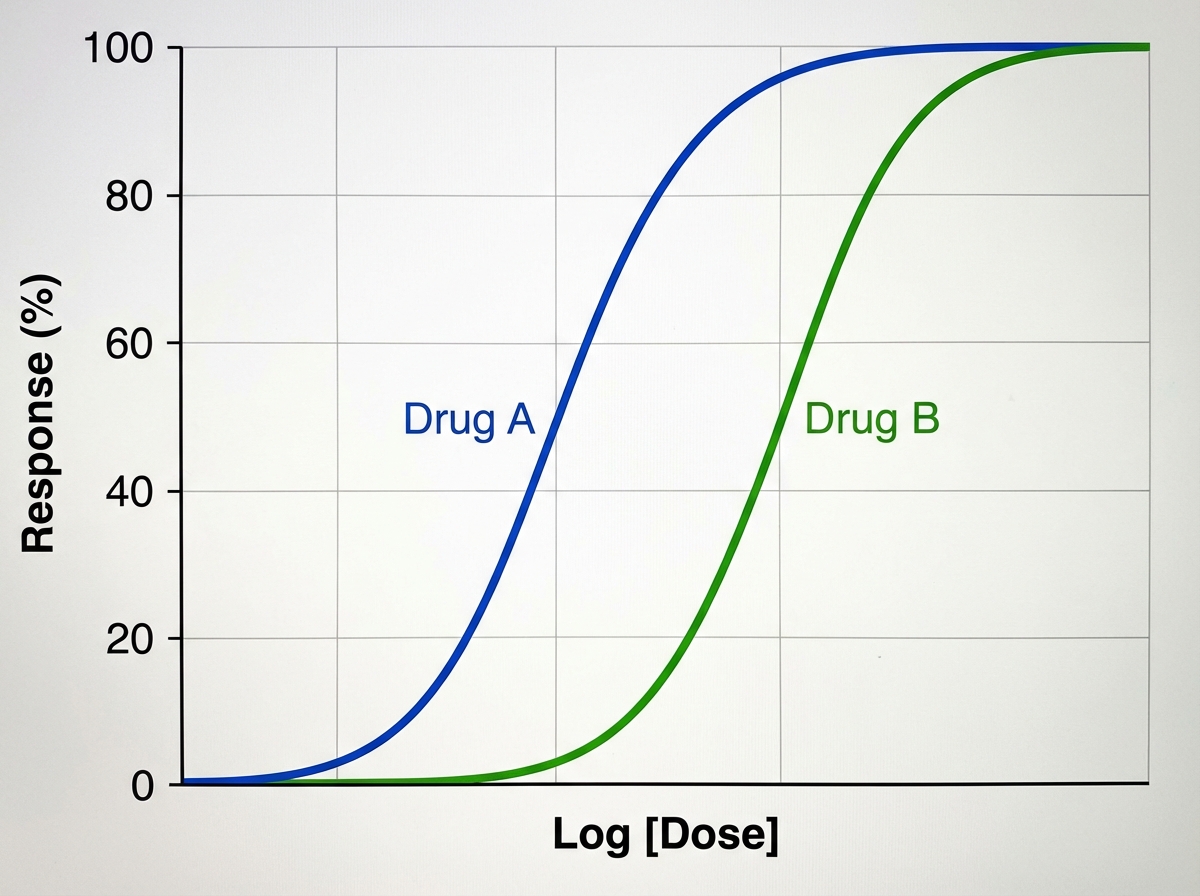
A medical student is reviewing dose-response curves of various experimental drugs. She is specifically interested in the different factors that cause the curve to shift in different directions. From her study, she plots the following graph (see image). She marks the blue curve for drug A, which acts optimally on a receptor. After drawing the second (green) curve for drug B, she discovers that more of drug B is required to produce the same response as drug A, although drug B can still achieve the same maximum effect. Which of the following terms best describes the activity of drug B in comparison to drug A?
A 28-year-old male presents to his primary care physician with complaints of intermittent abdominal pain and alternating bouts of constipation and diarrhea. His medical chart is not significant for any past medical problems or prior surgeries. He is not prescribed any current medications. Which of the following questions would be the most useful next question in eliciting further history from this patient?
You are interested in studying the etiology of heart failure reduced ejection fraction (HFrEF) and attempt to construct an appropriate design study. Specifically, you wish to look for potential causality between dietary glucose consumption and HFrEF. Which of the following study designs would allow you to assess for and determine this causality?
A new study is investigating the effects of an experimental drug, Exerzisin, on the duration and intensity of exercise. In the treatment group participants are given daily Exerzisin at the main treatment facility and instructed to exercise as much as they would like on the facility's exercise equipment. Due to an insufficient number of exercise units at the main treatment center, the control subjects are given free access to an outside, private gym. The duration and intensity of exercise in both groups is measured with a pedometer. The perspicacious undergraduate, hired to input all the data, points out that the treatment group may be more motivated to exercise harder and longer because their exercising can be observed by the investigators. To which form of bias is he alluding?
An office team is being observed by an outside agency at the request of management to make sure they are completing all their tasks appropriately. Several of the employees are nervous that they are being watched and take care to perform their jobs with extra care, more so than they would have done during a normal workday. What best describes this behavior?
A group of gastroenterologists is concerned about low colonoscopy screening rates. They decide to implement a free patient navigation program to assist local residents and encourage them to obtain colonoscopies in accordance with U.S. Preventive Services Task Force (USPSTF) guidelines. Local residents were recruited at community centers. Participants attended monthly meetings with patient navigators and were regularly reminded that their adherence to screening guidelines was being evaluated. Colonoscopy screening rates were assessed via chart review, which showed that 90% of participants adhered to screening guidelines. Data collected via chart review for local residents recruited at community centers who did not participate in the free patient navigation system found that 34% of that population adhered to USPSTF guidelines. Which of the following has most likely contributed to the observed disparity in colonoscopy screening rates?
You are conducting a lab experiment on skeletal muscle tissue to examine force in different settings. The skeletal muscle tissue is hanging down from a hook. The experiment has 3 different phases. In the first phase, you compress the muscle tissue upwards, making it shorter. In the second phase, you attach a weight of 2.3 kg (5 lb) to its lower vertical end. In the third phase, you do not manipulate the muscle length at all. At the end of the study, you see that the tension is higher in the second phase than in the first one. What is the mechanism underlying this result?
Want unlimited practice?
Get full access to all questions, explanations, and performance tracking.
Scan to download app