
Meta-analyses and systematic reviews — MCQs

A surgeon is interested in studying how different surgical techniques impact the healing of tendon injuries. In particular, he will compare 3 different types of suture repairs biomechanically in order to determine the maximum load before failure of the tendon 2 weeks after repair. He collects data on maximum load for 90 different repaired tendons from an animal model. Thirty tendons were repaired using each of the different suture techniques. Which of the following statistical measures is most appropriate for analyzing the results of this study?
A pharmaceutical company conducts a randomized clinical trial to demonstrate that their new anticoagulant drug, Aclotsaban, prevents more thrombotic events following total knee arthroplasty than the current standard of care. A significant number of patients are lost to follow-up, and many fail to complete treatment according to the study arm to which they were assigned. Despite these protocol deviations, the results for the patients who completed the course of Aclotsaban are encouraging. Which of the following analytical approaches is most appropriate for the primary analysis to establish the efficacy of Aclotsaban?
A research group wants to assess the safety and toxicity profile of a new drug. A clinical trial is conducted with 20 volunteers to estimate the maximum tolerated dose and monitor the apparent toxicity of the drug. The study design is best described as which of the following phases of a clinical trial?
An academic medical center in the United States is approached by a pharmaceutical company to run a small clinical trial to test the effectiveness of its new drug, compound X. The company wants to know if the measured hemoglobin a1c (Hba1c) of patients with type 2 diabetes receiving metformin and compound X would be lower than that of control subjects receiving only metformin. After a year of study and data analysis, researchers conclude that the control and treatment groups did not differ significantly in their Hba1c levels. However, parallel clinical trials in several other countries found that compound X led to a significant decrease in Hba1c. Interested in the discrepancy between these findings, the company funded a larger study in the United States, which confirmed that compound X decreased Hba1c levels. After compound X was approved by the FDA, and after several years of use in the general population, outcomes data confirmed that it effectively lowered Hba1c levels and increased overall survival. What term best describes the discrepant findings in the initial clinical trial run by institution A?
A 65-year-old man is admitted to the hospital because of a 1-month history of fatigue, intermittent fever, and weakness. Results from a peripheral blood smear taken during his evaluation are indicative of possible acute myeloid leukemia. Bone marrow aspiration and subsequent cytogenetic studies confirm the diagnosis. The physician sets aside an appointed time-slot and arranges a meeting in a quiet office to inform him about the diagnosis and discuss his options. He has been encouraged to bring someone along to the appointment if he wanted. He comes to your office at the appointed time with his daughter. He appears relaxed, with a full range of affect. Which of the following is the most appropriate opening statement in this situation?
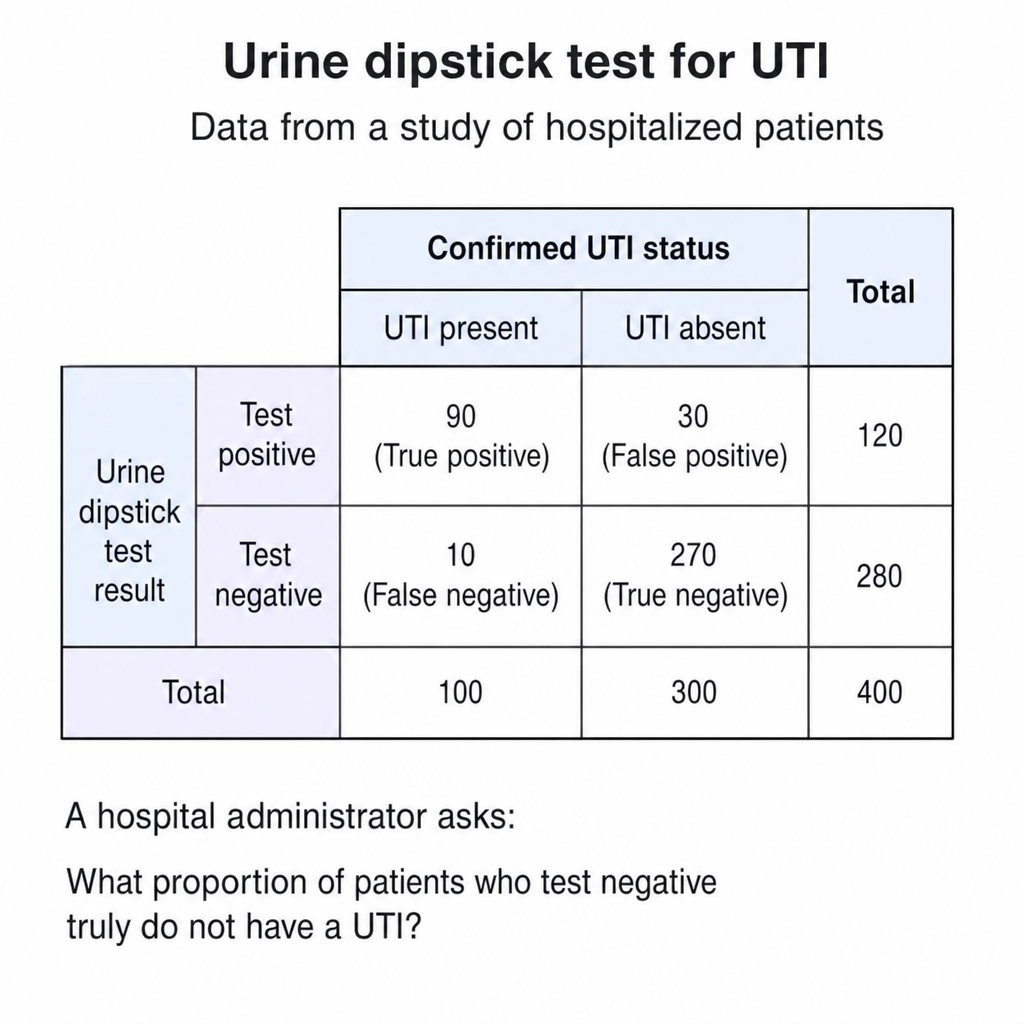
A researcher is reviewing data from a study evaluating a new urine dipstick test for detecting a urinary tract infection (UTI) in hospitalized patients. The following results were recorded: 90 patients with confirmed UTI tested positive, 10 with confirmed UTI tested negative, 30 patients without UTI tested positive, and 270 patients without UTI tested negative. A hospital administrator asks the researcher what proportion of patients who test negative truly do not have a UTI. Which value from the 2×2 table answers this question?
A research team has data from three completed studies on statin use and Alzheimer's disease: Study A (case-control, OR=0.6, n=500), Study B (retrospective cohort, RR=0.7, n=10,000), and Study C (RCT with cognitive decline as secondary endpoint, RR=0.9, n=2,000). The case-control study used prevalent cases, the cohort study had significant loss to follow-up in the unexposed group, and the RCT was underpowered for cognitive outcomes. Synthesize the evidence to determine the most reliable conclusion about the association.
A public health department needs to determine whether a cluster of birth defects in a county is associated with industrial pollution. They have limited resources, the suspected exposure occurred 3-5 years ago, and the outcome is rare (15 cases identified). Multiple potential confounders exist including maternal age, socioeconomic status, and prenatal care access. The community demands rapid answers. Evaluate the most appropriate initial study design considering feasibility, ethics, and scientific validity.
A pharmaceutical company wants to evaluate a new anticoagulant's effectiveness in preventing stroke in atrial fibrillation patients. They have limited funding and need results within 2 years. The drug has promising phase 2 data. Concurrent medications and comorbidities vary widely in the target population. The company must choose between a pragmatic trial in 50 community hospitals or an explanatory trial at 3 academic centers with strict protocols. Evaluate which design best serves both scientific and practical objectives.
A randomized controlled trial of a new diabetes medication shows significant reduction in HbA1c levels (p<0.001). However, 40% of participants in the treatment group and 15% in the placebo group dropped out before study completion, primarily due to gastrointestinal side effects in the treatment group. The analysis includes only participants who completed the study. Analyze the impact on study conclusions.
Want unlimited practice?
Get full access to all questions, explanations, and performance tracking.
Scan to download app